- Download Complete NCERT Solutions for Class 12 Physics Chapter 4
- NCERT Solutions for Class 12 Physics Chapter 4: Overview and Structure
- Step-by-Step Solutions for Chapter Exercises
- Key Features of NCERT Solutions for Chapter 4
- Why Choose Infinity Learn NCERT Solutions
- NCERT Solutions for Class 12 Physics Moving Charges and Magnetism
NCERT Solutions for Class 12 Physics Chapter 4 — Moving Charges and Magnetism
By Rohit RP
|
Updated on 28 Oct 2026, 11:24 IST
Chapter 4 of the NCERT Class 12 Physics textbook transitions from stationary charges and steady currents to exploring how moving charges generate magnetic fields and experience magnetic forces. Building directly upon the foundation established in Chapter 3 (Current Electricity), this chapter forms the core of electromagnetism. It holds substantial weight for CBSE board examinations as well as competitive tests like JEE Main and NEET. Infinity Learn provides structured, step-by-step NCERT solutions designed to break down complex derivations, vector directions, and numerical problems related to the Biot-Savart law and magnetic forces.
Download Complete NCERT Solutions for Class 12 Physics Chapter 4
Download the official PDF for complete NCERT Solutions for Class 12 Physics Chapter 4 to access all chapter-end exercises, detailed step-by-step solutions, and offline study materials.
Key Concepts
- Magnetic force on a moving charge (Lorentz force) and on a current-carrying conductor
- Motion of a charged particle in a magnetic field
- Biot-Savart law and its applications
- Ampere's circuital law and its applications
- Magnetic field due to a solenoid and a toroid
- Force between two parallel current-carrying conductors
- Torque on a current loop and the moving coil galvanometer
NCERT Solutions for Class 12 Physics Chapter 4: Overview and Structure
This chapter bridges foundational electricity concepts with advanced electromagnetic induction covered in subsequent chapters. Students must master key formulas including the Biot-Savart expression, Ampere's law line integrals, magnetic force equations, and galvanometer conversion formulas. In CBSE board assessments, this chapter typically carries a weightage of 6 to 8 marks, featuring both conceptual derivations and numerical calculations.
NCERT Class 12 Physics Chapter 4: All Exercises
The chapter-end exercises consist of standard problems focusing on the Biot-Savart law, Ampere's law, magnetic forces on conductors, and moving coil galvanometer calculations. Note that as per the current rationalised NCERT syllabus, the earlier additional exercises set for this chapter has been removed.
Step-by-Step Solutions for Chapter Exercises
Question 1: A circular coil of wire consisting of 100 turns, each of radius 8.0 cm carries a current of 0.40 A. What is the magnitude of the magnetic field B at the centre of the coil?
Given:
- Number of turns (N): 100
- Radius of each turn (r): 8.0 cm = 0.08 m
- Current flowing in the coil (I): 0.40 A
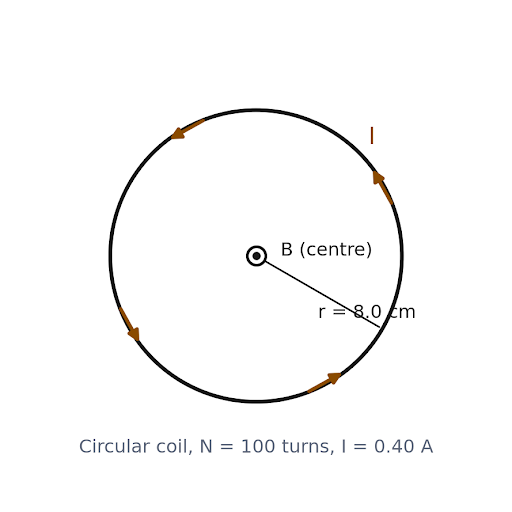
Steps:

State the formula for the magnetic field at the centre of a circular coil:
B = μ0NI⁄2r
Best Courses for You

JEE

NEET

Foundation JEE

Foundation NEET

CBSE
Substitute the given values using the permeability of free space μ₀ = 4π×10⁻⁷ T·m/A:
B = (4π×10-7 × 100 × 0.40)⁄(2 × 0.08)
Simplify the numerator and denominator:
B = (1.2566×10-6 × 40)⁄0.16
Compute the final numerical value:
B = 3.14×10⁻⁴ T
Answer:
The magnitude of the magnetic field at the centre of the coil is 3.14 × 10⁻⁴ T.
Question 2: A long straight wire carries a current of 35 A. What is the magnitude of the field B at a point 20 cm from the wire?
Given:
- Current in the wire (I): 35 A
- Distance of the point from the wire (r): 20 cm = 0.2 m
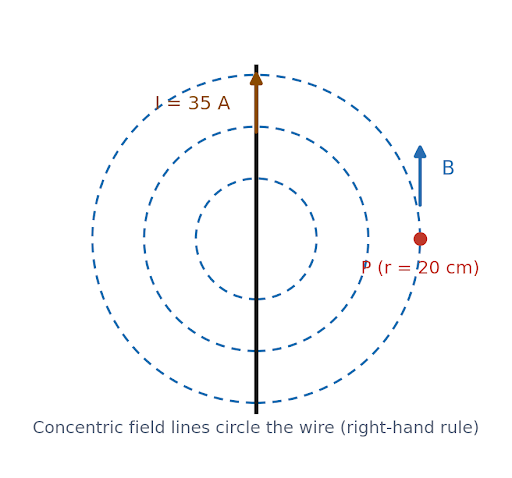
Steps:
Write the formula for the magnetic field due to a long straight current-carrying wire:
B = μ0I⁄2πr
Substitute the known parameters:
B = (4π×10-7 × 35)⁄(2π × 0.2)
Cancel common terms and simplify:
B = (2×10-7 × 35)⁄0.2
Calculate the result: B = 3.5×10⁻⁵ T
Answer:
The magnitude of the magnetic field at a point 20 cm from the wire is 3.5 × 10⁻⁵ T.
Question 3: A long straight wire in the horizontal plane carries a current of 50 A in north to south direction. Give the magnitude and direction of B at a point 2.5 m east of the wire.
Given:
- Current in the wire (I): 50 A
- Distance of the point from the wire (r): 2.5 m
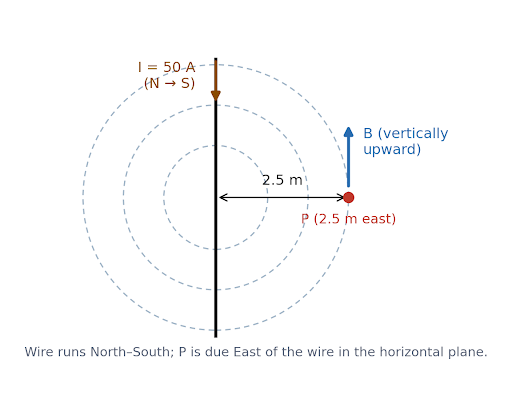
Steps:
Apply the formula for the magnetic field of a long straight wire:
B = μ0I⁄2πr
Substitute the given values with μ₀ = 4π×10⁻⁷ T·m/A:
B = (4π×10-7 × 50)⁄(2π × 2.5)
Simplify the numerical expression:
B = (2×10-7 × 50)⁄2.5
Determine the direction using Maxwell's right-hand thumb rule for a vertically downward current: the magnetic field at a point due east is directed vertically upward.
B = 4×10⁻⁶ T, directed vertically upward
Answer:
The magnitude of the magnetic field is 4 × 10⁻⁶ T, directed vertically upward.
Question 4: A horizontal overhead power line carries a current of 90 A in east to west direction. What is the magnitude and direction of the magnetic field due to the current 1.5 m below the line?
Given:
- Current in the power line (I): 90 A
- Distance below the line (r): 1.5 m
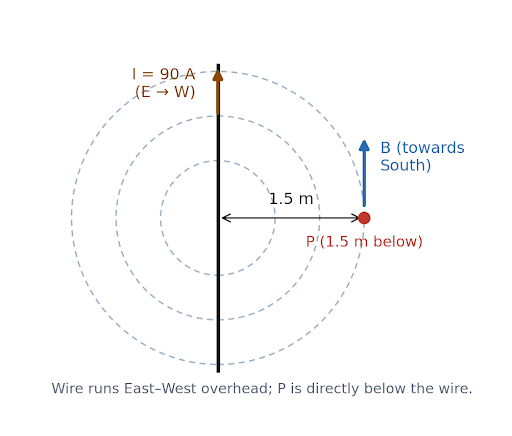
Steps:
Use the straight wire magnetic field formula:
B = μ0I⁄2πr
Substitute the parameters:
B = (4π×10-7 × 90)⁄(2π × 1.5)
Compute the value:
B = (2×10-7 × 90)⁄1.5
Determine the direction: using the right-hand thumb rule, the magnetic field below an east-to-west overhead wire points towards the south.
B = 1.2×10⁻⁵ T, directed towards the South
Answer:
The magnitude of the magnetic field is 1.2 × 10⁻⁵ T directed towards the south.
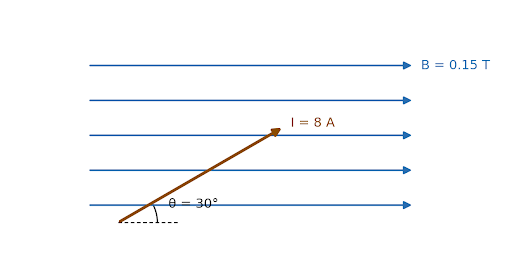
Question 5: What is the magnitude of magnetic force per unit length on a wire carrying a current of 8 A and making an angle of 30° with the direction of a uniform magnetic field of 0.15 T?
Given:
- Current (I): 8 A
- Magnetic field (B): 0.15 T
- Angle (θ): 30°
Steps:
Write the formula for magnetic force on a current-carrying wire:
F = BIl sin θ
Rearrange to find force per unit length (F⁄l):
F⁄l = BI sin θ
Substitute the given values:
F⁄l = 0.15 × 8 × sin 30°
Calculate the result with sin(30°) = 0.5:
F⁄l = 0.6 N/m
Answer:
The magnitude of the magnetic force per unit length on the wire is 0.6 N/m.
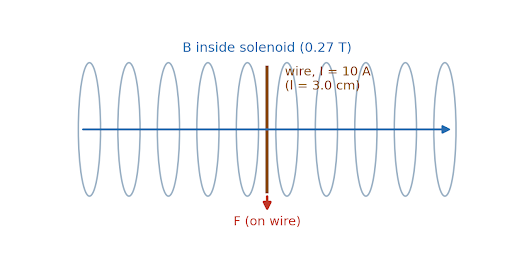
Question 6: A 3.0 cm wire carrying a current of 10 A is placed inside a solenoid perpendicular to its axis. The magnetic field inside the solenoid is given to be 0.27 T. What is the magnetic force on the wire?
Given:
- Length of the wire (l): 3.0 cm = 0.03 m
- Current flowing in the wire (I): 10 A
- Magnetic field (B): 0.27 T
- Angle (θ): 90° (perpendicular)
Steps:
Apply the magnetic force formula:
F = BIl sin θ
Substitute the values:
F = 0.27 × 10 × 0.03 × sin 90°
Compute the final force:
F = 8.1×10⁻² N
Answer:
The magnetic force on the wire is 8.1 × 10⁻² N.
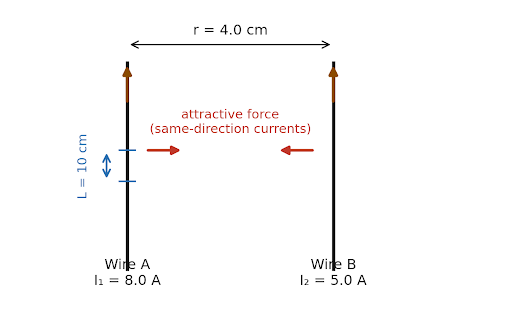
Question 7: Two long and parallel straight wires A and B carrying currents of 8.0 A and 5.0 A in the same direction are separated by a distance of 4.0 cm. Estimate the force on a 10 cm section of wire A.
Given:
- Current in wire A (I₁): 8.0 A
- Current in wire B (I₂): 5.0 A
- Distance between wires (r): 4.0 cm = 0.04 m
- Length of the section (L): 10 cm = 0.1 m
Steps:
State the formula for the magnetic force between two parallel current-carrying wires:
F⁄L = μ0I1I2⁄2πr
Substitute the parameters:
F⁄L = (4π×10-7 × 8.0 × 5.0)⁄(2π × 0.04)
Simplify the expression:
F⁄L = (2×10-7 × 8.0 × 5.0)⁄0.04 = 2×10⁻⁴ N/m
For the 10 cm (0.1 m) section:
F = (2×10-4) × 0.1
F = 2×10⁻⁵ N (attractive)
Answer:
The magnitude of the force on a 10 cm section of wire A is 2 × 10⁻⁵ N (attractive, directed normally from A towards B).
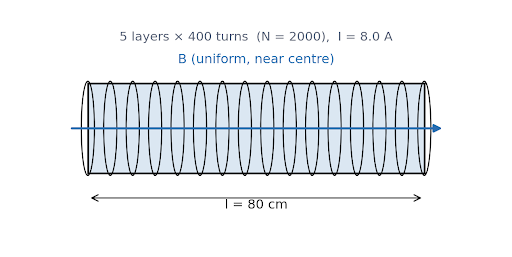
Question 8: A closely wound solenoid 80 cm long has 5 layers of windings of 400 turns each. The diameter of the solenoid is 1.8 cm. If the current carried is 8.0 A, estimate the magnitude of B inside the solenoid near its centre.
Given:
- Length of the solenoid (l): 80 cm = 0.8 m
- Layers of windings: 5
- Turns per layer: 400
- Current (I): 8.0 A
Steps:
Calculate the total number of turns (N):
N = 5 × 400 = 2000
Determine the turns per unit length (n):
n = N⁄l = 2000⁄0.8 = 2500 turns/m
Write the formula for the magnetic field inside a long solenoid:
B = μ0nI
Substitute the values:
B = 4π×10-7 × 2500 × 8.0
Compute the final value:
B = 2.5×10⁻² T
Answer:
The magnitude of B inside the solenoid near its centre is 2.5 × 10⁻² T.
Key Features of NCERT Solutions for Chapter 4
- Step-by-step explanations for every exercise question
- Simple and straightforward methods for solving Biot-Savart and Ampere's law problems
- Exam-oriented answers structured strictly in alignment with the CBSE marking scheme
- Expert-verified solutions ensuring high technical accuracy
- Dual utility supporting both CBSE board examinations and competitive test preparation (JEE Main and NEET)
- Free access to solutions along with supplementary learning resources
Why Choose Infinity Learn NCERT Solutions
Mastering moving charges and magnetism requires a clear physical understanding of three-dimensional forces, field vectors, and loop geometry. Infinity Learn solutions present complex derivations and numerical calculations in a logical progression. Students receive robust guidance on tricky problem types including solenoid winding layers, toroid radii, and galvanometer conversion setups. The platform bridges classroom learning with competitive exam preparation through expert-designed explanations.
Explore Infinity Learn's complete NCERT Solutions for Class 12 Physics to build mastery across all topics. Take advantage of free access to step-by-step solutions, detailed video explanations, and targeted practice questions. Download the Infinity Learn app for seamless learning on the go, and sign up today for a free trial or demo class to experience expert instruction firsthand.
course
No courses found
NCERT Solutions for Class 12 Physics Moving Charges and Magnetism
What is the difference between the Biot-Savart law and Ampere's circuital law?
The Biot-Savart law determines the magnetic field produced by any arbitrary current element, making it suitable for complex or asymmetrical geometries. Ampere's circuital law relates the line integral of a magnetic field around a closed loop to the net current passing through the loop, providing a streamlined approach for highly symmetrical configurations such as long straight wires, solenoids, and toroids.
How many questions does Class 12 Physics Chapter 4 contain in the current syllabus?
Chapter 4 contains standard chapter-end exercises covering magnetic forces, Lorentz force calculations, Biot-Savart and Ampere's law applications, solenoid and toroid fields, parallel conductor interactions, and moving coil galvanometer conversions.
How is a galvanometer converted into a voltmeter or an ammeter?
A galvanometer is converted into a voltmeter by connecting a very high resistance in series with its coil. Conversely, it is converted into an ammeter by connecting a very small shunt resistance in parallel with the coil.
What determines the radius of a charged particle's path in a magnetic field?
The radius of the circular trajectory depends directly on the mass and velocity of the particle, and inversely on its charge magnitude and the magnetic field strength, expressed by the formula:
r = mv⁄qB
How important is Chapter 4 for CBSE Class 12 board exams?
Chapter 4 carries a substantial weightage of 6 to 8 marks in the theory examination. Board evaluations frequently test numerical problems on magnetic forces, parallel wire interactions, and galvanometer conversions, alongside derivations for solenoids and toroids.
Are Infinity Learn's NCERT Solutions for Chapter 4 updated as per the latest CBSE syllabus?
Yes. All solutions and exercise sets fully comply with current rationalised NCERT guidelines, ensuring students focus exclusively on relevant board and competitive exam topics.
Is Moving Charges and Magnetism important for NEET and JEE Main preparation?
Yes. Moving Charges and Magnetism serves as an essential foundation for engineering and medical entrance tests, frequently featuring conceptual and numerical applications of Lorentz force, magnetic flux density, and moving coil instruments.
