Table of Contents
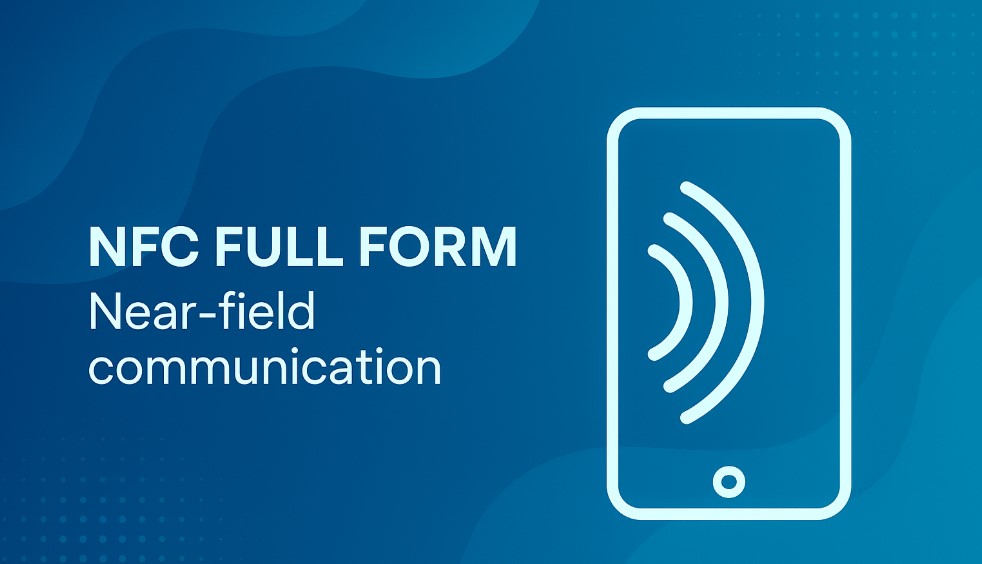
NFC Full Form – Near-field communication, or NFC, is a wireless technology. It connects two electronic devices when they are close. The range is very short, only about 4 centimeters. NFC is fast and easy. You just tap two devices, and they talk. No cables. No complex setup. It works in phones, cards, wearables, and more. It powers payments, access, sharing, and even charging. Let’s explore how it works, where it’s used, and what makes it special.
What is NFC?


NFC means Near-Field Communication. It lets devices exchange data over short distances. You may have seen it in action. When someone taps their phone to pay? That’s NFC. When a contactless card opens a metro gate? That’s NFC. It uses radio waves to send data, but unlike Bluetooth or Wi-Fi, it only works when devices are very close. That’s both a strength and a weakness. Close range makes it more secure, but it also limits how far it can work.
History of NFC
NFC came from Radio Frequency Identification, a tech that uses radio waves. It lets devices talk by just being close. RFID began for tracking and tagging, but NFC made it faster and more interactive. In 1983, Charles Walton got the first RFID patent. By 1997, NFC-like ideas appeared in toys. Hasbro used it in Star Wars figures.
In 2002, Sony and Philips teamed up to define the technical foundations of NFC. Engineers Franz Amtmann and Philippe Maugars played key roles in developing the technology. By 2003, NFC was officially recognized as a global standard. The following year, Sony, Nokia, and Philips launched the NFC Forum to promote its growth. That same year, Nokia introduced an external NFC accessory for mobile phones.
In 2005, NFC was tested for payments & transport in France & Germany. In 2006, the first NFC tag specs came out. The “SmartPoster” format also launched.
In 2007, the UK held its first NFC consumer trial. In 2008, AirTag introduced the world’s first NFC software kit for developers. In 2009, NFC became useful for pairing devices and sharing data. China used it in buses and trams. In 2010, NFC entered smartphones.
France launched Cityzi in Nice, Europe’s first city-wide NFC service. By 2011, Google showed off NFC for games and sharing. Symbian OS and BlackBerry adopted NFC too. In 2012, the UK saw smartposters in restaurants. Sony released Smart Tags. In 2013, Samsung and VISA worked on mobile payments. IBM used NFC for phone-based authentication.
In 2014, Dinube introduced native NFC payments on phones without stickers or cases. Google bought Softcard, a mobile wallet. Android Pay started in 2015. That same year, Swatch and VISA made a payment watch. Today, Bluetooth and Ultra-Wideband (UWB) are seen as future competitors, but NFC still powers contactless life, fast, simple, and just a tap away.
Must Check – List of All Full Form


How Does NFC Work?
NFC runs at 13.56 MHz. It’s part of the ISM radio band, unlicensed and available worldwide. It supports three speeds: 106, 212, & 424 kbit/s. Not very fast, but enough for small tasks. NFC needs 2 parts: An initiator and a target. The initiator sends out a magnetic field. The target responds. The target can be active or passive. A passive target doesn’t have its own power. It gets power from the initiator’s signal. This is why NFC tags can work without batteries.
Near-field Communication Modes
There are three main modes. Each mode is useful in different ways. NFC gives flexibility with simple control.
- Card Emulation: Your phone acts like a credit card or Metro card. You tap it to pay or enter.
- Reader/Writer: Your phone reads an NFC tag. A simple tap can open a link, launch an app, or show a message.
- Peer-to-Peer: Two devices share files or data. It could be photos, contacts, or small files.
Do Check – IBM Full Form
Near-field Communication Tags
NFC tags are small chips. They are often placed inside cards, stickers, or posters. You can tap your phone to read them. Some tags can also be rewritten. They can store links, text, or commands. Businesses use them for advertising. Home users use them for automation. Tag types range from Type 1 to Type 5. Each type has different speed, memory, and features.


NFC Wireless Charging
NFC doesn’t just send data. It can also charge small devices. This is called NFC Wireless Charging (WLC). It was introduced by the NFC Forum. It can deliver up to 1 watt of power. That’s not a lot, but enough for wearables and earbuds. The antenna can be tiny, just 3×3 mm. This is perfect for space-limited gadgets. It’s slower than Qi charging. But it works in very small devices where Qi can’t.
Do Check: USB Full Form
NFC vs Bluetooth
When it comes to short-range wireless communication, NFC and Bluetooth often stand side by side, Both help devices connect without wires, but they work differently. Let’s see how these two technologies compare in range, speed, setup, and power.
| Feature | NFC | Bluetooth |
| Topology | Point-to-point | WPAN |
| Range | < 20 cm | Up to 100 m |
| Speed | 424 kbit/s | Up to 2 Mbit/s |
| Pairing Needed | No | Yes |
| Setup Time | < 0.1 sec | 6 seconds |
| Cryptography | Not with RFID | Available |
Applications of NFC
NFC is all around us today. It quietly powers everyday actions. From tapping a card to pairing devices, NFC makes life faster and easier. Let’s explore where this tiny tech makes a big impact.
- Contactless Payments
The most famous use. Tap your phone or card to pay. No need for cash or swiping. Services like Google Pay, Apple Pay, and Samsung Pay use NFC. Retailers everywhere accept it.
- Travel and Transit
NFC cards work on metro gates and buses. It’s fast, touchless, and secure. Phones with NFC can also be used. You just tap and go.
- Identity and Access
NFC is used in ID cards and e-passports. It stores secure identity data. Offices and hotels use NFC badges or phones for door access. It’s more secure than keys.
- Marketing and Posters
Posters with NFC tags let your phone open a website or app instantly. Just a tap is enough. They’re common in ads, stores, and event promotions.
- File Sharing
NFC lets you share contacts or photos. It was used in Android Beam and Samsung’s S-Beam. NFC starts the connection. Then Bluetooth or Wi-Fi Direct takes over.
- Smart Home Automation
Place NFC tags around your home. Program them to change settings. For example, tap one to mute your phone Or another to start music.
- Gaming with NFC
NFC is also used in gaming. Nintendo’s Amiibo toys are a key example. Each toy has a chip inside. When tapped on a console, it unlocks new content. Consoles like 3DS, Wii U, & Switch support this. It brings extra fun and custom features to games.
- Security of NFC
NFC is quite secure. Its short range makes spying hard, but it’s not perfect. Hackers can try to eavesdrop or relay. A relay attack copies your signal. The hacker then uses it as if they were you. To stay safe, NFC apps use encryption. Payment systems use tokenization. The real card number is never shared. That’s why mobile payments are safe
Also Check – PhD Full Form
NFC Standardization and Control
NFC is controlled by several groups. These groups make sure NFC works everywhere. They help phones, cards, and readers speak the same language.
- NFC Forum: Sets rules and certifies devices.
- ISO/IEC: Provides global technical standards.
- GSMA: Helps with mobile carrier support.
- EMVCo: Manages payment security and specs.
NFC Global Adoption
NFC is going global, what started as a niche technology is now part of daily life in many countries. From travel to shopping, people everywhere are tapping to pay and connect. Let’s take a look at how different regions have adopted NFC in their own way.
- UK: Contactless cards and Apple Pay are very common.
- India uses NFC in many everyday places like cinemas, metro stations, & retail stores.
- China: Wallets like Alipay use NFC and QR codes.
- France, especially the city of Nice, was among the first in Europe to adopt NFC technology widely.
- Africa: Airtel and partners use it in over 15 countries.
Must Read – KCAL Full Form
Devices with NFC
Most modern smartphones have NFC. Android, iOS, and Windows support it. BlackBerry used it in its Tag system. Apple joined later, but now fully supports it. Wearables like smartwatches also use NFC. Even earbuds and fitness bands support tap-to-pair or tap-to-charge. Some laptops and tablets include it too.
What’s Next for NFC?
NFC is getting smarter. Wireless charging is one big future. So is secure identity use. Governments may use NFC in digital IDs. Wearables will use it for more tasks. Phones will use NFC in new ways, like unlocking cars. Smart posters may give real-time data and with IoT devices growing, NFC will be everywhere. One tap. One touch. That’s the future.
NFC Full Form FAQs
What are NFC tags?
NFC tags are small, wireless chips that can hold and share data. When you tap them with your phone, they can open links, run apps, or perform preset tasks automatically.
Is NFC safe to use?
Yes. Its short range makes it hard to hack. Mobile payments use encryption.
What is card emulation in NFC?
Your phone acts like a card to make payments or enter secured areas.
Where is NFC used?
In payments, transit systems, door access, marketing posters, file sharing, and more.
What powers NFC tags?
They don’t need batteries. They use the signal from your phone to power up.