NCERT Solutions for Class 12 Physics Chapter 10 Wave Optics
By Brijesh Sharma
|
Updated on 3 Nov 2026, 10:53 IST
How does light behave when it travels as a wave? Class 12 Physics Chapter 10, Wave Optics, uses the wave model of light to explain wavefronts, Huygens' principle, interference, Young's double-slit experiment and diffraction.
The chapter builds on the ideas of light introduced in Chapter 9, but shifts from tracing light rays to studying phenomena that arise from the wave nature of light. Students also work with phase difference, path difference, coherent sources, fringe positions and diffraction patterns.
These NCERT Solutions for Class 12 Physics Chapter 10 provide step-by-step solutions to the chapter's exercise questions, with the relevant formulas, substitutions and reasoning shown clearly.
[Download Class 12 Physics Chapter 10 NCERT Solutions PDF for revision and practice]
Download Class 12 Physics Chapter 10 NCERT Solutions
Download the Class 12 Physics Chapter 10 NCERT Solutions PDF for Wave Optics, including the exercise questions and step-by-step solutions covering wavefronts, Huygens' principle, interference, Young's double-slit experiment and diffraction.
NCERT Class 12 Physics Chapter 10: Structure and Key Topics
Chapter 10 progresses from the wave description of light to the phenomena that distinguish wave optics from geometrical optics.
Loading PDF...
The chapter broadly follows this sequence:
Wavefronts → Huygens' principle → Reflection and refraction using wavefronts → Interference → YDSE → Coherent sources → Diffraction
The numerical questions involve quantities such as wavelength, speed, refractive index, phase difference, fringe position and fringe width. The chapter also includes conceptual questions on wavefronts, coherent sources and the nature of interference and diffraction.
In the CBSE 2026–27 syllabus, Chapter 10 includes the expression for fringe width in Young's double-slit experiment, with no derivation of the final expression required, along with qualitative treatment of the width of the central maximum in single-slit diffraction. Chapter 11 then moves to the dual nature of radiation and matter.

Important Formulas for Chapter 10
Relation Between Phase Difference and Path Difference
φ = (2π/λ) Δx
Best Courses for You

JEE

NEET

Foundation JEE

Foundation NEET

CBSE
where Δx is the path difference.
Constructive Interference (bright fringes)
Δx = nλ, n = 0, 1, 2, 3, …
Destructive Interference (dark fringes)
Δx = (n + 1/2)λ
Position of Bright Fringes in YDSE
yn = nλD/d
Position of Dark Fringes in YDSE
yn = (2n − 1)λD/2d
where D is the distance between the slits and screen and d is the separation between the two slits.
Fringe Width
β = λD/d
Speed of Light in a Medium
v = c/μ
Wavelength in a Medium
λ′ = λ/μ
The frequency of light remains unchanged when it passes from one medium to another.
Single-Slit Diffraction
For minima
a sinθ = nλ
For the first minimum
a sinθ = λ
Width of the central maximum (small angles)
W = 2λD/a
The CBSE syllabus prescribes qualitative treatment of the width of the central maximum.
NCERT Questions and Step-by-Step Solutions
Question 1 Exercise 10.1
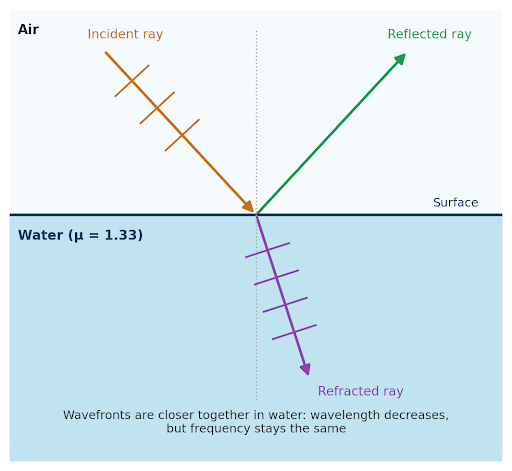
Monochromatic light of wavelength 589 nm is incident from air on a water surface. What are the wavelength, frequency and speed of (a) reflected, and (b) refracted light? Refractive index of water is 1.33.
Given
λ = 589 nm = 589 × 10−9 m
μ = 1.33, c = 3 × 10⁸ m s−1
Step 1: Frequency of the incident light
ν = c/λ = (3 × 10⁸)/(589 × 10−9) ≈ 5.09 × 10¹⁴ Hz
The frequency remains unchanged on reflection or refraction.
(a) Reflected light
The reflected light stays in air, so its speed and wavelength are unchanged:
λr = 589 nm, νr ≈ 5.09 × 10¹⁴ Hz, vr = 3 × 10⁸ m s−1
(b) Refracted light
v = c/μ = (3 × 10⁸)/1.33 ≈ 2.26 × 10⁸ m s−1
The frequency stays ν ≈ 5.09 × 10¹⁴ Hz. Using λ′ = λ/μ:
λ′ = 589/1.33 ≈ 443 nm
Answer
Reflected light:
λ = 589 nm, ν ≈ 5.09 × 10¹⁴ Hz, v = 3 × 10⁸ m s−1
Refracted light:
λ ≈ 443 nm, ν ≈ 5.09 × 10¹⁴ Hz, v ≈ 2.26 × 10⁸ m s−1
Question 2 Exercise 10.2
What is the shape of the wavefront in each of the following cases: (a) Light diverging from a point source. (b) Light emerging from a convex lens when a point source is placed at its focus. (c) The portion of the wavefront of light from a distant star intercepted by the Earth.
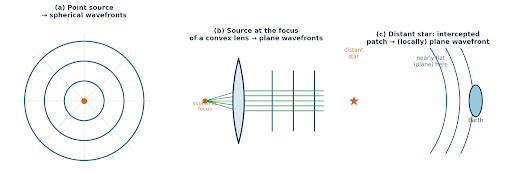
(a) Point source
All points at the same distance from a point source share the same phase at any instant; these points form a spherical surface.
(b) Point source at the focus of a convex lens
Rays emerging from the lens are parallel to one another. A set of parallel rays corresponds to a plane wavefront.
(c) Light from a distant star
A star is extremely far from the Earth, so the spherical wavefront reaching us has a very large radius of curvature. Over the small region intercepted by the Earth, it can be treated as a plane wavefront.
Answer
(a) Spherical wavefront
(b) Plane wavefront
(c) Plane wavefront
Question 3 Exercise 10.3
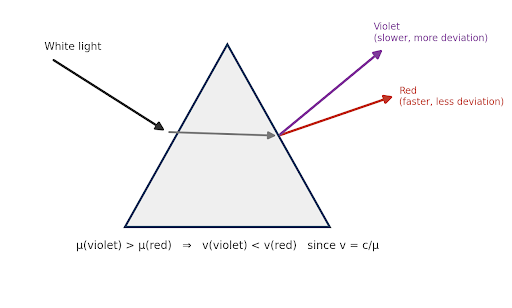
(a) The refractive index of glass is 1.5. What is the speed of light in glass? (Speed of light in vacuum is 3.0 × 10⁸ m s⁻¹) (b) Is the speed of light in glass independent of the colour of light? If not, which of the two colours red and violet travels slower in a glass prism?
Given
μ = 1.5, c = 3.0 × 10⁸ m s−1
(a) Speed of light in glass
v = c/μ = (3.0 × 10⁸)/1.5 = 2.0 × 10⁸ m s−1
(b) Does speed depend on colour?
No. The refractive index of glass varies with wavelength, and violet light has a higher refractive index than red light. Since v = c/μ, a higher refractive index means a lower speed.
Answer
v = 2.0 × 10⁸ m s−1
Violet light travels slower than red light in glass.
Question 4 Exercise 10.4
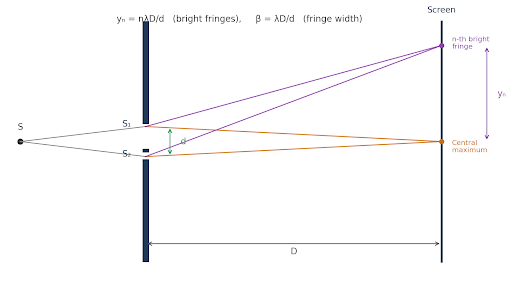
In a Young's double-slit experiment, the slits are separated by 0.28 mm and the screen is placed 1.4 m away. The distance between the central bright fringe and the fourth bright fringe is measured to be 1.2 cm. Determine the wavelength of light used in the experiment.
Given
d = 0.28 mm = 0.28 × 10⁻³ m, D = 1.4 m
y4 = 1.2 cm = 1.2 × 10⁻² m, n = 4
Step 1: Bright-fringe position formula
yn = nλD/d ⇒ y4 = 4λD/d ⇒ λ = y4d/4D
Step 2: Substitute the values
λ = [(1.2 × 10⁻²)(0.28 × 10⁻³)] / [4(1.4)] = (3.36 × 10⁻⁶)/5.6
λ = 6.0 × 10⁻⁷ m = 600 nm
Answer
λ = 600 nm
Question 5 Exercise 10.5
In Young's double-slit experiment using monochromatic light of wavelength λ, the intensity of light at a point on the screen where path difference is λ, is K units. What is the intensity of light at a point where path difference is λ/3?
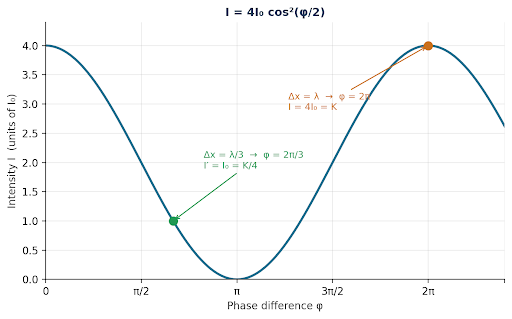
Let I0 be the intensity due to each coherent wave. For two waves of equal intensity, the resultant intensity is:
I = 4I0 cos2(φ/2), φ = (2π/λ)Δx
Step 1: Use the first condition (Δx = λ)
φ = (2π/λ)×λ = 2π ⇒ I = 4I0cos2π = 4I0
4I0 = K ⇒ I0 = K/4
Step 2: Second point (Δx = λ/3)
φ = (2π/λ)(λ/3) = 2π/3
I′ = 4I0cos2(π/3) = 4I0(1/2)2 = I0 = K/4
Answer
I′ = K/4 units
Question 6 Exercise 10.6
A beam of light consisting of two wavelengths, 650 nm and 520 nm, is used to obtain interference fringes in a Young's double-slit experiment. (a) Find the distance of the third bright fringe on the screen from the central maximum for wavelength 650 nm. (b) What is the least distance from the central maximum where the bright fringes due to both the wavelengths coincide?
Given
λ1 = 650 nm, λ2 = 520 nm
(a) Third bright fringe for 650 nm light
yn = nλD/d ⇒ y3 = 3(650 nm)D/d = 1950(D/d) nm
The numerical value cannot be obtained unless the values of D and d are specified.
(b) Least distance where bright fringes coincide
For bright fringes to coincide, n1λ1 = n2λ2:
650n1 = 520n2 ⇒ 5n1 = 4n2
The smallest non-zero integers satisfying this are n1 = 4 and n2 = 5.
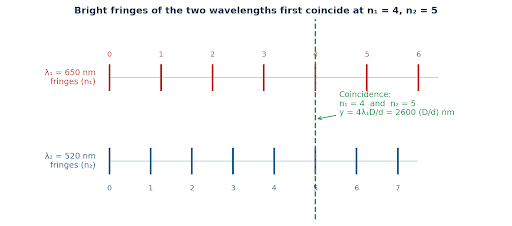
y = 4(650)D/d = 2600(D/d) nm
Answer
y3 = 1950(D/d) nm (for λ1 = 650 nm)
First coincidence at y = 2600(D/d) nm
Key Features of NCERT Solutions for Class 12 Physics Chapter 10
- Detailed approach to each problem: The solutions explain why a particular formula or concept is used and then work through the problem step by step, helping students understand the reasoning behind the answer.
- Concepts explained alongside calculations: Topics such as wave speed, frequency, wavelength, refraction, and wavefronts are explained before applying them to problems for a better understanding of the concepts used.
- Clear working for YDSE problems: Questions involving fringe width, fringe position, and intensity are broken down into manageable steps instead of jumping straight to the answer.
- Better understanding of wave differences: The solutions explain how path difference and phase difference are related and where each is used.
- Complete numerical working: Calculations include the necessary units and lead clearly to the final answer, making it easier for students to check their own work.
- Useful for exam revision: The explanations, formulas, and worked examples give students a convenient way to review important concepts and problem types before their exams.
Why Infinity Learn NCERT Solutions for Class 12 Physics Chapter 10 Wave Optics
- Learn from Expert Physics Faculty: Get guidance from Physics faculty with experience teaching students preparing for JEE and NEET.
- Understand Interference and Diffraction Through Diagrams: Diagram-rich explanations help you follow interference patterns, diffraction patterns, and related concepts more easily.
- Practice Previous-Year Exam Questions: Previous-year board and competitive exam questions help you see how Wave Optics is asked in different examinations.
- Strengthen Your Concepts with Mock Tests: Chapter-wise mock tests give you additional practice and help you check how well you have understood the concepts.
- Get Help with Difficult Derivations: Doubt-resolution support is available when you need help with tricky Wave Optics derivations or related questions.
course
No courses found
Class 12 Physics Chapter 10 Wave Optics FAQs
What is the formula for fringe width in Young's double-slit experiment?
The fringe width in Young's double-slit experiment is:
β = λD/d
where λ is the wavelength of light, D is the distance between the slits and the screen, and d is the separation between the two slits.
The CBSE 2026–27 syllabus requires the final expression for fringe width; its derivation is not required.
What is the difference between interference and diffraction?
Interference results from the superposition of waves from two or more coherent sources. Young's double-slit experiment is a standard example.
Diffraction refers to the spreading of light when it passes through a narrow aperture or around an obstacle, with the pattern arising from the superposition of waves from different parts of the same wavefront.
In the Class 12 syllabus, Chapter 10 includes interference and Young's double-slit experiment as well as diffraction due to a single slit.
What is Huygens' principle?
Huygens' principle states that every point on a wavefront acts as a source of secondary wavelets that spread through the medium. The new wavefront is obtained as the common tangent surface to these secondary wavelets.
In Chapter 10, this principle is used to explain the reflection and refraction of plane waves.
Is Wave Optics important for NEET and JEE Main?
Wave Optics is part of the Physics syllabus relevant to preparation for competitive examinations such as JEE Main and NEET. Topics such as wavefronts, interference, Young's double-slit experiment and diffraction form part of the chapter's core content. Students preparing for these examinations can use the NCERT questions to practise the underlying concepts and numerical relationships.
Where can I download the NCERT Solutions PDF for Chapter 10?
You can access the Class 12 Physics Chapter 10 NCERT Solutions PDF through Infinity Learn's study materials. The PDF can be used alongside the NCERT textbook for revision and practice.
