- Key Concepts Covered in Class 12 Math Chapter 6 – Application of Derivatives
- Chapter Overview and Important Results
- Download Class 12 Application of Derivatives NCERT PDF
- Class 12 Maths Chapter 6 NCERT Solutions– Applications of Derivatives
- Key Features of Infinity Learn NCERT Solutions for Class 12 Math Chapter 6
- Why Use NCERT Solutions for Application of Derivatives?
- Study Class 12 Math with Infinity Learn
- FAQs on NCERT Solutions for Class 12 Math Chapter 6
NCERT Solutions for Class 12 Math Chapter 6 – Application of Derivatives
By Karan singh ildefaultfield
|
Updated on 15 Sep 2026, 11:57 IST
Application of Derivatives is Chapter 6 of the Class 12 Mathematics textbook and forms part of the Calculus unit of the CBSE syllabus. The chapter covers the derivative as a rate of change, increasing and decreasing functions, and maxima and minima, including the first derivative test, the second derivative test, and absolute maximum and minimum values on a closed interval. The NCERT Solutions for Class 12 Math Chapter 6 provide concept-wise worked-out answers to important questions selected from different exercises. These NCERT Solutions help students understand the application of derivative-based methods and practice problems in alignment with the latest syllabus requirements.
Key Concepts Covered in Class 12 Math Chapter 6 – Application of Derivatives
The chapter covers the following important concepts:
- The derivative as a rate of change of one quantity with respect to another
- Related rates, where two changing quantities are linked by a formula
- Increasing and decreasing functions
- Using the sign of the first derivative to find intervals of increase and decrease
- Critical points, where the derivative is zero or undefined
- Local maxima and local minima
- The first derivative test
- The second derivative test
- Absolute maximum and minimum values on a closed interval
- Optimization problems, where a quantity is maximized or minimized under a constraint
Chapter Overview and Important Results
The Derivative as a Rate of Change
If a quantity y depends on a quantity x, then dy/dx measures how fast y changes for a small change in x. In this chapter, both quantities usually change with time, so the chain rule links them.
dy/dt = (dy/dx) x (dx/dt)
The method for a rate of change question is always the same. Write the formula connecting the quantities, differentiate both sides with respect to time, substitute the values given, and state the answer with its units.
Download Class 12 Application of Derivatives NCERT PDF
Increasing and Decreasing Functions
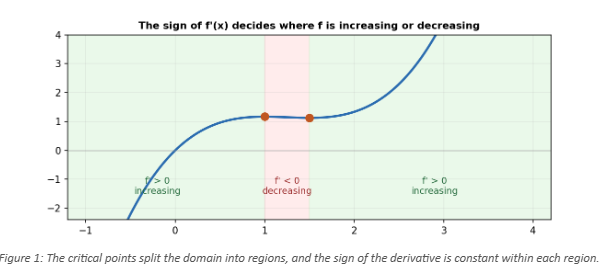
The sign of the first derivative tells you which way the graph is heading.
Loading PDF...
- f′(x) > 0 on an interval means f is strictly increasing there
- f′(x) < 0 on an interval means f is strictly decreasing there
To find the intervals, differentiate, set the derivative equal to zero to find the critical points, mark those points on a number line, and test the sign of the derivative in each region between them.
Maxima and Minima
A critical point is a value of x where f′(x) = 0 or where the derivative does not exist. Every local maximum and local minimum occurs at a critical point, though not every critical point is one.
First derivative test- Look at how the sign of f′ behaves as x passes through the critical point. If it changes from positive to negative, the point is a local maximum. If it changes from negative to positive, it is a local minimum. If it does not change sign at all, the point is neither and is called a point of inflection.

Second derivative test- This is usually quicker when the second derivative is easy to find.
f′(c) = 0 and f″(c) < 0 means a local maximum at c
Best Courses for You

JEE

NEET

Foundation JEE

Foundation NEET

CBSE
f′(c) = 0 and f″(c) > 0 means a local minimum at c
If f″(c) = 0, the test gives no information, and you must fall back on the first derivative test.
Absolute Maximum and Minimum on a Closed Interval
On a closed interval, the largest and smallest values may occur at a turning point, but they may equally occur at one of the two endpoints. So all of these have to be checked.
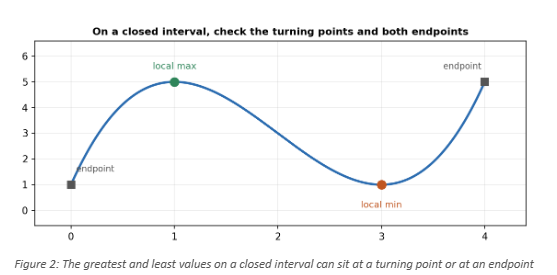
The procedure is to find the critical points inside the interval, evaluate the function at each of them, evaluate it at both endpoints as well, and then simply pick out the largest and the smallest of those values.
Selected NCERT Questions, Grouped by Concept
The questions below are taken from across the chapter and arranged by concept rather than by exercise number so that each method can be practiced as one block.
| Concept | What the questions test | Source |
| A. Simple rates of change | Differentiating a formula with respect to one variable | Ex 6.1 Q1 |
| B. Related rates | Two quantities changing together with time | Ex 6.1 Q2, Q3, Q4, Q10 |
| C. Proving monotonic behavior | Showing a derivative keeps one sign | Ex 6.2 Q1, Q2, Q10 |
| D. Finding intervals | Splitting a domain at the critical points | Ex 6.2 Q4, Q5 |
| E. Maxima and minima | First and second derivative tests | Ex 6.3 Q1(i), Q3, Q9 |
| F. Closed interval problems | Comparing turning points with endpoints | Ex 6.3 Q5, Q10 |
| G. Optimization | Forming a quantity and minimizing it | Misc. Q1, Q7 |
Note. No question is drawn from tangents and normals or from approximations, since both sections have been withdrawn from the chapter.
Class 12 Maths Chapter 6 NCERT Solutions– Applications of Derivatives
Concept A: Simple Rates of Change
Q1. Ex 6.1 Q1: Find the rate of change of the area of a circle with respect to its radius r when (a) r = 3 cm and (b) r = 4 cm.
Step 1. Write the formula connecting the quantities. The area of a circle depends only on its radius.
A = πr²
Step 2. Decide what is being asked for. The question wants the rate of change of area with respect to the radius, which is dA/dr. Note that this is not with respect to time, so no chain rule is needed here.
Step 3. Differentiate with respect to r. Since π is a constant, bring the power down and reduce it by one.
dA/dr = 2πr
Step 4. Substitute each value in turn. When r = 3, dA/dr = 2π(3) = 6π. When r = 4, dA/dr = 2π(4) = 8π.
(a) 6π cm² per cm
(b) 8π cm² per cm
Remember: the units of a rate of change are the units of the top quantity divided by the units of the bottom one. Here, that is square centimeters per centimeter. Marks are given for the units, so do not leave them off.
Concept B: Related Rates
Q2. Ex 6.1 Q2: The volume of a cube is increasing at the rate of 8 cm³ per second. How fast is the surface area increasing when the length of an edge is 12 cm?
Step 1. Name the quantities. Let the edge of the cube be x, its volume V, and its surface area S. Both V and S change because x changes, and x changes with time.
V = x³ S = 6x²
Step 2. Write down what is given and what is wanted. We are told dV/dt = 8. We want dS/dt at the moment when x = 12.
Step 3. Use the volume to find how fast the edge is growing. Differentiate V = x³ with respect to time. The chain rule gives a factor of dx/dt.
dV/dt = 3x² (dx/dt), so 8 = 3x² (dx/dt), which rearranges to dx/dt = 8 / (3x²).
Step 4. Differentiate the surface area with respect to time.
dS/dt = 12x (dx/dt)
Step 5. Substitute the expression for dx/dt found in Step 3.
dS/dt = 12x × 8/(3x²) = 96/(3x) = 32/x
Step 6. Put in x = 12.
dS/dt = 32/12 = 8/3 cm² per second
Remember: substitute the particular value of x only at the very end. Putting x = 12 in too early freezes the variable, and the differentiation then gives zero.
Q3. Ex 6.1 Q3: The radius of a circle is increasing uniformly at the rate of 3 cm per second. Find the rate at which the area of the circle is increasing when the radius is 10 cm.
Step 1. Formula. A = πr².
Step 2. Given and wanted. We are given dr/dt = 3. We want dA/dt when r = 10.
Step 3. Differentiate with respect to time. The variable is r, but we are differentiating with respect to t, so the chain rule brings in dr/dt.
dA/dt = 2πr (dr/dt)
Step 4. Substitute both values.
dA/dt = 2π(10)(3) = 60π
The area is increasing at 60π cm² per second
Q4. Ex 6.1 Q4: An edge of a variable cube is increasing at the rate of 3 cm per second. How fast is the volume of the cube increasing when the edge is 10 cm long?
Step 1. Formula. V = x³, where x is the edge.
Step 2. Given and wanted. dx/dt = 3, and we want dV/dt when x = 10.
Step 3. Differentiate with respect to time.
dV/dt = 3x² (dx/dt)
Step 4. Substitute. dV/dt = 3(10)²(3) = 3 × 100 × 3 = 900.
The volume is increasing at 900 cm³ per second
Remember: compare this with Question 2. There, the volume rate was given, and the edge rate had to be found. Here the edge rate is given, and the volume rate is wanted. The formula is the same, only the direction of the working changes.
Q5. Ex 6.1 Q10: A ladder 5 m long is leaning against a wall. The bottom of the ladder is pulled along the ground away from the wall at the rate of 2 cm per second. How fast is its height on the wall decreasing when the foot of the ladder is 4 m away from the wall?
Step 1. Set up the relationship. Let x be the distance of the foot from the wall and y the height of the top up the wall. The ladder, the wall, and the ground form a right-angled triangle with the ladder as the hypotenuse.
x² + y² = 25
Step 2. Given and wanted. dx/dt = 2 cm per second. We want dy/dt when x = 4.
Step 3. Find y at that moment. From 16 + y² = 25, we get y² = 9, so y = 3.
Step 4. Differentiate the relationship with respect to time. The 25 is a constant, so its derivative is zero.
2x (dx/dt) + 2y (dy/dt) = 0
Step 5. Make dy/dt the subject. Dividing through by 2 and rearranging:
dy/dt = −(x/y)(dx/dt)
Step 6. Substitute x = 4, y = 3 and dx/dt = 2.
dy/dt = −(4/3)(2) = −8/3
The height is decreasing at 8/3 cm per second
Remember: the minus sign is doing real work. It tells you the height is falling while the foot moves out. State the answer as a decrease and quote the size as a positive number.
Concept C: Proving a Function is Increasing or Decreasing
Q6. Ex 6.2 Q1: Show that the function f(x) = 3x + 17 is strictly increasing on R.
Step 1. Differentiate. f′(x) = 3.
Step 2. Examine the sign. The derivative is the constant 3, which is positive no matter what value x takes.
Step 3. Conclude. Since f′(x) > 0 for every real x, the function is strictly increasing on the whole of R.
Remember: for a proof of this kind, you do not need intervals or a sign table. Showing that the derivative never changes sign is the entire argument.
Q7. Ex 6.2 Q2: Show that the function f(x) = e²ˣ is strictly increasing on R.
Step 1. Differentiate. By the chain rule, f′(x) = 2e²ˣ.
Step 2. Examine the sign. An exponential is positive for every real input, so e²ˣ > 0 always. Multiplying by 2 keeps it positive.
Step 3. Conclude. f′(x) > 0 for all x, so the function is strictly increasing on R.
Remember: the fact that e to any power is strictly positive is worth stating explicitly. It is the step that carries the proof.
Q8. Ex 6.2 Q10: Prove that the logarithmic function is strictly increasing on (0, ∞).
Step 1. Write the function and its domain. f(x) = log x, defined for x > 0.
Step 2. Differentiate. f′(x) = 1/x.
Step 3. Examine the sign on the given interval. On (0, ∞), every value of x is positive, so 1/x is positive throughout.
Step 4. Conclude. f′(x) > 0 for all x in (0, ∞), so log x is strictly increasing there.
Remember: the interval matters. The claim is only made for x > 0, which is exactly where the logarithm is defined.
Concept D: Finding Intervals of Increase and Decrease
Q9. Ex 6.2 Q4: Find the intervals in which f(x) = 2x² − 3x is (a) strictly increasing and (b) strictly decreasing.
Step 1. Differentiate. f′(x) = 4x − 3.
Step 2. Find the critical point by setting the derivative to zero.
4x − 3 = 0, so x = 3/4.
Step 3. Split the number line at that point. This gives two regions, x < 3/4 and x > 3/4.
Step 4. Test the sign of f′ in each region. Pick any convenient test value in each. At x = 0, f′ = −3, which is negative. At x = 1, f′ = 1, which is positive.
decreasing on (−∞, 3/4)
increasing on (3/4, ∞)
Remember: you do not need to test many values. One convenient number from each region is enough, because a continuous derivative cannot change sign without passing through zero.
Q10. Ex 6.2 Q5: Find the intervals in which f(x) = 2x³ − 3x² − 36x + 7 is (a) strictly increasing and (b) strictly decreasing.
Step 1. Differentiate. f′(x) = 6x² − 6x − 36.
Step 2. Factor. Take out the common factor 6 first, which makes the quadratic much easier to handle.
f′(x) = 6(x² − x − 6) = 6(x − 3)(x + 2)
Step 3. Find the critical points. Setting each bracket to zero gives x = 3 and x = −2.
Step 4. Split the number line into three regions and test the sign of f′ in each.
For x < −2, take x = −3: both brackets are negative, so the product is positive.
For −2 < x < 3, take x = 0: (x − 3) is negative and (x + 2) is positive, so the product is negative.
For x > 3, take x = 4: both brackets are positive, so the product is positive.
Increasing on (−∞, −2) and (3, ∞)
decreasing on (−2, 3)
Remember: factoring the derivative is what makes the sign test quick. Judging the sign of a product of brackets is far easier than substituting into an unfactored quadratic.
Concept E: Maxima and Minima
Q11. Ex 6.3 Q1(i): Find the maximum and minimum values, if any, of f(x) = (2x − 1)² + 3.
Step 1. Look at the structure before differentiating. The term (2x − 1)² is a square, so it can never be negative. Its smallest possible value is 0.
Step 2. Find where that smallest value occurs. Setting 2x − 1 = 0 gives x = 1/2.
Step 3. Find the value of f there. f(1/2) = 0 + 3 = 3.
Step 4. Consider whether there is a maximum. As x grows large in either direction, (2x − 1)² grows without bound, so f has no greatest value.
Minimum value 3, at x = 1/2
No maximum value
Remember: a completed square can often be read directly, without calculus. Recognizing that a squared term is never negative saves several lines of working.
Q12. Ex 6.3 Q3: Find the local maxima and local minima, if any, of the given functions, and find the corresponding local values.
This question is a set of parts, all worked the same way. The method is worth setting out in full, using f(x) = x² as the pattern.
Step 1. Differentiate. f′(x) = 2x.
Step 2. Find the critical points by setting the derivative to zero. Here 2x = 0 gives x = 0.
Step 3. Apply the second derivative test. f″(x) = 2, which is positive.
Step 4. Interpret. Since f′(0) = 0 and f″(0) > 0, the point x = 0 is a local minimum.
Step 5. Find the local value by substituting back into the original function: f(0) = 0.
Local minimum value 0, occurring at x = 0
Remember: the question asks for two things, the location and the value. Give both. Finding x = 0 and stopping there loses half the marks.
Q13. Ex 6.3 Q9: What is the maximum value of the function sin x + cos x?
Step 1. Differentiate. f′(x) = cos x − sin x.
Step 2. Set the derivative to zero. cos x − sin x = 0 gives cos x = sin x, which means tan x = 1.
Step 3. Solve. The first solution is x = π/4.
Step 4. Apply the second derivative test. f″(x) = −sin x − cos x. At x = π/4, both sine and cosine equal 1/√2, so f″ = −2/√2, which is negative. A negative second derivative confirms a maximum.
Step 5. Find the value. f(π/4) = 1/√2 + 1/√2 = 2/√2 = √2.
maximum value √2
Remember: there is a useful check here. Any expression of the form a sin x + b cos x has a maximum value equal to the square root of (a² + b²). With a = b = 1, that gives √2, matching the calculus.
Concept F: Absolute Values on a Closed Interval
Q14. Ex 6.3 Q5: Find the absolute maximum and absolute minimum values of the given function on the stated closed interval.
The method is the same for every part, so it is set out here in full for f(x) = x³ on the interval [−2, 2].
Step 1. Differentiate and find the critical points. f′(x) = 3x². Setting this to zero gives x = 0, which lies inside the interval.
Step 2. Evaluate at the critical point. f(0) = 0.
Step 3. Evaluate at both endpoints. f(−2) = −8 and f(2) = 8.
Step 4. Compare all three values. The list is −8, 0, and 8. Absolute maximum: 8, at x = 2
Absolute minimum: −8, at x = −2
Remember: on a closed interval, the endpoints are candidates too. In this question, the critical point turns out to be neither the largest nor the smallest value, so checking only x = 0 would have given the wrong answer entirely.
Q15. Ex 6.3 Q10: Find the maximum value of 2x³ − 24x + 107 in the interval [1, 3].
Step 1. Differentiate. f′(x) = 6x² − 24.
Step 2. Find the critical points. Setting 6x² − 24 = 0 gives x² = 4, so x = 2 or x = −2.
Step 3. Discard any critical point outside the interval. The value x = −2 lies outside [1, 3], so it plays no part. Only x = 2 is kept.
Step 4. Evaluate at the critical point and at both endpoints.
f(1) = 2 − 24 + 107 = 85
f(2) = 16 − 48 + 107 = 75
f(3) = 54 − 72 + 107 = 89
Step 5. Compare. The largest of 85, 75, and 89 is 89, which occurs at the right-hand endpoint.
Step 6. The same critical points x = ±2 apply, and only x = −2 lies in [−3, −1]. Evaluate f(x) = 2x³ − 24x + 107 at the critical point and both endpoints.
f(−3) = 2(−27) − 24(−3) + 107 = −54 + 72 + 107 = 125 f(−2) = 2(−8) − 24(−2) + 107 = −16 + 48 + 107 = 139 f(−1) = 2(−1) − 24(−1) + 107 = −2 + 24 + 107 = 129 |
Step 7. Compare the three values.
Answer: maximum value = 139 at x = −2 on [−3, −1]. (The first interval [1, 3] gives 89 at x = 3, as in the draft’s Step 5.)
Remember: notice that the critical point x = 2 gives the smallest of the three values, not the largest. This is exactly why the endpoints must always be included in the comparison.
Concept G: Optimization
Q16. Miscellaneous Q1: Show that the function f(x) = (log x)/x has a maximum at x = e.
Step 1. Differentiate using the quotient rule. With u = log x and v = x, we have u′ = 1/x and v′ = 1.
f′(x) = [ (1/x)(x) − (log x)(1) ] / x² = (1 − log x) / x²
Step 2. Set the derivative to zero. A fraction is zero only when its numerator is zero, so 1 − log x = 0, giving log x = 1 and therefore x = e.
Step 3. Confirm it is a maximum using the sign of f′. The denominator x² is always positive, so the sign of f′ is decided entirely by the numerator 1 − log x.
For x < e, log x < 1, so the numerator is positive, and f is increasing.
For x > e, log x > 1, so the numerator is negative, and f is decreasing.
Step 4. Conclude. The derivative changes from positive to negative as x passes through e, which by the first derivative test is exactly the condition for a local maximum.
f has a maximum at x = e, where the value is 1/e
Remember: when the derivative is a fraction with an always positive denominator, you can ignore the denominator completely when testing signs. That shortens the argument considerably.
Q17. Miscellaneous Q7: The sum of the perimeter of a circle and a square is k, where k is a constant. Prove that the sum of their areas is least when the side of the square is double the radius of the circle.
Step 1. Name the variables and write the constraint. Let r be the radius of the circle and abe the side of the square. The perimeters add to the constant k.
2πr + 4a = k
Step 2. Write the quantity to be minimized. The total area is the sum of the two areas.
A = πr² + a²
Step 3. Reduce to a single variable. From the constraint, a = (k − 2πr)/4. Substituting this into the area gives A as a function of r alone.
A = πr² + [(k − 2πr)/4]²
Step 4. Differentiate with respect to r. The second term needs the chain rule, and the derivative of the inside is −2π/4.
dA/dr = 2πr + 2[(k − 2πr)/4](−2π/4) = 2πr − π(k − 2πr)/4
Step 5. Set the derivative to zero and solve. Multiplying through by 4 and dividing by π:
8r − (k − 2πr) = 0, so 8r + 2πr = k, giving r = k / (8 + 2π)
Step 6. Find the corresponding value of a. Substituting back into a = (k − 2πr)/4 and simplifying gives a = 2k / (8 + 2π).
Step 7. Compare a with r. Dividing one by the other, a/r = 2, so a = 2r.
Step 8. Confirm it is a minimum. Differentiating again gives d²A/dr² = 2π + π²/2, which is positive. A positive second derivative confirms a minimum.
The total area is least when the side of the square is twice the radius
Remember: every optimization question follows this same order. Name the variables, write the constraint, write the quantity to be optimized, use the constraint to remove one variable, differentiate, solve, and confirm with the second derivative. Working to that sequence earns the method marks even if the algebra goes wrong somewhere in the middle.
Key Features of Infinity Learn NCERT Solutions for Class 12 Math Chapter 6
- Covers selected questions arranged in seven concept groups rather than in exercise order.
- Rate of change solutions state clearly what is given and what is wanted before any differentiation.
- Interval questions set out the critical points and the sign test region by region.
- Closed interval questions compare the turning points with both endpoints every time.
- Optimization questions follow one fixed sequence, which is set out in full.
- Flags the tangents and normals and approximations material withdrawn in the rationalization.
Why Use NCERT Solutions for Application of Derivatives?
This is one of the highest-scoring chapters in the paper, and the questions are predictable in shape. A rate of change question always needs a formula and the chain rule. An interval question always needs critical points and a sign test. An optimization question always needs a constraint used to remove a variable. Once the shape is recognized, the working is routine.
Students can use these solutions to:
- Set out a rate of change question by listing what is given and what is wanted first.
- Avoid substituting a particular value before differentiating.
- Factor a derivative before testing signs, which makes the sign table much quicker.
- Remember to check the endpoints on every closed interval question.
- Follow one reliable sequence for optimization, and confirm the answer with the second derivative test.
Study Class 12 Math with Infinity Learn
Infinity Learn provides NCERT Solutions for every chapter of the current Class 12 Math syllabus, with step-by-step working, solutions written in the order the CBSE marking scheme expects, and clear labeling of the topics affected by the rationalization, so no time is spent on material that is no longer examined. Practice chapter by chapter, check your method against the worked solutions, and revise the key results before your board examination.
course
No courses found
FAQs on NCERT Solutions for Class 12 Math Chapter 6
How do I approach a rate of change question?
Write the formula connecting the quantities, note what rate you are given and what rate you want, differentiate the formula with respect to time using the chain rule, and only then substitute the particular values. Finish by stating the units.
Why must I not substitute the given value too early?
Because substituting turns a variable into a constant, and the derivative of a constant is zero. If you put x = 12 into a formula before differentiating, the working collapses. Substitute only after the differentiation is complete.
How do I find where a function is increasing or decreasing?
Differentiate, set the derivative equal to zero to find the critical points, mark those points on a number line, and test the sign of the derivative in each region between them. Where the derivative is positive, the function is increasing, and where it is negative, it is decreasing.
What is the difference between the first and second derivative tests?
The first derivative test looks at how the sign of the first derivative changes as x passes through a critical point. The second derivative test evaluates the second derivative at that point, where a negative value indicates a maximum and a positive value indicates a minimum. The second test is usually quicker, but it gives no information when the second derivative is zero.
Why do I have to check the endpoints on a closed interval?
Because the greatest or least value of a function on a closed interval does not have to occur at a turning point. It can occur at either end. Checking only the critical points can therefore give the wrong answer, as happens in Question 15 above.
What is the standard method for an optimization question?
Name the variables, write the constraint relating them, write an expression for the quantity to be maximized or minimized, use the constraint to reduce that expression to one variable, differentiate and set the result to zero, then confirm the nature of the turning point with the second derivative.
Are tangents and normals still part of Chapter 6?
No. The sections on tangents and normals and on approximations were both withdrawn in the rationalization, together with their exercises. The chapter now consists of three exercises and a Miscellaneous Exercise.
