NCERT Solutions for Class 12 Math Chapter 11 Three-Dimensional Geometry
By Ankit Ankit
|
Updated on 15 Sep 2026, 15:29 IST
Three-Dimensional Geometry extends coordinate geometry beyond a flat plane and helps students work with points, lines, and directions in space. Class 12 Math Chapter 11 introduces direction cosines, direction ratios, equations of lines in space, angles between lines, and related concepts. NCERT Solutions for Class 12 Math Chapter 11 Three-Dimensional Geometry explain the textbook questions with clear formulas and step-by-step calculations.
Students can use these solutions to understand how vector concepts are applied in three dimensions and how different forms of line equations are used.
Key Concepts Covered in Class 12 Math Chapter 11 – Three Dimensional Geometry
The chapter covers the following important concepts:
- Direction cosines of a line, and the angles they are taken from
- The relation l² + m² + n² = 1, and the check it gives on every answer
- Direction ratios, and why a line has one set of direction cosines but many sets of direction ratios
- Direction ratios of the line joining two given points
- Using direction ratios to test three points for collinearity
- The vector equation of a line through a given point and parallel to a given vector
- The Cartesian equation of a line, and converting between the vector and Cartesian forms
- The equation of the line passing through two given points
- The angle between two lines, from their direction vectors or from their direction ratios
- The conditions for two lines to be parallel and for two lines to be perpendicular
- Skew lines, and the shortest distance between two skew lines
- The shortest distance between two parallel lines
- Rewriting an equation into standard form before reading off a point or the direction ratios
A note on notation. The textbook draws a small arrow above every vector. On this page, vectors are printed in bold instead, so a means the vector and |a| means its magnitude. The figures keep the arrow notation used in the textbook.
A note on the syllabus. Planes are no longer part of this chapter. The rationalized textbook keeps direction cosines, the equation of a line, the angle between two lines, and the shortest distance between two lines, so questions on the equation of a plane, the angle between two planes, or the distance of a point from a plane sit outside the current syllabus.
Chapter Overview and Important Results
Where the Marks Go in This Chapter
The formulas here are short, and there are not many of them. Two habits account for most of the marks lost. The first is reading direction ratios off an equation that is not in standard form: an expression such as (1 − x)/3 or (6 − z)/5 has to be rewritten before anything can be read from it, and skipping that step reverses a sign and, with it, the whole answer. The second is using the wrong distance formula, because skew lines and parallel lines are handled differently. A distance is also never negative, so the modulus at the end is part of the answer rather than decoration.
Loading PDF...
Direction Cosines and Direction Ratios
If a line makes angles α, β and γ with the positive x, y and z axes, the cosines of those angles are its direction cosines, written l, m and n. Any three numbers in the same proportion as l, m and n are direction ratios of the line.
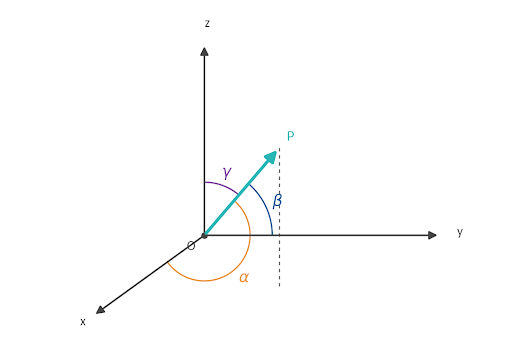
Figure 1: The three angles a line makes with the coordinate axes
l = cos α, m = cos β, n = cos γ
l² + m² + n² = 1

from direction ratios a, b, c: l = a ÷ √(a² + b² + c²), m = b ÷ √(a² + b² + c²), n = c ÷ √(a² + b² + c²)
direction ratios of the line joining P(x1, y1, z1) and Q(x2, y2, z2):
Best Courses for You

JEE

NEET

Foundation JEE

Foundation NEET

CBSE
x2 − x1, y2 − y1, z2 − z1
A line has two sets of direction cosines, one for each of the two directions along it, and the two sets differ only by an overall change of sign. Direction ratios are not unique at all: 2, 3, 6 and 4, 6, 12 describe the same direction. Three points A, B and C are collinear when the direction ratios of AB and BC are proportional, since the two segments then share both a direction and the point B.
Forms of the Equation of a Line
| What is given | Vector form | Cartesian form |
| A point with position vector a and a direction b | r = a + λb | (x − x1)/a = (y − y1)/b = (z − z1)/c |
| Two points with position vectors a and b | r = a + λ(b − a) | (x − x1)/(x2 − x1) = (y − y1)/(y2 − y1) = (z − z1)/(z2 − z1) |
In the vector form, λ is a parameter: as it runs through all real values, r traces out the whole line. The two forms carry the same information, so converting between them is only a matter of reading off the point and the direction and writing them the other way round.
Angle, Parallel and Perpendicular
cos θ = |b1 · b2| ÷ (|b1| |b2|)
cos θ = |a1a2 + b1b2 + c1c2| ÷ [√(a1² + b1² + c1²) × √(a2² + b2² + c2²)]
perpendicular: a1a2 + b1b2 + c1c2 = 0
parallel: a1/a2 = b1/b2 = c1/c2
The modulus in the angle formula is what keeps the answer acute. Without it, reversing the direction of one line would change the angle between them, which is not what the question means.
Shortest Distance Between Two Lines
Two lines in space that are neither parallel nor intersecting are called skew. They cannot be drawn in one plane, and the shortest distance between them is measured along the line that meets both at right angles.
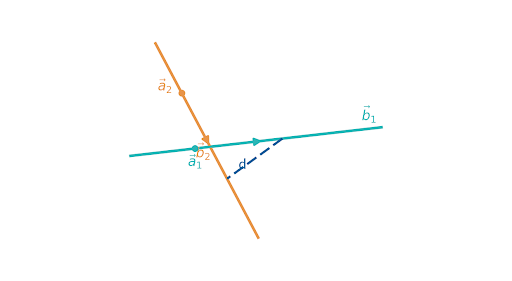
Figure 2: Two skew lines and the shortest distance between them
skew lines r = a1 + λb1 and r = a2 + μb2:
d = |(b1 × b2) · (a2 − a1)| ÷ |b1 × b2|
parallel lines r = a1 + λb and r = a2 + μb:
d = |b × (a2 − a1)| ÷ |b|
If two lines are not parallel and the shortest distance works out as zero, they are not skew at all: they intersect. That is worth stating in the answer, because it is the geometric meaning of the number rather than an extra step.
Putting an Equation into Standard Form
Before anything is read off a Cartesian equation, each of x, y, and z must appear with coefficient 1 and a plus sign, in the shape (x − x1)/a. Three rewrites cover almost every case in the exercise: (1 − x)/3 becomes (x − 1)/(−3); (7y − 14)/2p is 7(y − 2)/2p, which becomes (y − 2)/(2p/7); and (6 − z)/5 becomes (z − 6)/(−5). Doing this first turns the hardest-looking questions in Exercise 11.2 into routine ones, because the point and the direction ratios can then be read straight off.
Three Dimensional Class 12 NCERT Solutions
Q1. Ex 11.1 Q1: If a line makes angles 90°, 135° and 45° with the x, y and z axes respectively, find its direction cosines.
Step 1. The direction cosines are the cosines of those three angles, taken in the same order.
Step 2. l = cos 90° = 0.
Step 3. m = cos 135°. Since 135° = 180° − 45°, this is −cos 45° = −1/√2.
Step 4. n = cos 45° = 1/√2.
Step 5. Check: 0 + ½ + ½ = 1, as required.
Answer: 0, −1/√2 and 1/√2.
Remember: an obtuse angle gives a negative direction cosine. Dropping that minus sign points the line the other way.
Q2. Ex 11.1 Q2: Find the direction cosines of the line which makes equal angles with the coordinate axes.
Step 1. Let the common angle be α, so l = m = n = cos α.
Step 2. Substitute into l² + m² + n² = 1.
3 cos² α = 1, so cos² α = 1/3
Step 3. Taking the square root, cos α = ±1/√3.
Answer: ±1/√3, ±1/√3, ±1/√3, with the same sign throughout. The two sign choices are the same line described in opposite directions.
Remember: the identity l² + m² + n² = 1 is doing all the work here. It is the only equation available, so any question that gives no numbers at all is usually asking for it.
Q3. Ex 11.1 Q3: If a line has direction ratios −18, 12 and −4, what are its direction cosines?
Step 1. Direction ratios are only proportional to the direction cosines, so divide each by the square root of the sum of their squares.
√((−18)² + 12² + (−4)²) = √(324 + 144 + 16) = √484 = 22
Step 2. Divide each ratio by 22.
−18/22, 12/22, −4/22
Step 3. Reduce each fraction.
Answer: −9/11, 6/11 and −2/11.
Remember: the same line also has direction ratios −9, 6, −2 and 9, −6, 2. Ratios can be scaled freely; direction cosines cannot.
Q4. Ex 11.1 Q4: Show that the points (2, 3, 4), (−1, −2, 1) and (5, 8, 7) are collinear.
Step 1. Call the points A, B, and C, and subtract coordinates to get direction ratios.
AB: −3, −5, −3 BC: 6, 10, 6
Step 2. Compare the two sets. Each ratio of BC is −2 times the matching ratio of AB, so the two sets are proportional.
Step 3. Proportional direction ratios mean AB is parallel to BC. The two segments also share the point B, and two parallel lines through a common point are the same line.
Answer: the three points are collinear.
Remember: the shared point matters. Proportional direction ratios on their own only prove the segments are parallel, not that the points lie on one line.
Q5. Ex 11.1 Q5: Find the direction cosines of the sides of the triangle whose vertices are (3, 5, −4), (−1, 1, 2) and (−5, −5, −2).
Step 1. Call the vertices A, B and C and take the sides in order.
Step 2. For AB the direction ratios are −4, −4, 6, and √(16 + 16 + 36) = √68 = 2√17.
direction cosines of AB: −2/√17, −2/√17, 3/√17
Step 3. For BC the direction ratios are −4, −6, −4, and the square root is again √68 = 2√17.
direction cosines of BC: −2/√17, −3/√17, −2/√17
Step 4. For CA the direction ratios are 8, 10, −2, and √(64 + 100 + 4) = √168 = 2√42.
Direction cosines of CA: 4/√42, 5/√42, −1/√42
Answer: AB: −2/√17, −2/√17, 3/√17. BC: −2/√17, −3/√17, −2/√17. CA: 4/√42, 5/√42, −1/√42.
Remember: taking the sides the other way round, as AC instead of CA, reverses all three signs. Both answers describe the same side, so state which direction you took.
Q6. Ex 11.2 Q1: Show that the three lines with direction cosines 12/13, −3/13, −4/13; 4/13, 12/13, 3/13; and 3/13, −4/13, 12/13 are mutually perpendicular.
Step 1. Two lines are perpendicular when l1l2 + m1m2 + n1n2 = 0. Mutually perpendicular means this must hold for all three pairs.
Step 2. First and second:
(48 − 36 − 12)/169 = 0
Step 3. Second and third:
(12 − 48 + 36)/169 = 0
Step 4. First and third:
(36 + 12 − 48)/169 = 0
Answer: every pair gives zero, so the three lines are mutually perpendicular.
Remember: all three pairs have to be checked. Two out of three does not establish mutual perpendicularity, and the marking scheme expects to see each one.
Q7. Ex 11.2 Q2: Show that the line through the points (1, −1, 2) and (3, 4, −2) is perpendicular to the line through the points (0, 3, 2) and (3, 5, 6).
Step 1. Subtract to get the direction ratios of each line.
First line: 2, 5, −4 Second line: 3, 2, 4
Step 2. Apply the perpendicularity condition a1a2 + b1b2 + c1c2 = 0.
2(3) + 5(2) + (−4)(4) = 6 + 10 − 16 = 0
Answer: The sum is zero, so the two lines are perpendicular.
Q8. Ex 11.2 Q3: Show that the line through the points (4, 7, 8) and (2, 3, 4) is parallel to the line through the points (−1, −2, 1) and (1, 2, 5).
Step 1. Find the direction ratios of each line.
First line: −2, −4, −4 Second line: 2, 4, 4
Step 2. Parallel lines have proportional direction ratios, so test the three fractions.
−2/2 = −1, −4/4 = −1, −4/4 = −1
Step 3. All three give the same value.
Answer: The direction ratios are proportional, so the lines are parallel.
Remember: the common value being negative only means the two sets of ratios point opposite ways along the same direction. The lines are still parallel.
Q9. Ex 11.2 Q4: Find the equation of the line which passes through the point (1, 2, 3) and is parallel to the vector 3i + 2j − 2k.
Step 1. Write the position vector of the given point: a = i + 2j + 3k.
Step 2. The direction is the given vector: b = 3i + 2j − 2k.
Step 3. Substitute into r = a + λb.
Answer:r = (i + 2j + 3k) + λ(3i + 2j − 2k).
Remember: the point goes outside the bracket and the direction inside it. Swapping them describes a different line entirely.
Q10. Ex 11.2 Q5: Find the equation of the line in vector and in Cartesian form that passes through the point with position vector 2i − j + 4k and is in the direction i + 2j − k.
Step 1. Here a = 2i − j + 4k and b = i + 2j − k.
Step 2. The vector form follows at once.
r = (2i − j + 4k) + λ(i + 2j − k)
Step 3. For the Cartesian form, read the point as (2, −1, 4) and the direction ratios as 1, 2, −1, then substitute into (x − x1)/a = (y − y1)/b = (z − z1)/c.
Step 4. Note that y1 = −1 makes the numerator y + 1, not y − 1.
Answer: vector form r = (2i − j + 4k) + λ(i + 2j − k); Cartesian form (x − 2)/1 = (y + 1)/2 = (z − 4)/(−1).
Q11. Ex 11.2 Q6: Find the Cartesian equation of the line which passes through the point (−2, 4, −5) and is parallel to the line (x + 3)/3 = (y − 4)/5 = (z + 8)/6.
Step 1. Read the direction ratios of the given line from the three denominators: 3, 5, and 6.
Step 2. Parallel lines share a direction, so the required line has the same direction ratios.
Step 3. Substitute the new point (−2, 4, −5) into the standard form, taking care with the signs in the numerators.
Answer: (x + 2)/3 = (y − 4)/5 = (z + 5)/6.
Remember: only the numerators change. A question that says parallel is telling you to copy the denominators across unchanged.
Q12. Ex 11.2 Q7: The Cartesian equation of a line is (x − 5)/3 = (y + 4)/7 = (z − 6)/2. Write its vector form.
Step 1. Read the point from the numerators. Since y + 4 is y − (−4), the point is (5, −4, 6).
Step 2. Read the direction ratios from the denominators: 3, 7, and 2.
Step 3. Write the two as vectors and combine them.
a = 5i − 4j + 6k, b = 3i + 7j + 2k
Answer:r = (5i − 4j + 6k) + λ(3i + 7j + 2k).
Remember: the sign flips when the point is read off. A numerator of y + 4 gives −4 in the position vector, not +4.
Q13. Ex 11.2 Q8: Find the angle between the lines r = 2i − 5j + k + λ(3i + 2j + 6k) and r = 7i − 6k + μ(i + 2j + 2k).
Step 1. The angle between two lines is the angle between their direction vectors, so take b1 = 3i + 2j + 6k and b2 = i + 2j + 2k.
Step 2. Find the two magnitudes.
|b1| = √(9 + 4 + 36) = 7, |b2| = √(1 + 4 + 4) = 3
Step 3. Find the dot product.
b1 · b2 = 3 + 4 + 12 = 19
Step 4. Substitute into cos θ = |b1 · b2| ÷ (|b1| |b2|).
cos θ = 19/21
Answer: θ = cos−1(19/21).
Remember: the points 2i − 5j + k and 7i − 6k play no part here. Only the direction vectors decide the angle.
Q14. Ex 11.2 Q9: Find the angle between the lines x/2 = y/2 = z/1 and (x − 5)/4 = (y − 2)/1 = (z − 3)/8.
Step 1. Read the direction ratios from the denominators: 2, 2, 1 and 4, 1, 8.
Step 2. Find the two square roots.
√(4 + 4 + 1) = 3, √(16 + 1 + 64) = 9
Step 3. Find the sum of the products of matching ratios.
2(4) + 2(1) + 1(8) = 8 + 2 + 8 = 18
Step 4. Substitute into the angle formula and reduce.
cos θ = 18/27 = 2/3
Answer: θ = cos−1(2/3).
Q15. Ex 11.2 Q10: Find the value of p so that the lines (1 − x)/3 = (7y − 14)/2p = (z − 3)/2 and (7 − 7x)/3p = (y − 5)/1 = (6 − z)/5 are at right angles.
Step 1. Neither equation is in standard form, so rewrite both before reading anything off. In the first, (1 − x)/3 = (x − 1)/(−3), and (7y − 14)/2p = 7(y − 2)/2p = (y − 2)/(2p/7).
(x − 1)/(−3) = (y − 2)/(2p/7) = (z − 3)/2
Step 2. In the second, (7 − 7x)/3p = 7(1 − x)/3p = (x − 1)/(−3p/7), and (6 − z)/5 = (z − 6)/(−5).
(x − 1)/(−3p/7) = (y − 5)/1 = (z − 6)/(−5)
Step 3. The direction ratios are now −3, 2p/7, 2 and −3p/7, 1, −5.
Step 4. Right angles mean the sum of the products is zero.
(−3)(−3p/7) + (2p/7)(1) + 2(−5) = 0
Step 5. Simplify: 9p/7 + 2p/7 − 10 = 0, so 11p/7 = 10.
Answer: p = 70/11.
Remember: every sign in this answer comes from Step 1 and Step 2. Reading the ratios off the printed form gives 3 instead of −3, and the equation then solves to the wrong value.
Q16. Ex 11.2 Q11: Show that the lines (x − 5)/7 = (y + 2)/(−5) = z/1 and x/1 = y/2 = z/3 are perpendicular to each other.
Step 1. Read the direction ratios: 7, −5, 1 and 1, 2, 3.
Step 2. Form the sum of the products of matching ratios.
7(1) + (−5)(2) + 1(3) = 7 − 10 + 3 = 0
Answer: The sum is zero, so the two lines are perpendicular.
Remember: perpendicular here does not mean the lines meet. Two skew lines can be perpendicular in direction without ever touching.
Q17. Ex 11.2 Q12: Find the shortest distance between the lines r = i + 2j + k + λ(i − j + k) and r = 2i − j − k + μ(2i + j + 2k).
Step 1. Read off the four vectors.
a1 = i + 2j + k, b1 = i − j + k
a2 = 2i − j − k, b2 = 2i + j + 2k
Step 2. Find the cross product of the two directions.
b1 × b2 = −3i + 3k, so |b1 × b2| = √(9 + 9) = 3√2
Step 3. Find the vector joining the two given points.
a2 − a1 = i − 3j − 2k
Step 4. Take the dot product of the two results.
(−3)(1) + 0(−3) + 3(−2) = −9
Step 5. Divide, and take the modulus because a distance cannot be negative.
d = 9 ÷ 3√2 = 3/√2
Answer: 3/√2 units, which is the same as 3√2/2 units.
Q18. Ex 11.2 Q13: Find the shortest distance between the lines (x + 1)/7 = (y + 1)/(−6) = (z + 1)/1 and (x − 3)/1 = (y − 5)/(−2) = (z − 7)/1.
Step 1. Read off the two points and the two sets of direction ratios. The points are (−1, −1, −1) and (3, 5, 7), and the ratios are 7, −6, 1 and 1, −2, 1.
Step 2. The vector joining the points is 4, 6, 8.
Step 3. Take the cross product of the two direction vectors.
−4i − 6j − 8k, with magnitude √(16 + 36 + 64) = √116 = 2√29
Step 4. Take its dot product with the joining vector.
4(−4) + 6(−6) + 8(−8) = −16 − 36 − 64 = −116
Step 5. Divide and take the modulus.
d = 116 ÷ 2√29 = 58/√29 = 2√29
Answer: 2√29 units.
Remember: the same working in determinant form uses the joining vector as the top row and the two sets of direction ratios below it. It is the same calculation written more compactly.
Q19. Miscellaneous Q1: Find the angle between the lines whose direction ratios are a, b, c and b − c, c − a, a − b.
Step 1. Form the sum of the products of matching ratios, which is the numerator of the angle formula.
a(b − c) + b(c − a) + c(a − b)
Step 2. Expand every bracket.
ab − ac + bc − ab + ca − cb
Step 3. The six terms cancel in pairs, so the sum is 0.
Step 4. A zero numerator makes cos θ = 0.
Answer: θ = 90°, so the two lines are perpendicular, whatever a, b and c are.
Remember: no arithmetic is needed once the expansion is written out. Questions given in letters rather than numbers are usually testing that the cancellation is spotted.
Q20. Miscellaneous Q5: Find the vector equation of the line passing through the point (1, 2, −4) and perpendicular to the two lines (x − 8)/3 = (y + 19)/(−16) = (z − 10)/7 and (x − 15)/3 = (y − 29)/8 = (z − 5)/(−5).
Step 1. Let the required direction ratios be b1, b2, b3. Perpendicular to each given line gives one equation each.
3b1 − 16b2 + 7b3 = 0
3b1 + 8b2 − 5b3 = 0
Step 2. Solving the pair by cross-multiplication gives b1 : b2 : b3 = 24 : 36 : 72, which reduces to 2 : 3 : 6.
Step 3. The same direction can be found in one step as the cross product of 3i − 16j + 7k and 3i + 8j − 5k, which is 24i + 36j + 72k.
Step 4. Take the point (1, 2, −4) as a and 2i + 3j + 6k as the direction.
Answer:r = (i + 2j − 4k) + λ(2i + 3j + 6k).
Remember: a direction perpendicular to two given directions is exactly what a cross product produces, so Chapter 10 shortens this question to two lines of work.
Key Features of Infinity Learn NCERT Solutions for Class 12 Math Chapter 11
- Covers 20 selected questions from Exercise 11.1, Exercise 11.2, and the Miscellaneous Exercise.
- Each question is mapped to the concept it tests, so revision can be targeted.
- Every solution is broken into clear steps with the reason given at each stage.
- Equations printed in non-standard form are rewritten first, in a separate step, because that is where the marks are lost.
- Includes the full formula set for direction cosines, the equation of a line, the angle between two lines, and the shortest distance.
- Prepared in line with the current rationalized NCERT textbook, in which planes are no longer part of this chapter.
Why Use NCERT Solutions for Three Dimensional Geometry?
This chapter asks students to hold a picture in mind that cannot be drawn accurately on paper, which is why the algebra has to be trusted instead. The safeguard is a method: put every equation into standard form, write down the point and the direction before anything else, then choose the formula. Students can use these solutions to:
- Move confidently between angles, direction cosines and direction ratios.
- Read a point and a direction off any equation of a line, in either form.
- Convert a line from vector form to Cartesian form and back again.
- Find the angle between two lines, and test a pair for parallelism or perpendicularity.
- Tell skew lines from parallel lines and apply the right distance formula to each.
- Handle equations printed with a negative or a multiplied variable, as in Question 15 above.
Conclusion
Three Dimensional Geometry rewards one habit above all others: writing every line in the same standard shape before doing anything with it. Once a question has been reduced to a point and a set of direction ratios, the rest of the chapter is a short list of formulas that are applied in the same order every time. The questions that look hardest are almost always ordinary questions printed in an awkward form.
Work through the 20 questions above, cover each solution and rebuild the steps from memory, including the rewriting step. Once lines in space feel familiar, move on to Chapter 12, Linear Programming, the shortest unit in the syllabus.
Study Class 12 Math with Infinity Learn
Infinity Learn provides NCERT Solutions for every chapter of the current Class 12 Math syllabus, with step-by-step working, proofs written in the order the CBSE marking scheme expects, and clear labeling of the topics removed in the rationalization, so no time is spent on material that is no longer examined. Practice chapter by chapter, check your method against the worked solutions, and revise the key results before your board examination. Start with the questions on this page, then continue through the rest of the syllabus with Infinity Learn.
course
No courses found
FAQs on NCERT Solutions for Class 12 Math Chapter 11 Three-Dimensional Geometry
How many exercises are there in NCERT Class 12 Math Chapter 11?
The rationalized textbook has two numbered exercises and a miscellaneous exercise. Exercise 11.1 has 5 questions, Exercise 11.2 has 15 questions, and the Miscellaneous Exercise has 5 questions.
Q2. What is the difference between direction cosines and direction ratios?
Direction cosines are the cosines of the angles the line makes with the three axes, and they always satisfy l² + m² + n² = 1. Direction ratios are any three numbers in the same proportion as those cosines. A line therefore has only one set of direction cosines for each of its two directions, but endlessly many sets of direction ratios.
Are planes still part of Class 12 Math Chapter 11?
No. In the rationalized textbook, the chapter covers direction cosines, the equation of a line in space, the angle between two lines, and the shortest distance between two lines. The sections on the equation of a plane, the angle between two planes, coplanarity, and the distance of a point from a plane have been removed.
What are skew lines, and how is the shortest distance between them found?
Skew lines are lines in space that are neither parallel nor intersecting, so no single plane contains both. The shortest distance is measured along the common perpendicular and is found by taking the cross product of the two direction vectors, taking its dot product with the vector joining a point on each line, and dividing by the magnitude of the cross product.
How do I convert a line from Cartesian form into vector form?
Read the point from the numerators, remembering that x + 3 means x1 = −3, and read the direction ratios from the denominators. The point becomes a, the direction ratios become b, and the equation is r = a + λb.
What do I do with an equation like (1 − x)/3 = (7y − 14)/2p?
Rewrite it before using it. Each variable must appear with coefficient 1 and a plus sign, so (1 − x)/3 becomes (x − 1)/(−3), and (7y − 14)/2p becomes (y − 2)/(2p/7). Only then are the direction ratios safe to read off, as in Question 15 above.
Q8. How many marks does Chapter 11 carry in the CBSE Class 12 Math examination?
Chapter 11 sits in Unit IV, Vectors and Three Dimensional Geometry, together with Chapter 10. The unit carries 14 marks in the theory paper. The syllabus does not give a separate figure for Chapter 11 on its own.
