- Key Concepts Covered in Class 12 Math Chapter 12 – Linear Programming
- The Language of a Linear Programming Problem
- The Corner Point Method
- Bounded and Unbounded Regions
- When the Answer Is Not a Single Point
- Reading a Word Problem into a Linear Programming Problem
- Step-by-Step NCERT Solutions for Chapter 12 Linear Programming
- Key Features of Infinity Learn NCERT Solutions for Class 12 Math Chapter 12
- Why Use NCERT Solutions for Linear Programming?
- Study Class 12 Maths with Infinity Learn
- FAQs: NCERT Solutions for Class 12 Linear Programming
NCERT Solutions for Class 12 Math Chapter 12 Linear Programming
By Rohit RP
|
Updated on 17 Sep 2026, 10:52 IST
Linear Programming brings mathematics closer to real-world decision-making by showing how limited resources can be used to achieve the best possible result. Class 12 Math Chapter 12 introduces linear programming problems, objective functions, constraints, feasible regions, and graphical methods for optimization.
NCERT Solutions for Class 12 Math Chapter 12 Linear Programming help students understand how a word problem is converted into mathematical inequalities and represented on a graph. The solutions explain how feasible regions are identified and how maximum or minimum values are determined at corner points.
Key Concepts Covered in Class 12 Math Chapter 12 – Linear Programming
The chapter covers the following important concepts:
- What a linear programming problem is, and the kind of question it answers
- Decision variables, the objective function, and the constraints
- The non-negative constraints x ≥ 0 and y ≥ 0, and why they are always there
- Drawing a linear inequality and deciding which side of the line to shade
- The feasible region, feasible solutions, and the optimal solution
- Bounded and unbounded feasible regions
- Corner points, and the theorem that puts the optimal value at one of them
- The corner point method, applied in a fixed order
- The extra test an unbounded region needs before a maximum or a minimum can be claimed
- Problems whose optimal value is attained at every point of a line segment
- Problems with no feasible region at all
- Turning a word problem into an objective function and a set of constraints
The Language of a Linear Programming Problem
| Term | What it means |
| Decision variables | The quantities being chosen, usually x and y. In a word problem, they must be defined in words, with units, before anything else. |
| Objective function | The linear expression Z = ax + by that is to be made as large or as small as possible. |
| Constraints | The linear inequalities the variables have to satisfy. |
| Non-negative constraints | x ≥ 0 and y ≥ 0. They are part of nearly every problem, and they are what keeps the region in the first quadrant. |
| Feasible region | The set of points satisfying every constraint at the same time, so the part of the plane common to all the shadings. |
| Feasible solution | Any point of the feasible region. |
| Optimal solution | A feasible point at which Z takes its maximum or its minimum value. |
| Corner point | A vertex of the feasible region, found where two boundary lines meet. |
The Corner Point Method
The optimal value of Z, when it exists, is always attained at a corner point of the feasible region. That single fact turns a search over infinitely many points into a short table. The working always runs in the same order.
- Draw each constraint as a line, and shade the correct side using a test point. The origin is the quickest test whenever the line does not pass through it.
- The feasible region is the part common to every shading, together with x ≥ 0 and y ≥ 0.
- List every corner point, solving two equations simultaneously wherever two lines meet.
- Work out the value of Z at each corner and set the results out in a table.
- If the region is bounded, the largest value in the table is the maximum and the smallest is the minimum.
- If the region is unbounded, those values are candidates only, and each one must be tested before it can be claimed.
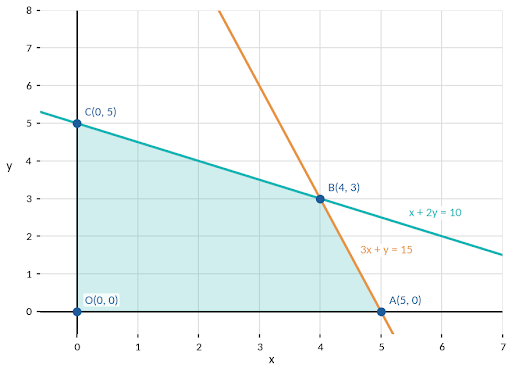
Figure 1: A bounded feasible region with its four corner points
Bounded and Unbounded Regions
A feasible region is bounded when it can be enclosed in a circle, and unbounded when it stretches away without limit. The difference decides how much work the question needs.
| Bounded region | Unbounded region | |
| Maximum of Z | always exists | exists only if the test below is passed |
| Minimum of Z | always exists | exists only if the test below is passed |
| Where it is found | at a corner point | at a corner point, when it exists |
M is the maximum only if ax + by > M has no point in common with the feasible region
m is the minimum only if ax + by < m has no point in common with the feasible region

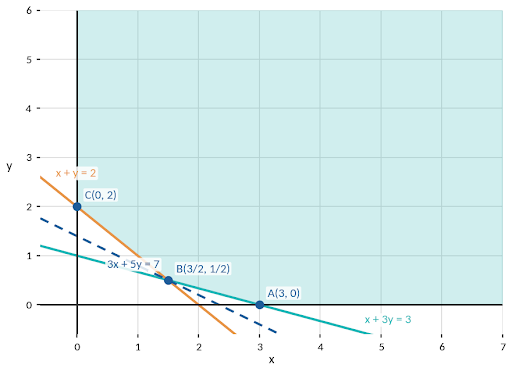
Figure 2: An unbounded region, with the dashed test line 3x + 5y = 7
In Figure 2, the smallest corner value is 7, and the open half-plane 3x + 5y < 7 lies entirely below the region, sharing no point with it. That is what confirms 7 as the minimum. Had the two overlapped, there would have been no minimum at all.
Best Courses for You

JEE

NEET

Foundation JEE

Foundation NEET

CBSE
When the Answer Is Not a Single Point
Two situations look like mistakes the first time they appear, and both are ordinary. If two corner points give the same optimal value, then every point on the segment joining them gives that value too, so the answer names the segment rather than one point. And if the constraints contradict one another, the feasible region is empty, there are no feasible solutions, and the problem has no maximum and no minimum.
Reading a Word Problem into a Linear Programming Problem
The application questions in the Miscellaneous Exercise are ordinary corner point questions once they have been translated, and the translation follows a fixed order. Decide what is being chosen and call those quantities x and y, stating what each one means and in what units. Write the quantity to be made largest or smallest as Z = ax + by. Turn each limit in the problem, on material, time, money, or space, into one inequality. Add x ≥ 0 and y ≥ 0, since a negative number of items means nothing. From there, the graph and the corner point table finish the question.
Step-by-Step NCERT Solutions for Chapter 12 Linear Programming
Q1. Ex 12.1 Q1: Maximize Z = 3x + 4y subject to x + y ≤ 4, x ≥ 0, y ≥ 0.
Step 1. Draw the line x + y = 4. Testing the origin gives 0 ≤ 4, which is true, so the shading is on the origin side.
Step 2. With x ≥ 0 and y ≥ 0, the feasible region is the triangle shown, and it is bounded.
Step 3. The corner points are O(0, 0), A(4, 0) and B(0, 4).
Step 4. Work out Z = 3x + 4y at each corner.
O(0, 0): Z = 0 A(4, 0): Z = 12 B(0, 4): Z = 16
Step 5. The region is bounded, so the largest of these values is the maximum.
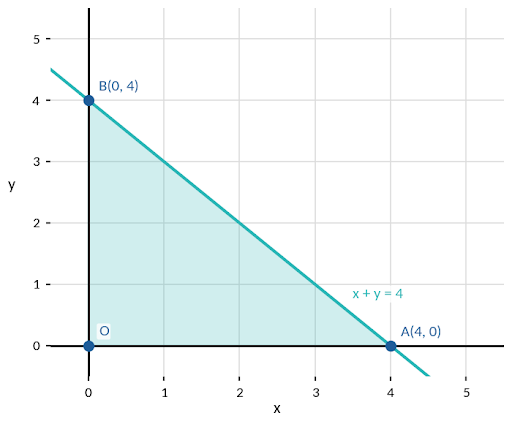
Feasible region for Question 1
Answer: the maximum value of Z is 16, at the point (0, 4).
Remember: the origin is the quickest test point for deciding which side to shade, and it works for every line that does not pass through it.
Q2. Ex 12.1 Q2: Minimize Z = −3x + 4y subject to x + 2y ≤ 8, 3x + 2y ≤ 12, x ≥ 0, y ≥ 0.
Step 1. Both inequalities are satisfied at the origin, so both are shaded toward it. With the two axes, the feasible region is the bounded quadrilateral shown.
Step 2. Three corners can be read off the axes: O(0, 0), A(4, 0) and C(0, 4). The fourth is where the two lines cross.
Step 3. Subtract x + 2y = 8 from 3x + 2y = 12.
2x = 4, so x = 2 and then y = 3, giving B(2, 3)
Step 4. Work out Z = −3x + 4y at each corner.
O: Z = 0 A(4, 0): Z = −12 B(2, 3): Z = 6 C(0, 4): Z = 16
Step 5. The region is bounded, so the smallest value is the minimum.
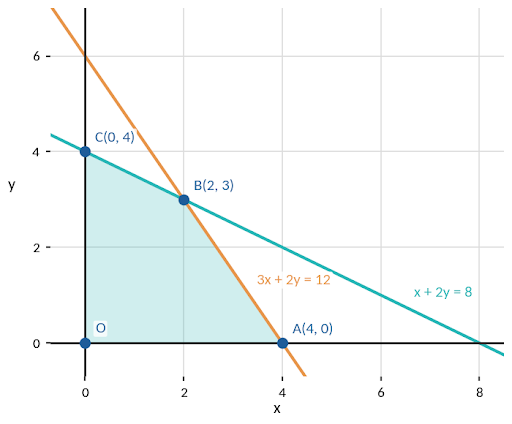
Feasible region for Question 2
Answer: the minimum value of Z is −12, at the point (4, 0).
Remember: a negative coefficient on x pushes the minimum toward large x, not toward the origin. Never assume where the answer will be; evaluate every corner.
Q3. Ex 12.1 Q3: Maximize Z = 5x + 3y subject to 3x + 5y ≤ 15, 5x + 2y ≤ 10, x ≥ 0, y ≥ 0.
Step 1. Both lines are shaded toward the origin, so the feasible region is bounded.
Step 2. The corners on the axes are O(0, 0), A(2, 0) and B(0, 3).
Step 3. For the fourth corner solve 3x + 5y = 15 and 5x + 2y = 10 together. Multiplying the first by 2 and the second by 5 gives 6x + 10y = 30 and 25x + 10y = 50.
19x = 20, so x = 20/19 and y = 45/19
Step 4. Work out Z = 5x + 3y at each corner.
O: Z = 0 A(2, 0): Z = 10 B(0, 3): Z = 9 C(20/19, 45/19): Z = 235/19
Step 5. Since 235/19 is about 12.4, it is the largest of the four.
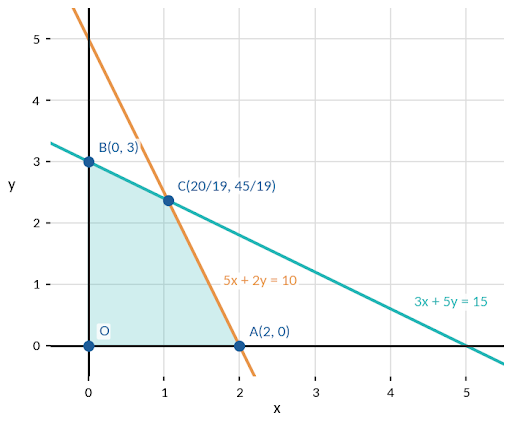
Feasible region for Question 3
Answer: the maximum value of Z is 235/19, at the point (20/19, 45/19).
Remember: corner points with fractional coordinates are perfectly normal. Leave them as fractions; rounding them changes the value of Z and costs the mark.
Q4. Ex 12.1 Q4: Minimize Z = 3x + 5y such that x + 3y ≥ 3, x + y ≥ 2, x, y ≥ 0.
Step 1. Both inequalities are false at the origin, so both are shaded away from it. The feasible region stretches upwards and to the right without limit, so it is unbounded.
Step 2. The corners are A(3, 0), C(0, 2), and the point where the two lines meet.
Step 3. Subtract x + y = 2 from x + 3y = 3.
2y = 1, so y = 1/2 and x = 3/2, giving B(3/2, 1/2)
Step 4. Work out Z = 3x + 5y at each corner.
A(3, 0): Z = 9 B(3/2, 1/2): Z = 7 C(0, 2): Z = 10
Step 5. The smallest value is 7, but the region is unbounded, so this is only a candidate. Draw 3x + 5y = 7 as a dashed line and look at the open half-plane 3x + 5y < 7.
Step 6. That half-plane has no points in common with the feasible region, which confirms the candidate.
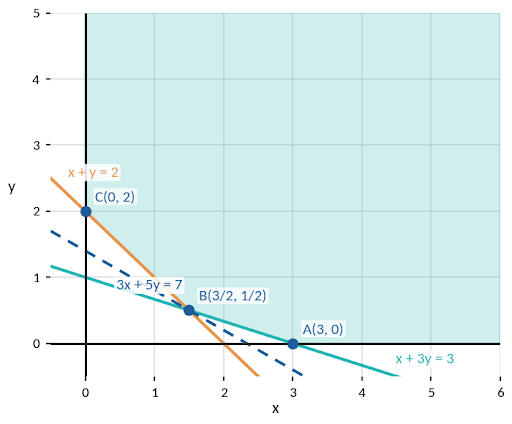
Unbounded region for Question 4, with the test line 3x + 5y = 7
Answer: the minimum value of Z is 7, at the point (3/2, 1/2).
Remember: the test in Step 5 and Step 6 is part of the answer for every unbounded region. Without it, the corner table proves nothing.
Q5. Ex 12.1 Q5: Maximize Z = 3x + 2y subject to x + 2y ≤ 10, 3x + y ≤ 15, x, y ≥ 0.
Step 1. Both lines are shaded toward the origin, giving a bounded region with four corners.
Step 2. Three of them are O(0, 0), A(5, 0) and C(0, 5).
Step 3. For the fourth, substitute y = 15 − 3x from the second line into the first.
x + 2(15 − 3x) = 10, so −5x = −20, x = 4 and y = 3
Step 4. Work out Z = 3x + 2y at each corner.
O: Z = 0 A(5, 0): Z = 15 B(4, 3): Z = 18 C(0, 5): Z = 10
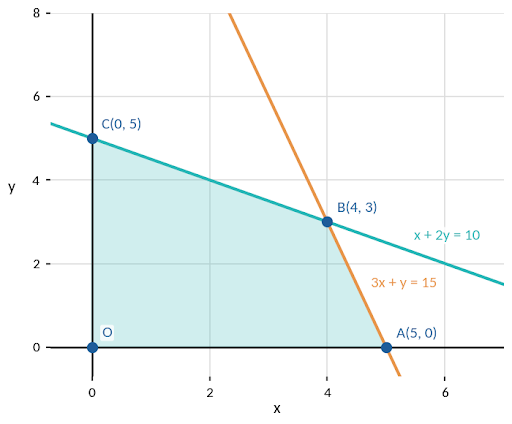
Feasible region for Question 5
Answer: The maximum value of Z is 18, at the point (4, 3).
Remember: substitution is quicker than elimination when one equation already has a coefficient of 1, as 3x + y = 15 does here.
Q6. Ex 12.1 Q6: Minimize Z = x + 2y subject to 2x + y ≥ 3, x + 2y ≥ 6, x, y ≥ 0.
Step 1. Both inequalities exclude the origin, so the feasible region lies away from it and is unbounded.
Step 2. The corner points are A(6, 0) and B(0, 3).
Step 3. Work out Z = x + 2y at each.
A(6, 0): Z = 6 B(0, 3): Z = 6
Step 4. The region is unbounded, so test the open half-plane x + 2y < 6. It has no points in common with the feasible region, because every feasible point satisfies x + 2y ≥ 6. So 6 is the minimum.
Step 5. The two corners give the same value, so every point on the segment joining them gives it too. The point (2, 2) lies on that segment, and indeed Z = 2 + 4 = 6 there.
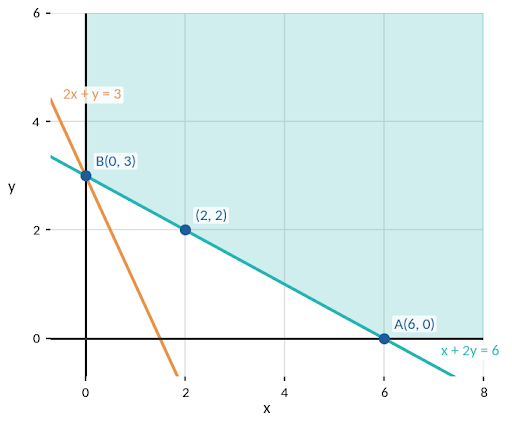
Unbounded region for Question 6
Answer: the minimum value of Z is 6, attained at every point of the line x + 2y = 6 lying in the feasible region, that is, on the whole segment joining (0, 3) and (6, 0).
Remember: equal values at two corners are not a sign of an error. It means the objective line is parallel to that edge, so the whole edge is optimal.
Q7. Ex 12.1 Q7: Minimize and maximize Z = 5x + 10y subject to x + 2y ≤ 120, x + y ≥ 60, x − 2y ≥ 0, x, y ≥ 0.
Step 1. Shade each constraint in turn. The result is a bounded region with four corners, so both a maximum and a minimum must exist.
Step 2. Two corners lie on the x axis: A(60, 0) from x + y = 60 and B(120, 0) from x + 2y = 120.
Step 3. For C, solve x + 2y = 120 with x = 2y, giving 4y = 120, so y = 30 and x = 60. For D, solve x + y = 60 with x = 2y, giving 3y = 60, so y = 20 and x = 40.
Step 4. Work out Z = 5x + 10y at each corner.
A(60, 0): Z = 300 B(120, 0): Z = 600 C(60, 30): Z = 600 D(40, 20): Z = 400
Step 5. The smallest value is 300, and the largest is 600, and 600 occurs at two corners.
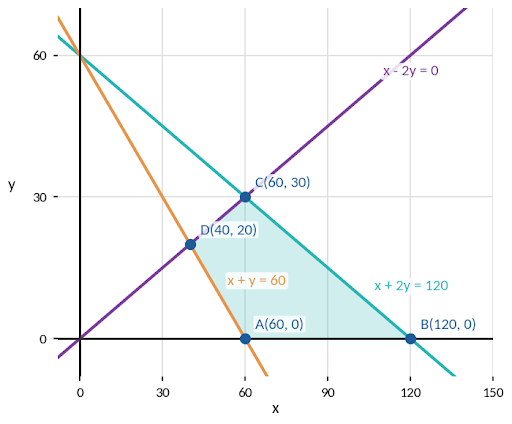
Feasible region for Question 7
Answer: the minimum value of Z is 300, at (60, 0). The maximum value is 600, attained at every point of the segment joining (120, 0) and (60, 30).
Remember: when a question asks for both, the same table answers both. There is no need to redraw anything.
Q8. Ex 12.1 Q8: Minimize and maximize Z = x + 2y subject to x + 2y ≥ 100, 2x − y ≤ 0, 2x + y ≤ 200, x, y ≥ 0.
Step 1. The three constraints cut out a bounded region with four corners, shown below.
Step 2. Two corners lie on the y axis: A(0, 50) from x + 2y = 100 and D(0, 200) from 2x + y = 200.
Step 3. For B, solve x + 2y = 100 with y = 2x, giving 5x = 100, so x = 20 and y = 40. For C, solve 2x + y = 200 with y = 2x, giving 4x = 200, so x = 50 and y = 100.
Step 4. Work out Z = x + 2y at each corner.
A(0, 50): Z = 100 B(20, 40): Z = 100 C(50, 100): Z = 250 D(0, 200): Z = 400
Step 5. The largest value is 400 at a single corner. The smallest is 100, and it occurs at two corners, so the whole edge between them is optimal.
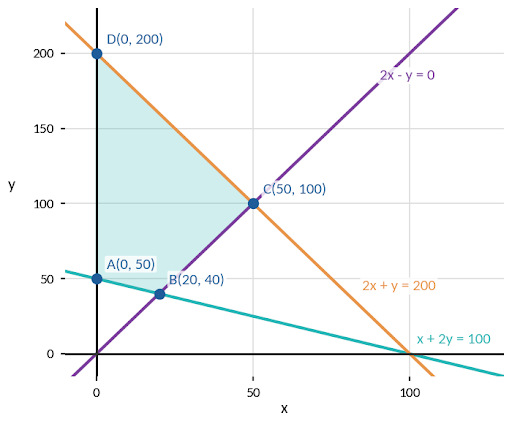
Feasible region for Question 8
Answer: the maximum value of Z is 400, at (0, 200). The minimum value is 100, attained at every point of the segment joining (0, 50) and (20, 40).
Remember: the objective function here is x + 2y, and one of the constraints is x + 2y ≥ 100. Whenever the objective matches the edge it sits on, expect a whole segment of optimal points.
Q9. Ex 12.1 Q9: Maximize Z = −x + 2y subject to x ≥ 3, x + y ≥ 5, x + 2y ≥ 6, y ≥ 0.
Step 1. Each constraint excludes the origin, so the feasible region lies to the right and above, and it is unbounded.
Step 2. The corner points are A(6, 0) from x + 2y = 6 on the x axis, B(4, 1) where x + y = 5 meets x + 2y = 6, and C(3, 2) where x = 3 meets x + y = 5.
Step 3. Work out Z = −x + 2y at each corner.
A(6, 0): Z = −6 B(4, 1): Z = −2 C(3, 2): Z = 1
Step 4. The largest value is 1, but the region is unbounded, so test the open half-plane −x + 2y > 1.
Step 5. That half-plane does have points in common with the feasible region, for example (3, 4), where −x + 2y = 5. So values larger than 1 are attainable, and 1 is not the maximum.
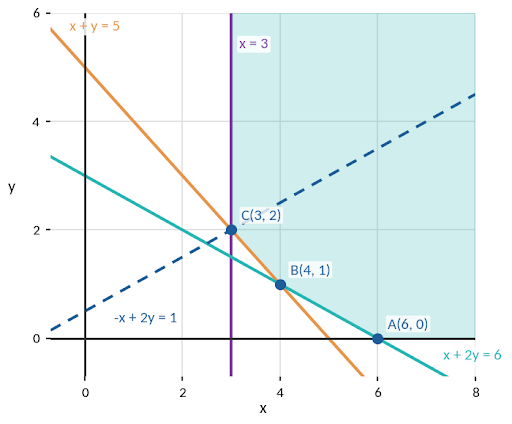
Unbounded region for Question 9, with the test line -x + 2y = 1
Answer: Z has no maximum value.
Remember: this is the case Question 4 was preparing you for. The same test gives the opposite verdict, and no maximum is a complete and correct answer.
Q10. Ex 12.1 Q10: Maximize Z = x + y subject to x − y ≤ −1, −x + y ≤ 0, x, y ≥ 0.
Step 1. Rewrite each constraint so the shading is easy to see. The first gives y ≥ x + 1 and the second gives y ≤ x.
Step 2. The first asks for points above the line y = x + 1, and the second for points on or below the line y = x. Since x + 1 is always greater than x, no point can satisfy both.
Step 3. The graph shows the same thing: the two shaded regions never meet, so there is no feasible region.
The two constraints in Question 10 never overlap
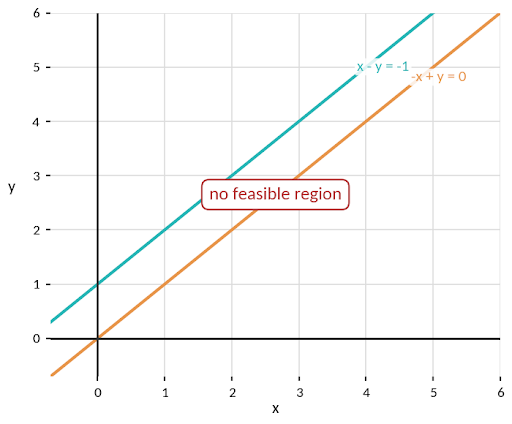
Answer: there is no feasible region, so Z has no maximum value.
Remember: an empty feasible region is a legitimate answer, not a sign that the graph was drawn wrongly. Say plainly that no feasible solution exists.
Key Features of Infinity Learn NCERT Solutions for Class 12 Math Chapter 12
- Covers all 10 questions of Exercise 12.1, the only numbered exercise in the rationalized chapter.
- A graph of the feasible region is given with every question, with the corner points marked.
- Each question is mapped to the situation it tests, from a simple bounded region to an empty one.
- The open half-plane test for unbounded regions is shown in full, both when it confirms an answer and when it rules one out.
- Includes the terminology table and the corner point method that every question relies on.
- Prepared in line with the current rationalized NCERT textbook.
Common Mistakes to Avoid in Linear Programming
While solving Linear Programming problems, students should carefully identify the correct feasible region and all its corner points. Shading the wrong side of a constraint can change the feasible region and lead to an incorrect answer.
After finding the feasible region, calculate the value of the objective function (Z) at each relevant corner point. If the feasible region is unbounded, check whether the objective function has a maximum or minimum value under the given constraints.
In the final answer, clearly state both the optimal value of (Z) and the point at which it occurs, whenever the question asks for them.
Why Use NCERT Solutions for Linear Programming?
Linear Programming becomes easier when each problem is solved in a clear order. Students need to form the objective function and constraints correctly, draw the corresponding lines, identify the feasible region and then evaluate the objective function at the relevant corner points.
These NCERT Solutions can help students:
- Identify the objective function and constraints correctly.
- Draw the boundary lines for each inequality.
- Use a test point to determine the required half-plane.
- Identify the feasible region accurately.
- Find all relevant corner points of the feasible region.
- Calculate the value of the objective function at each corner point.
- Distinguish between bounded and unbounded feasible regions.
- Identify the maximum or minimum value required in the question.
Following the same sequence in every problem reduces calculation and graphing errors and makes the corner-point method easier to apply.
Linear Programming questions are mainly about applying the correct method carefully. Start by defining the variables, write the objective function and constraints, draw the graph and identify the feasible region. Once the corner points are known, calculate the value of the objective function at each point and state the required maximum or minimum value clearly.
Practising the NCERT questions in this chapter will help students become more confident with graphs, inequalities, feasible regions and the corner-point method. After completing Linear Programming, students can continue with the next chapter, Probability.
Study Class 12 Maths with Infinity Learn
Infinity Learn provides NCERT Solutions for Class 12 Maths with step-by-step solutions for every chapter. The solutions explain the method used in each question so that students can understand the concept as well as the final answer.
Students can use the chapter-wise solutions to practise NCERT questions, compare their working with the solved steps and revise important concepts before school and board examinations. After completing the Linear Programming questions on this page, students can continue with the remaining Class 12 Maths chapters on Infinity Learn.
course
No courses found
FAQs: NCERT Solutions for Class 12 Linear Programming
How many exercises are there in NCERT Class 12 Math Chapter 12?
The rationalized textbook has Exercise 12.1, which contains 10 questions, together with a Miscellaneous Exercise made up of application problems. The section on different types of linear programming problems was removed in the rationalization.
What is a feasible region?
It is the set of all points that satisfy every constraint at the same time, including x ≥ 0 and y ≥ 0. On the graph, it is the part of the plane common to all the shadings. Any point in it is a feasible solution, and the optimal solution is always one of them.
Why does the corner point method only look at corners?
Because a linear objective function takes its largest and smallest values on a polygonal region at a vertex. Moving along an edge changes Z steadily in one direction, so the extreme values are pushed to the ends of the edge, which are the corner points.
What do I do when the feasible region is unbounded?
Find the corner values as usual, then test the candidate. For a claimed maximum M, check whether ax + by > M has any point in common with the feasible region; for a claimed minimum m, check ax + by < m. If there is no common point, the value stands, and if there is, no maximum or minimum exists.
What does it mean if two corner points give the same value of Z?
It means the objective line is parallel to the edge joining them, so every point on that edge gives the same value. The problem then has infinitely many optimal solutions, and the answer should name the segment rather than a single point, as in Questions 6, 7, and 8 above.
What if there is no feasible region at all?
Then the constraints contradict one another, and the problem has no feasible solution, so there is no maximum and no minimum. Question 10 above is exactly this case, and saying so clearly is the full answer.
How many marks does Chapter 12 carry in the CBSE Class 12 Math examination?
Linear Programming is Unit VI of the syllabus, and the unit consists of this chapter alone. It carries 5 marks in the theory paper.
