- Key Concepts Covered in Class 12 Math Chapter 10 – Vector Algebra
- Chapter Overview and Important Results
- Selected NCERT Exercises: Class 12 Math Chapter 10
- Class 12 Maths Chapter 10 Exercise Solutions
- Key Features of Infinity Learn NCERT Solutions for Class 12 Math Chapter 10
- Why Use NCERT Solutions for Vector Algebra?
- FAQs on NCERT Solutions for Class 12 Math Chapter 10
NCERT Solutions for Class 12 Math Chapter 10 Vector Algebra
By Karan singh ildefaultfield
|
Updated on 15 Sep 2026, 12:58 IST
Vector Algebra introduces mathematical quantities that have both magnitude and direction, making it an important chapter for geometry, physics, and higher mathematics. Class 12 Math Chapter 10 covers vectors, direction cosines, different types of vectors, addition, scalar multiplication, dot product, and cross product. NCERT Solutions for Class 12 Math Chapter 10 Vector Algebra provide step-by-step methods for solving the textbook exercises and understanding how vector operations work. These NCERT Solutions can help students visualize directions, apply formulas correctly, and avoid common sign mistakes. Regular practice with NCERT questions also makes it easier to distinguish between scalar and vector products. A clear understanding of this chapter is helpful before moving to Three-Dimensional Geometry.
Key Concepts Covered in Class 12 Math Chapter 10 – Vector Algebra
The chapter covers the following important concepts:
- The difference between a scalar and a vector, and how to tell one from the other
- Types of vectors: zero, unit, equal, collinear, co-initial, and negative
- Position vectors, and the direction cosines and direction ratios of a vector
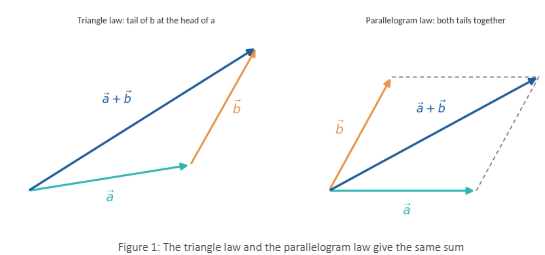
- Adding vectors by the triangle law and by the parallelogram law
- Multiplying a vector by a scalar, and what a negative scalar does to the direction
- Writing a vector in component form along the unit vectors i, j and k
- The magnitude of a vector and the unit vector in its direction
- The section formula for internal and external division
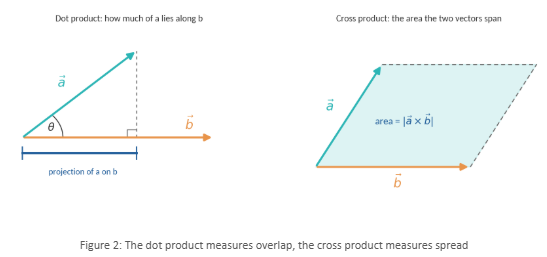
- The scalar (dot) product, the angle between two vectors and the projection of one vector on another
- The vector (cross) product, and a unit vector perpendicular to two given vectors
- Areas of triangles and parallelograms found from a cross product
- The test for perpendicular vectors and the test for parallel vectors
A note on notation. The textbook draws a small arrow above every vector. On this page, vectors are printed in bold instead, so a means the vector and |a| means its magnitude. The figures keep the arrow notation used in the textbook.
Chapter Overview and Important Results
A scalar is fixed by a single number together with its unit. A vector needs a direction as well, and that one extra requirement shapes every rule in the chapter. Two habits account for most of the marks lost here. The first is answering with the wrong kind of quantity: the dot product of two vectors is a number, the cross product is a vector, and the two can never be swapped. The second is forgetting to divide by the magnitude when a unit vector is asked for. Neither is a calculation error, and both disappear if the question is read once more before the final line is written.
Types of Vector
| Term | What it means |
| Zero vector | Magnitude 0 with no definite direction, written 0. It is the result of adding the sides of a closed figure taken in order. |
| Unit vector | A vector of magnitude 1. The unit vector along a is a divided by |a|, and the textbook writes it with a small hat above the letter. |
| Position vector | The vector from the origin O to a point P, written OP. Its components are the coordinates of P. |
| Equal vectors | Same magnitude and same direction, wherever in space they happen to be drawn. |
| Collinear or parallel vectors | Parallel to one and the same line, so b = λa for some scalar λ. They may point the same way or opposite ways. |
| Co-initial vectors | Two or more vectors drawn from the same starting point. |
| Negative of a vector | Same magnitude as a but the opposite direction, written −a. |
Adding Vectors
Two vectors are added by placing the tail of the second at the head of the first. The sum is then the vector running from the first tail to the last head. Drawing both from the same point gives exactly the same answer as the diagonal of the parallelogram they form, so the triangle law and the parallelogram law are two views of one rule. Taken in order, the three sides of a triangle add to the zero vector, and several objective questions in the chapter are that single fact in disguise.
Components, Magnitude and Direction Cosines
a = a1i + a2j + a3k |a| = √(a1² + a2² + a3²)
unit vector along a = a ÷ |a| vector of magnitude m along a = m × (a ÷ |a|)

direction cosines: l = a1 ÷ |a|, m = a2 ÷ |a|, n = a3 ÷ |a|
l² + m² + n² = 1
The direction cosines are the cosines of the angles the vector makes with the three axes, and they are simply the components of the unit vector along it. Direction ratios are any three numbers in the same proportion as the components, so a vector has one set of direction cosines but any number of sets of direction ratios. For two points P(x1, y1, z1) and Q(x2, y2, z), the joining vector is found by subtracting the initial point from the terminal point.
Best Courses for You

JEE

NEET

Foundation JEE

Foundation NEET

CBSE
PQ = (x2 − x1)i + (y2 − y1)j + (z2 − z1)k
The Section Formula
If R divides the join of P and Q in the ratio m:n, and a and b are the position vectors of P and Q, then the position vector of R is given by one of the following.
internally: (m b + n a) ÷ (m + n) externally: (m b − n a) ÷ (m − n)
midpoint of PQ: (a + b) ÷ 2
The two formulas differ only in a pair of signs. Internal division adds in the numerator and in the denominator; external division subtracts in both.
The Two Products
| Scalar or dot product | Vector or cross product | |
| Written | a · b | a × b |
| The answer is | a number | a vector |
| Definition | |a| |b| cos θ | |a| |b| sin θ, along the direction perpendicular to both, fixed by the right-hand rule |
| In components | a1b1 + a2b2 + a3b3 | the three-by-three determinant with i, j, k in the first row, the components of a in the second, and those of b in the third |
| It is zero when | the vectors are perpendicular | the vectors are parallel or collinear |
| Use it for | angles, projections, tests for perpendicularity | perpendicular directions, areas, tests for parallelism |
cos θ = (a · b) ÷ (|a| |b|) projection of a on b = (a · b) ÷ |b|
area of a triangle with sides a and b = ½ |a × b|
area of a parallelogram with adjacent sides a and b = |a × b|
Choosing Between the Two Products
Most of the work in this chapter is decided before any arithmetic starts, by asking what kind of answer the question wants. If it asks for an angle, a projection, or a check on whether two vectors are perpendicular, the answer is a number, and the dot product is the tool.
If it asks for a vector perpendicular to two given vectors, for the area of a triangle or a parallelogram, or for a check on whether two vectors are parallel, the cross product is the tool. Questions about three collinear points are the useful exception: they can be settled either by showing that one joining vector is a scalar multiple of another, or by showing that the longest of the three distances equals the sum of the other two.
Selected NCERT Exercises: Class 12 Math Chapter 10
The chapter has Exercise 10.1 with 5 questions, Exercise 10.2 with 19 questions, Exercise 10.3 with 18 questions, Exercise 10.4 with 12 questions and a Miscellaneous Exercise with 19 questions. The 20 questions below are taken from all five so that every method in the chapter is covered.
| Q | Source | Concept covered |
| 1 | Ex 10.1 Q2 | Telling a scalar quantity from a vector quantity |
| 2 | Ex 10.1 Q4 | Reading co-initial, equal, and collinear vectors off a figure |
| 3 | Ex 10.1 Q5 | True or false statements on collinearity and equality |
| 4 | Ex 10.2 Q1 | Magnitude of a vector given in component form |
| 5 | Ex 10.2 Q5 | Scalar and vector components from two given points |
| 6 | Ex 10.2 Q8 | Unit vector along the line joining two points |
| 7 | Ex 10.2 Q10 | Vector of a stated magnitude in a given direction |
| 8 | Ex 10.2 Q11 | Showing that two vectors are collinear |
| 9 | Ex 10.2 Q12 | Direction cosines of a vector |
| 10 | Ex 10.2 Q15 | Section formula, internal and external division |
| 11 | Ex 10.3 Q1 | Angle between two vectors from the dot product |
| 12 | Ex 10.3 Q4 | Projection of one vector on another |
| 13 | Ex 10.3 Q10 | Finding a scalar that makes two vectors perpendicular |
| 14 | Ex 10.3 Q13 | Three unit vectors whose sum is the zero vector |
| 15 | Ex 10.3 Q16 | Proving that three points are collinear |
| 16 | Ex 10.4 Q1 | Magnitude of a cross product |
| 17 | Ex 10.4 Q2 | Unit vector perpendicular to two given vectors |
| 18 | Ex 10.4 Q9 | Area of a triangle from its vertices |
| 19 | Misc. Q3 | Displacement as a sum of two vectors |
| 20 | Misc. Q10 | Diagonal and area of a parallelogram |
Class 12 Maths Chapter 10 Exercise Solutions
Q1. Ex 10.1 Q2: Classify the following measures as scalars or vectors: (i) 10 kg (ii) 2 meters northwest (iii) 40° (iv) 40 watts (v) 10−19 coulomb (vi) 20 m/s2.
Step 1. Ask one question of each measure: does it need a direction before it is fully described?
Step 2. A mass of 10 kg, an angle of 40°, a power of 40 watts, and a charge of 10−19 coulombs are each settled by their size alone, so all four are scalars.
Step 3. A displacement of 2 meters northwest states a direction, and an acceleration of 20 m/s2 acts along a direction, so both of these are vectors.
Answer: scalars: 10 kg, 40°, 40 watts, and 10−19 coulombs. Vectors: 2 meters northwest and 20 m/s2.
Remember: speed is a scalar, but velocity is a vector, and distance is a scalar, but displacement is a vector. The pairs differ only by the direction.
Q2. Ex 10.1 Q4: In the figure, identify (i) co-initial vectors, (ii) equal vectors, and (iii) collinear but not equal vectors.
Step 1. Co-initial vectors start from the same point. Both a and d leave the top-left corner, so they are co-initial.
Step 2. Equal vectors need the same magnitude and the same direction. Both b and d point downwards, and each is one side long, so they are equal.
Step 3. Collinear vectors are parallel to one line. Both a and c lie along the horizontal, so they are collinear, but they point in opposite directions and so are not equal.
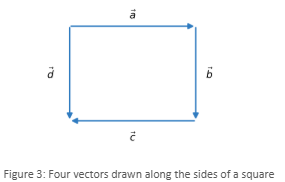
Answer: (i) a and d (ii) b and d (iii) a and c.
Q3. Ex 10.1 Q5: Answer true or false. (i) a and −a are collinear. (ii) Two collinear vectors are always equal in magnitude. (iii) Two vectors having the same magnitude are collinear. (iv) Two collinear vectors having the same magnitude are equal.
Step 1. The negative of a vector lies along the same line, only reversed, so (i) is true.
Step 2. For (ii), the vector 5a is collinear with a but five times as long, so the statement is false.
Step 3. For (iii), i and j both have magnitude 1, yet they are perpendicular, so the statement is false.
Step 4. For (iv), a and −a are collinear and have equal magnitudes, but they are not equal vectors, so the statement is false.
Answer: (i) true (ii) false (iii) false (iv) false.
Remember: equality of vectors needs the magnitude and the direction to match. A matching magnitude on its own is never enough.
Q4. Ex 10.2 Q1: Compute the magnitude of a = i + j + k, b = 2i − 7j − 3k and c = (1/√3)i + (1/√3)j − (1/√3)k.
Step 1. The magnitude is the square root of the sum of the squares of the components.
Step 2. |a| = √(1 + 1 + 1) = √3.
Step 3. |b| = √(4 + 49 + 9) = √62.
Step 4. |c| = √(1/3 + 1/3 + 1/3) = √1 = 1.
Answer: √3, √62, and 1. The third vector has magnitude 1, so it is a unit vector.
Remember: squaring removes every minus sign, so a negative component never makes the magnitude smaller.
Q5. Ex 10.2 Q5: Find the scalar and vector components of the vector with initial point (2, 1) and terminal point (−5, 7).
Step 1. Subtract the initial point from the terminal point, coordinate by coordinate.
PQ = (−5 − 2)i + (7 − 1)j
Step 2. This gives PQ = −7i + 6j.
Step 3. The scalar components are the coefficients on their own, and the vector components are those coefficients kept with their unit vectors.
Answer: scalar components −7 and 6; vector components −7i and 6j.
Remember: the order matters. Terminal minus initial, never the other way round, or the whole vector is reversed.
Q6. Ex 10.2 Q8: Find the unit vector in the direction of PQ, where P is (1, 2, 3) and Q is (4, 5, 6).
Step 1. PQ = (4 − 1)i + (5 − 2)j + (6 − 3)k = 3i + 3j + 3k.
Step 2. |PQ| = √(9 + 9 + 9) = √27 = 3√3.
Step 3. Divide the vector by its magnitude.
(3i + 3j + 3k) ÷ 3√3 = (1/√3)i + (1/√3)j + (1/√3)k
Answer: (1/√3)i + (1/√3)j + (1/√3)k.
Q7. Ex 10.2 Q10: Find a vector in the direction of 5i − j + 2k which has magnitude 8 units.
Step 1. |a| = √(25 + 1 + 4) = √30.
Step 2. The unit vector in that direction is (5i − j + 2k) ÷ √30.
Step 3. Multiply the unit vector by 8 to stretch it to the required length.
8 × (5i − j + 2k) ÷ √30 = (40i − 8j + 16k) ÷ √30
Answer: (40/√30)i − (8/√30)j + (16/√30)k.
Remember: reduce to a unit vector first, then multiply. Multiplying the original vector by 8 would give a length of 8√30 instead of 8.
Q8. Ex 10.2 Q11: Show that the vectors 2i − 3j + 4k and −4i + 6j − 8k are collinear.
Step 1. Compare the vectors component by component. Each component of the second is −2 times the matching component of the first.
−4i + 6j − 8k = −2(2i − 3j + 4k)
Step 2. So b = λa with λ = −2.
Step 3. A scalar multiple of a vector is parallel to that vector, so the two are collinear. The minus sign says they point in opposite directions.
Answer: the vectors are collinear, with b = −2a.
Q9. Ex 10.2 Q12: Find the direction cosines of the vector i + 2j + 3k.
Step 1. |a| = √(1 + 4 + 9) = √14.
Step 2. Divide each component by the magnitude.
Step 3. Check the result. The squares are 1/14, 4/14, and 9/14, and these add to 1, as direction cosines always must.
Answer: 1/√14, 2/√14 and 3/√14.
Remember: the check l² + m² + n² = 1 takes one line and catches almost every slip in this type of question.
Q10. Ex 10.2 Q15: Find the position vector of a point R which divides the line joining P and Q, whose position vectors are i + 2j − k and −i + j + k, in the ratio 2: 1 (i) internally (ii) externally.
Step 1. Write OP = i + 2j − k and OQ = −i + j + k.
Step 2. For internal division, use (2 OQ + 1 OP) ÷ (2 + 1).
[(−2i + 2j + 2k) + (i + 2j − k)] ÷ 3 = (−i + 4j + k) ÷ 3
Step 3. For external division, use (2 OQ − 1 OP) ÷ (2 − 1).
(−2i + 2j + 2k) − (i + 2j − k) = −3i + 3k
Answer: (i) −(1/3)i + (4/3)j + (1/3)k (ii) −3i + 3k.
Remember: the larger part of the ratio always goes with the farther point. Here, the 2 multiplies OQ, not OP.
Q11. Ex 10.3 Q1: Find the angle between two vectors a and b with magnitudes √3 and 2, given that a · b = √6.
Step 1. Start from the definition of the dot product.
a · b = |a| |b| cos θ
Step 2. Substitute the three known values: √6 = √3 × 2 × cos θ.
Step 3. So cos θ = √6 ÷ (2√3). Since √6 ÷ √3 = √2, this is √2 ÷ 2, which is 1/√2.
Step 4. The angle between two vectors is taken in [0, π], and cos(π/4) = 1/√2.
Answer: π/4.
Q12. Ex 10.3 Q4: Find the projection of the vector i + 3j + 7k on the vector 7i − j + 8k.
Step 1. Take the dot product of the two vectors.
a · b = 1(7) + 3(−1) + 7(8) = 7 − 3 + 56 = 60
Step 2. Find the magnitude of the vector being projected onto.
|b| = √(49 + 1 + 64) = √114
Step 3. The projection is the dot product divided by that magnitude.
Answer: 60 ÷ √114.
Remember: divide by the magnitude of the vector you are projecting onto. Dividing by the other magnitude answers a different question.
Q13. Ex 10.3 Q10: If a = 2i + 2j + 3k, b = −i + 2j + k, and c = 3i + j are such that a + λb is perpendicular to c, find λ.
Step 1. Form the combined vector.
a + λb = (2 − λ)i + (2 + 2λ)j + (3 + λ)k
Step 2. Perpendicular vectors have a dot product of zero, so set (a + λb) · c = 0.
Step 3. The vector c has no k component, so the third term contributes nothing.
3(2 − λ) + 1(2 + 2λ) + 0(3 + λ) = 0
Step 4. Simplify: 6 − 3λ + 2 + 2λ = 0, which gives 8 − λ = 0.
Answer: λ = 8.
Q14. Ex 10.3 Q13: If a, b, and c are unit vectors such that a + b + c = 0, find the value of a · b + b · c + c · a.
Step 1. Take the dot product of the whole equation with itself.
|a + b + c|² = (a + b + c) · (a + b + c)
Step 2. Expanding the right-hand side gives the three squares plus twice each of the three cross terms.
= |a|² + |b|² + |c|² + 2(a · b + b · c + c · a)
Step 3. Each vector is a unit vector, so each square is 1. The left-hand side is 0 because the sum of the three vectors is the zero vector.
0 = 1 + 1 + 1 + 2(a · b + b · c + c · a)
Step 4. Solve for the bracket.
Answer: −3/2.
Remember: taking the dot product of a vector equation with itself is the standard way of turning a statement about vectors into a statement about numbers.
Q15. Ex 10.3 Q16: Show that the points A(1, 2, 7), B(2, 6, 3) and C(3, 10, −1) are collinear.
Step 1. Find the three joining vectors.
AB = i + 4j − 4k, BC = i + 4j − 4k, AC = 2i + 8j − 8k
Step 2. Find their magnitudes.
|AB| = √33, |BC| = √33, |AC| = √132 = 2√33
Step 3. Since |AC| = |AB| + |BC|, the point B lies on the segment AC, and the three points cannot form a triangle.
Answer: the points A, B, and C are collinear.
Remember: here AB and BC turn out to be the same vector, which is a second and quicker proof: one is a scalar multiple of the other.
Q16. Ex 10.4 Q1: Find |a × b| if a = i − 7j + 7k and b = 3i − 2j + 2k.
Step 1. Set out the determinant with i, j, and k in the first row, the components of a in the second row, and those of b in the third.
Step 2. Expand along the first row, remembering the minus sign on the middle term.
= i(−14 + 14) − j(2 − 21) + k(−2 + 21)
a × b = 19j + 19k
Step 3. Take the magnitude of the result.
|a × b| = √(361 + 361) = 19√2
Answer: 19√2.
Remember: the middle term of the expansion carries a minus sign. Losing it is the single most common slip in this exercise.
Q17. Ex 10.4 Q2: Find a unit vector perpendicular to each of a + b and a − b, where a = 3i + 2j + 2k and b = i + 2j − 2k.
Step 1. Form the two vectors first.
a + b = 4i + 4j, a − b = 2i + 4k
Step 2. A cross product is perpendicular to both of the vectors that make it.
(a + b) × (a − b) = 16i − 16j − 8k
Step 3. Find its magnitude: √(256 + 256 + 64) = √576 = 24.
Step 4. Divide by that magnitude to get a unit vector.
Answer: ±(2i − 2j − k) ÷ 3.
Remember: the reverse of a perpendicular vector is also perpendicular, so both signs are acceptable unless the question fixes an orientation.
Q18. Ex 10.4 Q9: Find the area of the triangle with vertices A(1, 1, 2), B(2, 3, 5) and C(1, 5, 5).
Step 1. Build two vectors along the sides of the triangle.
AB = i + 2j + 3k, BC = −i + 2j
Step 2. Take their cross product.
AB × BC = −6i − 3j + 4k
Step 3. Its magnitude is √(36 + 9 + 16) = √61.
Step 4. The area of a triangle is half the magnitude of the cross product of two of its sides.
Answer: √61 ÷ 2 square units.
Remember: use the same two sides throughout. Mixing AB with CA is still correct, but mixing AB with CB reverses one side and is a common source of sign confusion.
Q19. Miscellaneous Q3: A girl walks 4 km toward the west, then walks 3 km in a direction 30° east of north and stops. Find her displacement from the starting point.
Step 1. Take i along east and j along north. The first leg is 4 km due west, so it is −4i.
Step 2. The phrase 30° east of north is measured from the north line, so the second leg makes 60° with the east direction.
second leg = 3 cos 60° i + 3 sin 60° j = (3/2)i + (3√3/2)j
Step 3. Displacement is the sum of the two legs, not the total distance walked.
−4i + (3/2)i + (3√3/2)j = −(5/2)i + (3√3/2)j
Step 4. Its magnitude is √(25/4 + 27/4) = √13.
Answer: −(5/2)i + (3√3/2)j, which is a displacement of √13 km, roughly 3.6 km, from where she started.
Remember: she walks 7 km in total but ends up only √13 km away. Distance and displacement are different quantities, and the question asks for the vector one.
Q20. Miscellaneous Q10: The two adjacent sides of a parallelogram are 2i − 4j + 5k and i − 2j − 3k. Find the unit vector parallel to its diagonal, and find its area.
Step 1. The diagonal drawn from the common corner is the sum of the two sides.
a + b = 3i − 6j + 2k
Step 2. Its magnitude is √(9 + 36 + 4) = √49 = 7, so the unit vector along the diagonal is that vector divided by 7.
Step 3. For the area, take the cross product of the two adjacent sides.
a × b = 22i + 11j
Step 4. The area of a parallelogram is the magnitude of that cross product.
|a × b| = √(484 + 121) = √605 = 11√5
Answer: unit vector (3/7)i − (6/7)j + (2/7)k, and area 11√5 square units.
Remember: the cross product gives the area of the parallelogram directly. Halving it is only for a triangle.
Key Features of Infinity Learn NCERT Solutions for Class 12 Math Chapter 10
- Covers 20 selected questions from Exercises 10.1, 10.2, 10.3, 10.4 and the Miscellaneous Exercise.
- Each question is mapped to the concept it tests, so revision can be targeted.
- Every solution is broken into clear steps with the reason given at each stage.
- The choice between the dot product and the cross product is made explicit wherever a question turns on it.
- Includes the formula set, the types of vector table, and the two diagrams that most questions in the chapter rely on.
- Prepared in line with the current rationalized NCERT textbook.
Why Use NCERT Solutions for Vector Algebra?
Most of the difficulty in this chapter comes from bookkeeping rather than from ideas. The formulas are short, but each has to be applied to three components at once, and a single dropped sign changes the answer completely. Working to a fixed order and checking the kind of answer produced removes almost all of that risk.
Students can use these solutions to:
- Separate scalar quantities from vector quantities before any algebra begins.
- Write a vector in component form and read its magnitude and direction cosines from it.
- Apply the section formula in both its internal and its external version.
- Decide which of the two products a question needs, then carry out the arithmetic in a settled order.
- Use the cross product for perpendicular directions and for areas, and the dot product for angles and projections.
- Test three points for collinearity and two vectors for perpendicularity or parallelism.
course
No courses found
FAQs on NCERT Solutions for Class 12 Math Chapter 10
How many exercises are there in NCERT Class 12 Math Chapter 10?
There are four numbered exercises and one miscellaneous exercise. Exercise 10.1 has 5 questions, Exercise 10.2 has 19, Exercise 10.3 has 18, Exercise 10.4 has 12, and the Miscellaneous Exercise has 19.
What is the difference between a scalar and a vector?
A scalar is completely described by a number together with its unit, such as a mass of 10 kg. A vector needs a direction as well, such as a displacement of 2 meters to the northwest. Speed is a scalar while velocity is a vector, and distance is a scalar while displacement is a vector.
When should I use the dot product and when the cross product?
Use the dot product when the answer is a number: the angle between two vectors, a projection, or a test for perpendicularity. Use the cross product when the answer is a vector or an area: a direction perpendicular to two given vectors, the area of a triangle or a parallelogram, or a test for parallelism.
How do I find a unit vector in a given direction?
Divide the vector by its own magnitude. For a = a1i + a2j + a3k, the magnitude is √(a1² + a2² + a3²), and the unit vector is a divided by that number. The result always has magnitude 1, which is worth checking on the first few attempts.
How can I show that three points are collinear?
There are two accepted methods. Either show that one joining vector is a scalar multiple of another, for example AB = λBC, or find the three distances and show that the largest equals the sum of the other two, as in Question 15 above.
What are direction cosines and direction ratios?
The direction cosines are the cosines of the angles a vector makes with the x, y and z axes, and they are the components of the unit vector along it. They always satisfy l² + m² + n² = 1. Direction ratios are any three numbers in the same proportion as the components, so a vector has one set of direction cosines but many sets of direction ratios.
How many marks does Chapter 10 carry in the CBSE Class 12 Math examination?
Chapter 10 sits in Unit IV, Vectors and Three Dimensional Geometry, together with Chapter 11. The unit carries 14 marks in the theory paper. The syllabus does not give a separate figure for Chapter 10 on its own.
