- Key Concepts Covered in Class 12 Math Chapter 8 – Application of Integrals
- Chapter Overview and Important Results
- Selected NCERT Questions, Grouped by Concept
- Class 12 Maths Chapter 8 Exercise Solutions
- Key Features of Infinity Learn NCERT Solutions for Class 12 Math Chapter 8
- Why Use NCERT Solutions for Application of Integrals?
- Study Class 12 Math with Infinity Learn
- FAQs on NCERT Solutions for Class 12 Math Chapter 8
NCERT Solutions for Class 12 Maths Chapter 8 Application of Integrals
By Karan singh ildefaultfield
|
Updated on 15 Sep 2026, 12:19 IST
Application of Integrals is Chapter 8 of the Class 12 Mathematics textbook and forms part of the Calculus unit of the CBSE syllabus. The chapter covers the area under simple curves, in particular the area of a region bounded by a curve, the x-axis or the y-axis, and two given ordinates, together with the areas of standard curves such as circles, parabolas, and ellipses.
Following the rationalization of the NCERT curriculum, the sections on the area of a region bounded by a curve and a line and on the area between two curves have been withdrawn, and the chapter now consists of a single numbered exercise together with a Miscellaneous Exercise. These NCERT Solutions provide worked answers grouped by concept, prepared in accordance with the current syllabus.
Key Concepts Covered in Class 12 Math Chapter 8 – Application of Integrals
The chapter covers the following important concepts:
- Area under a curve as the limit of a sum of thin strips
- Area bounded by a curve, the x-axis, and two ordinates
- Area bounded by a curve, the y-axis, and two horizontal lines
- Choosing between vertical strips and horizontal strips
- Reading the limits of integration from a sketch
- Area of a region bounded by a parabola
- Area of a circle and of an ellipse using symmetry
- Handling a region that lies partly below the x-axis
- Areas involving the modulus function
Chapter Overview and Important Results
Imagine slicing the region into very thin vertical strips. One strip standing at position x has height y and width dx, so its area is y times dx. Adding up all such strips from x = a to x = b is exactly what a definite integral does.
Area = ∫ from a to b of y dx, where y is written in terms of x
If the region is easier to describe by its horizontal extent, slice it into horizontal strips instead. A strip at height y has length x and thickness dy.
Area = ∫ from c to d of x dy, where x is written in terms of y
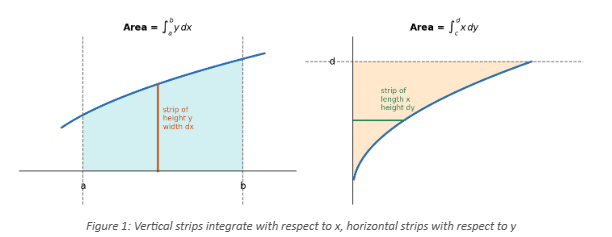

Use vertical strips when the region is bounded above and below by curves and the limits are given as values of x. Use horizontal strips when the region is bounded left and right and the limits are given as values of y, which is what happens whenever a question mentions the y-axis.
The Standard Procedure
Best Courses for You

JEE

NEET

Foundation JEE

Foundation NEET

CBSE
Every question in this chapter is answered by the same four steps, and it is worth following them in this order every time.
- Sketch the region. Marks are awarded for the sketch itself, and the limits are far easier to read off a diagram than to work out algebraically.
- Decide on the strips. Vertical strips mean integrating y with respect to x. Horizontal strips mean integrating x with respect to y.
- Write the boundary curve in the right form. For vertical strips, make y the subject. For horizontal strips, make x the subject.
- Set up and evaluate the definite integral, then state the answer in square units.
Symmetry
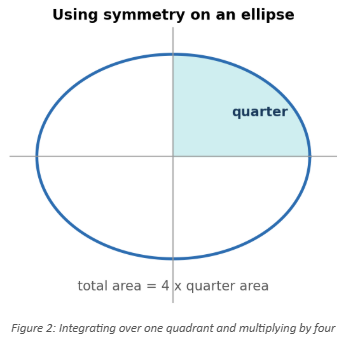
A circle and an ellipse are both symmetrical about each axis, so the region divides into four identical quarters. Finding the area of the quarter that lies in the first quadrant and multiplying by four is much quicker than integrating across the whole figure, and it also avoids any difficulty with signs.
Regions Below the Axis
A definite integral counts area below the x-axis as negative. If a region lies partly above and partly below, integrating straight across in one go makes the two parts cancel and gives a smaller answer, or even zero.
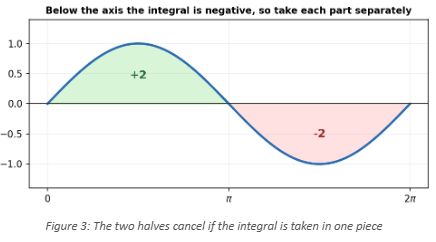
The fix is to split the integral at each point where the curve crosses the axis, take the absolute value of each piece, and then add them together.
Selected NCERT Questions, Grouped by Concept
Because the chapter is now short, the questions below cover very nearly the whole of it. They are arranged by concept rather than by exercise number.
| Concept | What the questions test | Source |
| A. Area with vertical strips | Integrating y dx between two ordinates | Ex 8.1 Q1, Q2; Misc. Q1 |
| B. Area with horizontal strips | Integrating x dy against the y-axis | Ex 8.1 (objective) |
| C. Circles and ellipses | Using symmetry and the standard root integral | Ex 8.1 Q4, Q5 and objective |
| D. Regions below the axis | Splitting the integral where the curve crosses | Misc. Q5 and objective questions |
| E. Modulus functions | Splitting at the corner point | Misc. Q4 |
Class 12 Maths Chapter 8 Exercise Solutions
Concept A: Area Using Vertical Strips
Q1. Ex 8.1 Q1: Find the area of the region bounded by the ellipse x²/16 + y²/9 = 1.
Step 1. Write the ellipse as x²/4² + y²/3² = 1, so a = 4 and b = 3. It is symmetric about both axes, so the total area is 4 times the area in the first quadrant.
Step 2. In the first quadrant, solve for y: y = (3/4)√(16 − x²), with x running from 0 to 4.
Step 3. Set up the integral.
area = 4 × ∫ from 0 to 4 of (3/4)√(16 − x²) dx = 3 ∫ from 0 to 4 of √(16 − x²) dx
Step 4. Apply ∫√(a² − x²) dx = (x/2)√(a² − x²) + (a²/2) sin⁻¹(x/a), with a = 4.
area = 3 [ (x/2)√(16 − x²) + 8 sin⁻¹(x/4) ] from 0 to 4
Step 5. Evaluate. At x = 4: 0 + 8 sin⁻¹(1) = 8 × (π/2) = 4π. At x = 0: 0. So the area = 3 × 4π.
Answer: 12π square units.
Remember: integrate over the first quadrant and multiply by 4. Integrating from −4 to 4 and doubling reaches the same answer, but the quarter-and-multiply setup is harder to slip a sign in.
Q2. Ex 8.1 Q2: Find the area of the region bounded by the ellipse x²/4 + y²/9 = 1.
Step 1. Write it as x²/2² + y²/3² = 1, so a = 2 (along x) and b = 3 (along y). Symmetric about both axes, so the area is 4 times the first-quadrant area.
Step 2. Solve for y: y = (3/2)√(4 − x²), with x from 0 to 2.
Step 3. Set up the integral.
area = 4 × ∫ from 0 to 2 of (3/2)√(4 − x²) dx = 6 ∫ from 0 to 2 of √(4 − x²) dx
Step 4. Apply the same standard form with a = 2.
area = 6 [ (x/2)√(4 − x²) + 2 sin⁻¹(x/2) ] from 0 to 2
Step 5. Evaluate. At x = 2: 0 + 2 sin⁻¹(1) = 2 × (π/2) = π. At x = 0: 0. So the area = 6 × π.
Answer: 6π square units.
Remember: here the major axis is along y, not x, but the area method is unchanged. The only thing that matters for the integral is which variable you integrate along and the matching limits.
Q3. Miscellaneous Exercise: Find the area under the given curves and given lines, for (i) y = x², x = 1, x = 2 and the x-axis, and (ii) y = x⁴, x = 1, x = 5, and the x-axis.
Part (i).
Step 1. The curve y = x² is a parabola opening upwards with its vertex at the origin. Between x = 1 and x = 2, it lies entirely above the x-axis, so no sign problem arises.
Step 2. Set up the integral.
Area = ∫ from 1 to 2 of x² dx = [x³/3] from 1 to 2
Step 3. Substitute. Area = 8/3 − 1/3 = 7/3.
Area = 7/3 square units
Part (ii).
Step 1. The curve y = x⁴ also lies above the x-axis throughout, since an even power is never negative.
Step 2. Set up and integrate.
Area = ∫ from 1 to 5 of x⁴ dx = [x⁵/5] from 1 to 5
Step 3. Substitute. At x = 5, 5⁵ = 3125, so the term is 3125/5 = 625. At x = 1, the term is 1/5.
Area = 625 − 1/5 = 3125/5 − 1/5 = 3124/5
Area = 3124/5 square units
Remember: before integrating, check whether the curve stays above the axis over the given range. For an even power, it always does, which is why both parts here are straightforward.
Concept B: Area Using Horizontal Strips
Q4. Exercise 8.1 (objective): Find the area of the region bounded by the curve y² = 4x, the y-axis, and the line y = 3.
Step 1. Notice which axis is mentioned. The boundary is the y-axis, and the limit is given as a value of y, not of x. That is the signal to use horizontal strips and to integrate with respect to y.
Step 2. Write x in terms of y. From y² = 4x, we rearrange to x = y²/4.
Step 3. Identify the limits. The region runs from the vertex at y = 0 up to the line y = 3.
Step 4. Set up the integral.
Area = ∫ from 0 to 3 of (y²/4) dy
Step 5. Integrate. Take the 1/4 outside and integrate y² to get y³/3.
= (1/4) [ y³/3 ] from 0 to 3 = [ y³/12 ] from 0 to 3
Step 6. Substitute. At y = 3, we get 27/12, and at y = 0, we get 0.
Area = 27/12 = 9/4 square units
Remember: whenever a question names the y-axis as a boundary, switch to horizontal strips. Trying to force vertical strips here would require splitting the region into awkward pieces.
Concept C: Circles and Ellipses
Q5. Exercise 8.1: Find the area of the region bounded by the ellipse x²/16 + y²/9 = 1.
Step 1. Read off the semi-axes. Comparing with the standard form, a² = 16 gives a = 4 along the x-axis, and b² = 9 gives b = 3 along the y-axis.
Step 2. Use symmetry. The ellipse is symmetrical about both axes, so the four quadrants contain identical areas. Work out the first quadrant portion and multiply by 4.
Step 3. Write y in terms of x. Rearranging gives y²/9 = 1 − x²/16, so y = (3/4)√(16 − x²), taking the positive root for the first quadrant.
Step 4. Set up the integral for the quarter, which runs from x = 0 to x = 4.
Area = 4 × ∫ from 0 to 4 of (3/4)√(16 − x²) dx
Step 5. Simplify the constants. The 4 outside and the 3/4 inside combine to give 3.
= 3 ∫ from 0 to 4 of √(16 − x²) dx
Step 6. Apply the standard integral with a = 4.
= 3 [ (x/2)√(16 − x²) + 8 sin⁻¹(x/4) ] from 0 to 4
Step 7. Substitute the upper limit. At x = 4, the square root becomes √0 = 0, so the first term vanishes. The second term is 8 sin⁻¹(1), and sin⁻¹(1) = π/2, giving 8 times π/2 = 4π.
Step 8. Substitute the lower limit. At x = 0, both terms are zero.
Area = 3(4π − 0) = 12π
Area = 12π square units
Remember: the answer matches the general formula πab, since π × 4 × 3 = 12π. That is a quick way to check your integration, though the working must still be shown in full.
Q6. Exercise 8.1: Find the area of the region bounded by the ellipse x²/4 + y²/9 = 1.
Step 1. Read off the semi-axes. Here a² = 4 gives a = 2, and b² = 9 gives b = 3. Note that this ellipse is taller than it is wide, the opposite of the previous one.
Step 2. Write y in terms of x. Rearranging gives y = (3/2)√(4 − x²).
Step 3. Set up the quarter integral from x = 0 to x = 2 and multiply by 4.
Area = 4 × ∫ from 0 to 2 of (3/2)√(4 − x²) dx = 6 ∫ from 0 to 2 of √(4 − x²) dx
Step 4. Apply the standard integral with a = 2.
= 6 [ (x/2)√(4 − x²) + 2 sin⁻¹(x/2) ] from 0 to 2
Step 5. Substitute. At x = 2, the root term is zero and sin⁻¹(1) = π/2, so the bracket gives 2 times π/2 = π. At x = 0, everything is zero.
Area = 6π
Area = 6π square units
Remember: again, πab confirms it, since π × 2 × 3 = 6π. Getting the semi-axes the wrong way round is the most common error in ellipse questions, so identify a and b carefully at Step 1.
Q7. Exercise 8.1 (objective): Find the area lying in the first quadrant and bounded by the circle x² + y² = 4, the x-axis, and the lines x = 0 and x = 2.
Step 1. Identify the region. The circle has a center at the origin and radius 2. The lines x = 0 and x = 2 are the y-axis and the vertical tangent at the right-hand edge, so the region described is exactly the quarter circle sitting in the first quadrant.
Step 2. Predict the answer. A full circle of radius 2 has area π(2)² = 4π, so a quarter of it should be π. It is worth having this in mind as a check.
Step 3. Write y in terms of x. From x² + y² = 4, we get y = √(4 − x²), positive because we are in the first quadrant.
Step 4. Set up the integral.
Area = ∫ from 0 to 2 of √(4 − x²) dx
Step 5. Apply the standard integral with a = 2, then substitute as in the previous question. The bracket gives π at the upper limit and 0 at the lower limit.
Area = π square units
Remember: recognizing the region as a quarter circle before integrating gives you the answer to check against. If the integration produces anything other than π, you know at once that something has gone wrong.
Concept D: Regions Lying Below the Axis
Q8. Miscellaneous Exercise: Find the area bounded by the curve y = sin x between x = 0 and x = 2π.
Step 1. Sketch first, because this question turns on the sketch. Between 0 and π, the sine curve is above the x-axis. Between π and 2π, it is below.
Step 2. See why one integral will not work. Integrating straight from 0 to 2π gives zero, because the part below the axis counts as negative and cancels the part above exactly. Zero is clearly not the area of the region.
Step 3. Split at the crossing point, which is x = π, and handle each piece separately.
Step 4. First piece, from 0 to π. The integral of sin x is −cos x.
[ −cos x ] from 0 to π = −cos π − (−cos 0) = −(−1) + 1 = 2
Step 5. Second piece, from π to 2π.
[ −cos x ] from π to 2π = −cos 2π − (−cos π) = −1 + (−1) = −2
Step 6. Take the absolute value of each piece and add. The second piece has size 2.
Area = 2 + |−2| = 4 square units
Remember: whenever the range spans a point where the curve crosses the axis, split there. Sketching first is what tells you that a crossing exists at all.
Q9. Miscellaneous Exercise (objective): Find the area bounded by the curve y = x³, the x-axis, and the ordinates x = −2 and x = 1.
Step 1. Check for a crossing. The cubic y = x³ is negative for x < 0 and positive for x > 0, so it crosses the axis at x = 0, which lies inside the given range.
Step 2. Split the integral at x = 0.
Step 3. Left piece, from −2 to 0. The integral of x³ is x⁴/4.
[ x⁴/4 ] from −2 to 0 = 0 − 16/4 = −4
Step 4. Right piece, from 0 to 1.
[ x⁴/4 ] from 0 to 1 = 1/4 − 0 = 1/4
Step 5. Take absolute values and add.
Area = |−4| + 1/4 = 4 + 1/4 = 17/4 square units
Remember: integrating in one pass from −2 to 1 would give −4 + 1/4 = −15/4, which is one of the wrong options offered in this question. The option list is built around exactly this mistake.
Q10. Miscellaneous Exercise (objective): Find the area bounded by the curve y = x|x|, the x-axis and the ordinates x = −1 and x = 1.
Step 1. Rewrite the function without the modulus. For x ≥ 0, we have |x| = x, so y = x². For x < 0 we have |x| = −x, so y = −x².
Step 2. Note the symmetry. The right half sits above the axis, and the left half sits below, and the two are mirror images. So the total area is twice the area of the right half.
Step 3. Find the right half, from 0 to 1, using y = x².
[ x³/3 ] from 0 to 1 = 1/3
Step 4. Double it.
Area = 2 × 1/3 = 2/3 square units
Remember: spotting the symmetry halves the work here. Without it, you would need to integrate −x² from −1 to 0 and then take the absolute value, which arrives at the same 1/3 by a longer route.
Concept E: Modulus Functions
Q11. Miscellaneous Exercise: Sketch the graph of y = |x + 3| and evaluate the integral of |x + 3| from x = −6 to x = 0.
Step 1. Rewrite without the modulus. The expression inside changes sign at x = −3. For x ≥ −3 we have |x + 3| = x + 3. For x < −3 we have |x + 3| = −(x + 3).
Step 2. Describe the sketch. The graph is a V-shape with its corner sitting on the x-axis at x = −3. Both arms rise away from that point, so the whole graph lies on or above the axis.
Step 3. Split the integral at the corner, which is at x = −3.
Step 4. Left piece, from −6 to −3, using −(x + 3).
∫ −(x + 3) dx = −[x²/2 + 3x]. Evaluating from −6 to −3 gives −[(9/2 − 9) − (18 − 18)] = −(−9/2) = 9/2.
Step 5. Right piece, from −3 to 0, using (x + 3).
∫ (x + 3) dx = [ x²/2 + 3x ]. Evaluating from −3 to 0 gives 0 − (9/2 − 9) = 9/2.
Step 6. Add the two pieces.
Total = 9/2 + 9/2 = 9
Remember: a modulus function must always be split at the point where the inside expression is zero. Here the two halves happen to be equal, which is a useful check, since the V is symmetrical about x = −3 and the range −6 to 0 is centered on it.
Key Features of Infinity Learn NCERT Solutions for Class 12 Math Chapter 8
- Covers very nearly the whole of the rationalized chapter, arranged in five concept groups.
- Every solution begins by describing the region, which is where the marks and the limits both come from.
- Explains when to use vertical strips and when to switch to horizontal strips.
- Shows how to handle a region lying partly below the x-axis and why a single integral fails there.
- Gives a quick check for circle and ellipse questions using the standard area formula.
- Flags the sections withdrawn in the rationalization, so no time is spent on deleted material.
Why Use NCERT Solutions for Application of Integrals?
This is a short chapter with a very predictable question pattern, which makes it one of the more reliable sources of marks in the paper. The integration involved is rarely difficult. What separates a full answer from a partial one is the setup: sketching the region, choosing the right strips, and reading the limits correctly.
Students can use these solutions to:
- Build the habit of sketching before integrating, since the sketch itself carries marks.
- Recognize from the wording whether to integrate with respect to x or with respect to y.
- Rearrange the boundary curve into the form the chosen strips require.
- Split the integral wherever the curve crosses the axis, instead of integrating straight through.
- Use symmetry on circles and ellipses to shorten the working.
Study Class 12 Math with Infinity Learn
Infinity Learn provides NCERT Solutions for every chapter of the current Class 12 Math syllabus, with step-by-step working, solutions written in the order the CBSE marking scheme expects, and clear labeling of the topics affected by the rationalization, so no time is spent on material that is no longer examined.
Practice chapter by chapter, check your method against the worked solutions, and revise the key results before your board examination. Start with the questions on this page, then continue through the rest of the syllabus with Infinity Learn.
course
No courses found
FAQs on NCERT Solutions for Class 12 Math Chapter 8
What is the basic formula for the area under a curve?
For a region bounded by a curve, the x-axis, and the lines x = a and x = b, the area is the definite integral of y with respect to x taken from a to b, with y written as a function of x. If the region is bounded by the y-axis instead, integrate x with respect to y between the corresponding y values.
How do I know whether to integrate with respect to x or y?
Look at the boundaries named in the question. If they are vertical lines such as x = 1 and x = 4, use vertical strips and integrate with respect to x. If the y-axis is a boundary, or the limits are given as values of y, use horizontal strips and integrate with respect to y.
Why do I get zero when I find the area under y = sin x from 0 to 2π?
Because the part of the region below the x-axis contributes a negative amount to the integral, and here it cancels the positive part exactly. Split the integral at x = π, take the absolute value of each piece, and then add them. The correct area is 4 square units.
Do I have to draw the sketch?
Yes. Marks are given for the diagram in this chapter, and beyond that, the sketch is the most reliable way to read off the limits and to spot whether any part of the region lies below the axis.
How does symmetry help with a circle or an ellipse?
Both curves are symmetrical about the x-axis and the y-axis, so all four quadrants contain the same area. Finding the first quadrant portion and multiplying by four is quicker than integrating across the whole figure and avoids sign difficulties.
Is there a quick way to check an ellipse answer?
Yes. The area enclosed by the ellipse with semi-axes a and b is πab. Use it to check your integration, but still show the full working, since the method is what is being marked.
Is the area between two curves still part of Chapter 8?
No. That section was withdrawn in the rationalization, along with the section on the area of a region bounded by a curve and a line. Questions asking for the area between a parabola and a line, or between two circles, are not examined from this chapter in the current syllabus.
