NCERT Solutions for Class 12 Physics Chapter 1 Electric Charges and Fields
By Ankit Ankit
|
Updated on 17 Sep 2026, 12:34 IST
Finding the right approach to questions on Coulomb's law, electric fields, electric dipoles or Gauss's law can be difficult when several quantities and directions are involved. Class 12 Physics Chapter 1, Electric Charges and Fields, introduces electrostatics through the properties of electric charge and then develops the ideas of electric force, field, dipole and electric flux.
The NCERT Solutions for Class 12 Physics Chapter 1 on this page work through selected chapter-end questions step by step. Each solution shows the relevant formula, substitution and calculation so that you can follow how the final answer is obtained rather than simply checking the numerical result.
Download Complete NCERT Solutions PDF for Class 12 Physics Chapter 1
Need the solutions in one place for revision or offline study?
You can use the PDF to revise the chapter-end exercises, check your working after attempting a question yourself, and revisit numerical problems before an examination.
Key Concepts Covered in Electric Charges and Fields
Before working through the exercises, it helps to know what each part of the chapter is dealing with.
Loading PDF...
- Electric Charge and Its Properties
Electric charge is the source of electrical interaction. The chapter discusses the two types of charge and three important properties:
- Additivity of charge
- Conservation of charge
- Quantisation of charge
- Coulomb's Law
Coulomb's law gives the electrostatic force between two point charges:
F = 1/4πε0 × |q1q2|/r2
The direction of the force depends on whether the charges are alike or unlike.

- Principle of Superposition
When several charges are present, the net electric force or electric field is obtained by adding the individual contributions as vectors.
- Electric Field and Field Lines
The electric field at a point is defined as the force experienced per unit positive test charge:
Best Courses for You

JEE

NEET

Foundation JEE

Foundation NEET

CBSE
E⃗ = F⃗/q
Electric field lines are used to represent the direction and relative strength of an electric field.
- Electric Dipole
An electric dipole consists of two equal and opposite charges separated by a small distance. Its dipole moment is
p⃗ = q d⃗
where the direction of d⃗ is from the negative charge to the positive charge.
- Dipole in an Electric Field
A dipole placed in a uniform electric field can experience a torque:
τ = pE sinθ
where θ is the angle between the dipole moment and the electric field.
- Continuous Charge Distribution
When charge is distributed continuously rather than concentrated at individual points, charge can be described using quantities such as linear, surface and volume charge density.
- Electric Flux
Electric flux measures the electric field passing through a given surface:
Φ = E⃗·A⃗ = EA cosθ
- Gauss's Law
Gauss's law relates the total electric flux through a closed surface to the net charge enclosed by that surface:
ΦE = qenclosed/ε0
It is particularly useful when the charge distribution has sufficient symmetry.
NCERT Solutions for Class 12 Physics Chapter 1: Electric Charges and Fields
Chapter Structure and Important Topics
The chapter moves from the basic properties of charge to methods for calculating electric fields. The main areas covered are:
- Electric charge
- Conductors and insulators
- Coulomb's law
- Forces between multiple charges
- Electric field
- Electric field due to a point charge
- Electric field due to a system of charges
- Electric field lines
- Electric flux
- Electric dipole and dipole moment
- Gauss's law and its applications
The chapter-end numerical problems bring these ideas together. A useful way to approach them is to first identify what quantity the question asks for, then determine which physical relation connects the given quantities to that quantity.
Important Formulas from Chapter 1
| Concept | Formula |
| Coulomb's law | F = (1/4πε0) × |q1q2|/r2 |
| Electric field | E = F/q |
| Field due to point charge | E = (1/4πε0) × |q|/r2 |
| Dipole moment | p = qd |
| Torque on dipole | τ = pE sinθ |
| Electric flux | Φ = EA cosθ |
| Gauss's law | ΦE = qenclosed/ε0 |
| Field due to an infinite line charge | E = λ/(2πε0r) |
Chapter Weightage and Examination Relevance
In the CBSE Physics syllabus, Electrostatics is covered as Unit I and includes both Chapter 1, Electric Charges and Fields, and Chapter 2, Electrostatic Potential and Capacitance. The two chapters together carry 16 marks in the prescribed theory structure.
For JEE Main and NEET preparation, the chapter is also useful because questions involving electric fields, charge distributions, dipoles and Gauss's law require students to apply the underlying concepts rather than simply recall definitions.
NCERT Solutions for Class 12 Physics Chapter 1: Important NCERT Exercises
Question 1 — Electric Field at the Midpoint
Two point charges qA = 3 μC and qB = −3 μC are located 20 cm apart in vacuum.
- (a) What is the electric field at the midpoint O of the line AB joining the two charges?
- (b) If a negative test charge of magnitude 1.5 × 10⁻⁹ C is placed at this point, what is the force experienced by the test charge?
Solution
Given: qA = +3 × 10⁻⁶ C, qB = −3 × 10⁻⁶ C, AB = 20 cm = 0.20 m
Since O is the midpoint, AO = BO = 10 cm = 0.10 m. Also, k = 1/4πε0 = 9 × 10⁹ N·m2C−2.
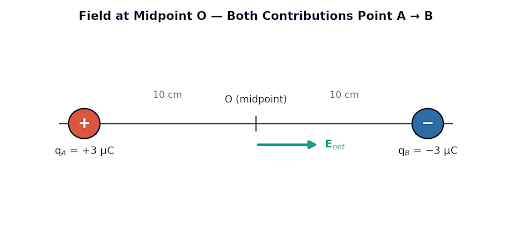
Fields from qA and qB both point from A towards B at the midpoint
(a) Electric field at the midpoint
The magnitude of the electric field due to either charge is:
E = k|q|/r2
EA = 9 × 109 × (3 × 10−6)/(0.10)2 = 2.7 × 10⁶ N/C
Similarly, EB = 2.7 × 10⁶ N/C.
At the midpoint, the field due to the positive charge is directed away from qA, while the field due to the negative charge is directed towards qB. Both fields therefore point in the same direction: from the positive charge towards the negative charge. Hence:
Enet = EA + EB = 2.7 × 10⁶ + 2.7 × 10⁶
Enet = 5.4 × 10⁶ N/C, directed from qA towards qB
(b) Force on the test charge
The test charge is q0 = −1.5 × 10⁻⁹ C. The force is F = q0E, so for magnitude:
|F| = |q0|E = 1.5 × 10−9 × 5.4 × 106
Because the test charge is negative, the force acts opposite to the electric field — so it is directed towards the positive charge qA.
|F| = 8.1 × 10⁻³ N, directed towards qA
Question 2 — Total Charge and Electric Dipole Moment
A system has two charges qA = 2.5 × 10⁻⁷ C and qB = −2.5 × 10⁻⁷ C located at points A: (0, 0, −15 cm) and B: (0, 0, +15 cm), respectively. What are the total charge and electric dipole moment of the system?
Solution:
Step 1: Find the total charge
The two charges are equal in magnitude and opposite in sign: qA = +2.5 × 10⁻⁷ C, qB = −2.5 × 10⁻⁷ C. Therefore:
qtotal = qA + qB = 2.5 × 10⁻⁷ − 2.5 × 10⁻⁷
qtotal = 0 C (the system is electrically neutral)
Step 2: Find the separation between the charges
The z-coordinates are zA = −15 cm and zB = +15 cm. Therefore:
d = 15 − (−15) = 30 cm = 0.30 m
Step 3: Calculate the dipole moment
The magnitude of the dipole moment is p = qd, where q is the magnitude of either charge. Thus:
p = (2.5 × 10⁻⁷)(0.30)
p = 7.5 × 10⁻⁸ C·m
Step 4: Determine its direction
The electric dipole moment points from the negative charge to the positive charge. Here, the negative charge is at z = +15 cm, while the positive charge is at z = −15 cm. Therefore, the dipole moment points along the negative z-axis.
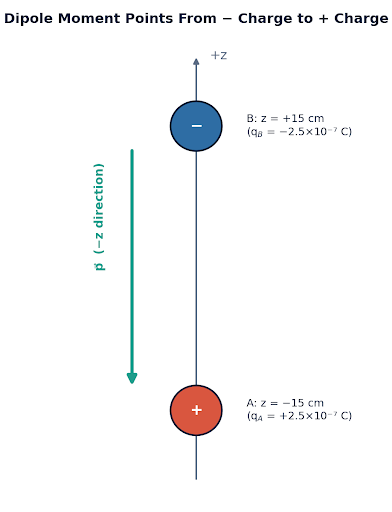
The dipole moment points from the negative charge (top) to the positive charge (bottom) — the −z direction.
p⃗ = −7.5 × 10⁻⁸ k̂ C·m (along the negative z-axis)
Question 3 — Torque on an Electric Dipole
An electric dipole with dipole moment 4 × 10⁻⁹ C·m is aligned at 30° with the direction of a uniform electric field of magnitude 5 × 10⁴ N/C. Calculate the magnitude of the torque acting on the dipole.
Solution:
Given: p = 4 × 10⁻⁹ C·m, E = 5 × 10⁴ N/C, θ = 30°
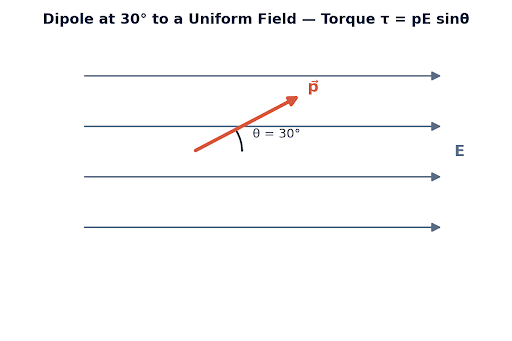
The dipole moment makes a 30° angle with the field.
The magnitude of torque on an electric dipole in a uniform electric field is:
τ = pE sinθ
Substituting, and using sin30° = 1/2:
τ = (4 × 10⁻⁹)(5 × 104) × (1/2) = 10 × 10−5
τ = 1.0 × 10⁻⁴ N·m
Question 4 — Electric Flux Through a Square
Consider a uniform electric field E⃗ = 3 × 10³ î N/C.
(a) What is the flux of this field through a square of 10 cm on a side whose plane is parallel to the yz-plane?
(b) What is the flux through the same square if the normal to its plane makes a 60° angle with the x-axis?
Solution:
Given: E⃗ = 3 × 10³ î N/C, side l = 10 cm = 0.10 m
A = l2 = (0.10)2 = 0.01 m2
Electric flux is:
Φ = EA cosθ
where θ is the angle between the electric field and the normal to the surface.
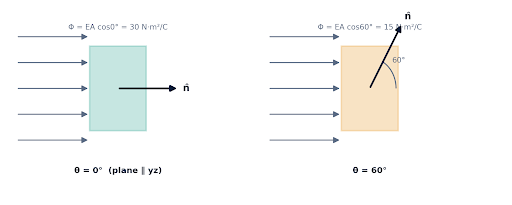
The normal at 0° gives maximum flux; tilting it to 60° reduces the flux.
(a) Plane parallel to the yz-plane
The normal to the yz-plane is along the x-axis. Since the electric field is also along the x-axis, θ = 0°. Therefore:
Φ = EA cos0° = (3 × 10³)(0.01)(1)
Φ = 30 N·m2/C
(b) Normal makes 60° with the x-axis
Here θ = 60°. Therefore:
Φ = EA cos60° = (3 × 10³)(0.01)(1/2)
Φ = 15 N·m2/C
Question 5 — Charge on a Conducting Sphere
A conducting sphere of radius 10 cm has an unknown charge. If the electric field 20 cm from the centre of the sphere is 1.5 × 10³ N/C and points radially inward, what is the net charge on the sphere?
Solution:
Given: R = 10 cm, r = 20 cm = 0.20 m, E = 1.5 × 10³ N/C
Since the field is measured outside the sphere, the sphere can be treated as a point charge at its centre for calculating the external field:
E = (1 / 4πε0) × |Q| / r2
Using:
1 / 4πε0 = 9 × 10⁹ N·m2/C2
we can write:
|Q| = Er2 / (9 × 10⁹)
|Q| = [(1.5 × 10³)(0.20)2] / (9 × 10⁹)
|Q| = 60 / (9 × 10⁹)
|Q| = 6.67 × 10⁻⁹ C
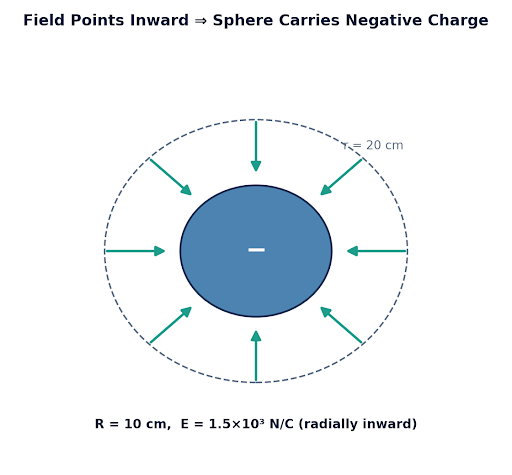
Field lines point inward toward the sphere — a signature of negative charge.
The electric field of a negative charge points towards the charge, so the sphere must have a negative charge.
Q = −6.67 × 10⁻⁹ C ≈ −6.67 nC
Question 6 — Charge and Electric Flux of a Conducting Sphere
A uniformly charged conducting sphere of 2.4 m diameter has a surface charge density of 80.0 μC/m2.
(a) Find the charge on the sphere.
(b) What is the total electric flux leaving the surface of the sphere?
Solution:
Given: D = 2.4 m, so radius r = 1.2 m; σ = 80.0 μC/m2 = 80.0 × 10⁻⁶ C/m2
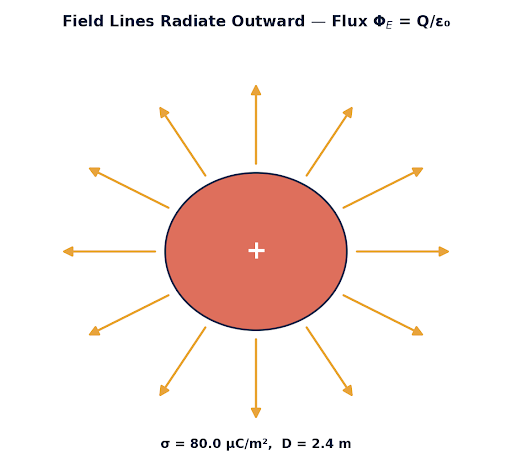
A uniformly charged sphere produces a radially outward field.
(a) Charge on the sphere
The surface area of a sphere is:
A = 4πr2
so the charge is:
Q = σA = σ(4πr2)
Q = 80 × 10−6 × 4π(1.2)2 ≈ 1.45 × 10⁻³ C
Q ≈ 1.45 × 10⁻³ C
(b) Total electric flux
According to Gauss's law:
ΦE = Q / ε0
Using:
ε0 = 8.854 × 10⁻¹² C2/(N·m2)
ΦE = (1.45 × 10⁻³) / (8.854 × 10⁻¹²)
ΦE ≈ 1.63 × 10⁸ N·m2/C
Question 7 — Linear Charge Density of an Infinite Line Charge
An infinite line charge produces a field of 9 × 10⁴ N/C at a distance of 2 cm. Calculate the linear charge density.
Solution:
Given: E = 9 × 10⁴ N/C, r = 2 cm = 0.02 m
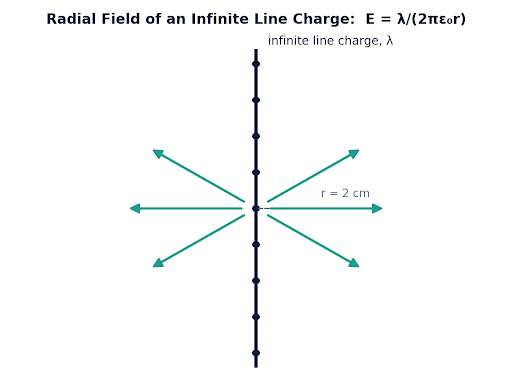
Field lines radiate outward from an infinite line charge.
For an infinite line charge:
E = λ / (2πε0r)
Rearranging:
λ = 2πε0rE
Using:
ε0 = 8.854 × 10⁻¹² C2/(N·m2)
λ = 2π(8.854 × 10⁻¹²)(0.02)(9 × 10⁴) ≈ 1.0 × 10⁻⁷ C/m
λ = 1.0 × 10⁻⁷ C/m = 0.1 μC/m
Question 8 — Electric Field Between Two Charged Plates
Two large, thin metal plates are parallel and close to each other. On their inner faces, the plates have surface charge densities of opposite signs and of magnitude 17.0 × 10⁻²² C/m2.
What is E: (a) in the outer region of the first plate, (b) in the outer region of the second plate, and (c) between the plates?
Solution:
Given: σ = 17.0 × 10⁻²² C/m2
For an infinite plane sheet of charge, the magnitude of the field produced by one sheet is:
E = σ / (2ε0)
The two plates carry equal and opposite surface charge densities.
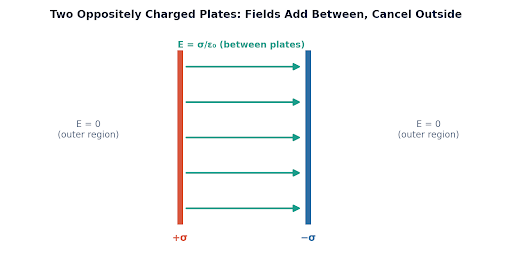
Fields from the two sheets cancel outside the plates and add between them.
(a) and (b) Outer regions of the plates
In the region outside either plate, the fields produced by the two oppositely charged plates are equal in magnitude and opposite in direction, so they cancel.
E = 0 (outside either plate)
(c) Region between the plates
Between the plates, the fields due to the two sheets act in the same direction. The field due to each sheet is:
E1 = σ / (2ε0)
Therefore:
Ebetween = σ/(2ε0) + σ/(2ε0) = σ/ε0
E = (17.0 × 10⁻²²) / (8.854 × 10⁻¹²)
E ≈ 1.92 × 10⁻¹⁰ N/C
The field is directed from the positively charged plate towards the negatively charged plate.
Key Features of These NCERT Solutions
- Exact NCERT question statements for the featured exercises
- Step-by-step working instead of final answers alone
- Formula selection explained before substitution
- Separate treatment of different parts of a question
- Direction of electric field, force and dipole moment stated wherever relevant
- SI units retained throughout calculations
- Numerical answers checked for magnitude and units
- Coverage of Coulomb's law, electric field, dipoles, electric flux, continuous charge distribution and Gauss's law
Why Use Infinity Learn for Class 12 Physics NCERT Solutions?
When using an NCERT solution, the final number is only one part of the answer. The working matters because it shows how the relevant Physics principle has been applied.
Infinity Learn's Class 12 Physics Chapter 1 solutions can be used to:
- Check your working after attempting an NCERT exercise yourself.
- Identify the formula required for a numerical problem.
- Follow the direction of electric fields and forces instead of treating them as scalar quantities.
- Revise important relations for Coulomb's law, dipoles, electric flux and Gauss's law.
- Prepare for CBSE examinations while also revising concepts that appear in JEE and NEET-level questions.
course
No courses found
FAQs on NCERT Solutions for Class 12 Physics Chapter 1 Electric Charges and Fields
What is the difference between electric field and electric potential?
Electric field is a vector quantity that describes the force experienced per unit positive test charge at a point. Electric potential is a scalar quantity that represents the potential energy per unit charge at a point. Electric field is measured in N/C or V/m, while electric potential is measured in volts (V).
How many questions are there in Class 12 Physics Chapter 1?
The NCERT chapter contains 24 numbered chapter-end exercises. The questions included on this page are selected exercises from that set, chosen to cover important numerical applications across the chapter.
When should I use Gauss's law instead of Coulomb's law?
Coulomb's law can be used to calculate the electric field produced by a point charge and can also be extended to charge distributions through integration. Gauss's law becomes especially convenient when the charge distribution has sufficient symmetry, such as spherical, cylindrical or planar symmetry.
What is the significance of electric dipole moment?
Electric dipole moment describes the strength and orientation of an electric dipole. Its direction is defined from the negative charge to the positive charge. It is used to determine quantities such as the torque experienced by a dipole in an external electric field.
Is Chapter 1 important for CBSE Class 12 Physics?
Yes. Electric Charges and Fields is part of the Electrostatics unit in the CBSE Class 12 Physics syllabus. The unit also includes Electrostatic Potential and Capacitance and carries 16 marks as a combined unit in the current syllabus structure.
Is this chapter important for JEE Main and NEET?
Yes. Electric charge, electric fields, Coulomb's law, dipoles, electric flux and Gauss's law are useful concepts for competitive-exam preparation. Solving the NCERT exercises first can help establish the basic relationships before moving to more application-heavy questions.
Are these solutions based on the latest NCERT syllabus?
The solutions use the NCERT Class 12 Physics Chapter 1 exercise questions as the source for the featured problems, matching the current CBSE-prescribed textbook structure.
