NCERT Solutions for Class 12 Math Chapter 13 Probability
By Ankit Ankit
|
Updated on 17 Sep 2026, 11:30 IST
Chapter 13, Probability, of NCERT Class 12 Mathematics develops probability beyond the basic concepts studied in earlier classes. The chapter covers conditional probability, the multiplication rule of probability, independent events, Bayes' theorem, random variables and probability distributions, mean and variance, and the binomial distribution.
These topics are important for Class 12 board preparation as well as competitive-exam preparation. The chapter requires students to apply probability formulas systematically, particularly in conditional-probability, independence, Bayes' theorem and distribution-based problems.
Infinity Learn's NCERT Solutions for Class 12 Maths Chapter 13 provide step-by-step solutions to the NCERT exercise questions, with the calculations arranged clearly so that students can follow the required method and present their answers effectively in examinations.
Download NCERT Solutions for Class 12 Maths Chapter 13 Probability
Download the PDF to access the NCERT solutions for Class 12 Maths Chapter 13 Probability and revise the exercise questions offline.
Key Concepts in Class 12 Maths Chapter 13 Probability
The chapter covers:
- Conditional probability and its properties
- Multiplication theorem on probability
- Independent events
- Partition of a sample space
- Theorem of total probability
- Bayes' theorem
- Random variables
- Probability distributions
- Mean and variance of a probability distribution
- Binomial distribution
- Bernoulli trials
NCERT Solutions for Class 12 Maths Chapter 13: Probability
The main topics covered in Chapter 13 are:
Loading PDF...
| Topic | What Students Need to Practise |
| Conditional Probability | Finding P(E | F) |
| Multiplication Theorem | Finding P(E ∩ F) |
| Independent Events | Checking whether P(E ∩ F) = P(E)·P(F) |
| Total Probability | Combining probabilities over a partition |
| Bayes' Theorem | Finding reverse conditional probabilities |
| Random Variables | Assigning numerical values to outcomes |
| Probability Distribution | Finding probabilities for values of a random variable |
| Mean | Finding the expected value of a probability distribution |
| Variance | Measuring the spread of a probability distribution |
| Binomial Distribution | Solving problems involving repeated Bernoulli trials |
Important Formulas
Conditional Probability
P(E | F) = P(E ∩ F) / P(F), P(F) ≠ 0
Multiplication Theorem
P(E ∩ F) = P(E)·P(F | E) or P(E ∩ F) = P(F)·P(E | F)

Independent Events
P(E ∩ F) = P(E)·P(F)
Best Courses for You

JEE

NEET

Foundation JEE

Foundation NEET

CBSE
Theorem of Total Probability
If E1, E2, …, En form a partition of the sample space:
P(A) = Σi=1n P(Ei)·P(A | Ei)
Bayes' Theorem
P(Ei | A) = [P(Ei)·P(A | Ei)] / Σj=1n [P(Ej)·P(A | Ej)]
Mean of a Random Variable
E(X) = Σi xi·P(X = xi)
Variance
Var(X) = E(X2) − [E(X)]2
Binomial Distribution
If X follows a binomial distribution with n trials, probability of success p, and q = 1 − p:
P(X = r) = nCr pr qn−r
CBSE Weightage for Probability
In the CBSE Class 12 Mathematics 2026–27 course structure, Unit VI: Probability carries 8 marks out of the 80-mark theory paper.
Students should therefore prepare the complete prescribed Probability syllabus rather than relying on a particular question type or assumed chapter-specific distribution of marks.
NCERT Class 12 Maths Chapter 13: All Exercises
The current NCERT 2026–27 reprint supplied for this page contains the following exercise structure:
| Exercise | Number of Questions |
| Exercise 13.1 | 18 questions |
| Exercise 13.2 | 18 questions |
| Exercise 13.3 | 14 questions |
| Miscellaneous Exercise on Chapter 13 | 13 questions |
The current reprint does not contain separately numbered Exercises 13.4 or 13.5. The chapter itself, however, continues to cover Bayes' theorem, random variables, probability distributions, mean and variance, and binomial distribution.
NCERT Class 12 Maths Chapter 13 Probability: Step-by-Step Solutions
Question 1: Given that E and F are events such that P(E) = 0.6, P(F) = 0.3 and P(E ∩ F) = 0.2, find P(E|F) and P(F|E).
Step 1: Formula for conditional probability
P(E | F) = P(E ∩ F) / P(F)
Step 2: Substitute the given values
P(E | F) = 0.2 / 0.3 = 2/3
Similarly,
P(F | E) = P(E ∩ F) / P(E) = 0.2 / 0.6 = 1/3
Answer
P(E | F) = 2/3, P(F | E) = 1/3
Question 2: A coin is tossed three times, where
(i) E: head on third toss, F: heads on first two tosses
(ii) E: at least two heads, F: at most two heads
(iii) E: at most two tails, F: at least one tail. Find P(E|F) in each case.
The sample space for three tosses is:
S = {HHH, HHT, HTH, THH, HTT, THT, TTH, TTT}
There are 8 equally likely outcomes.
(i) E = {HHH, THH, HTH, TTH}; F (first two heads) = {HHH, HHT}
Therefore E ∩ F = {HHH}, so:
P(E | F) = (1/8) / (2/8) = 1/2
(ii) E (at least two heads) = {HHH, HHT, HTH, THH}
F (at most two heads) = {HHT, HTH, THH, HTT, THT, TTH, TTT}
Therefore E ∩ F = {HHT, HTH, THH}, so P(E ∩ F) = 3/8 and P(F) = 7/8:
P(E | F) = (3/8) / (7/8) = 3/7
(iii) E (at most two tails) = all outcomes except TTT
F (at least one tail) = all outcomes except HHH
Therefore P(E ∩ F) = 6/8 and P(F) = 7/8:
P(E | F) = (6/8) / (7/8) = 6/7
Answer
(i) P(E | F) = 1/2
(ii) P(E | F) = 3/7
(iii) P(E | F) = 6/7
Question 3: A box of oranges is inspected by examining three randomly selected oranges drawn without replacement. If all three are good, the box is approved for sale. Find the probability that a box of 15 oranges, 12 good and 3 bad, will be approved for sale.
For the box to be approved, all three selected oranges must be good.
Step 1–3: Probabilities at each draw
P(G1) = 12/15, P(G2 | G1) = 11/14, P(G3 | G1G2) = 10/13
Step 4: Apply the multiplication theorem
P(G1 ∩ G2 ∩ G3) = (12/15) × (11/14) × (10/13) = 44/91
Answer
44/91
Question 4: Probability of solving a specific problem independently by A and B are 1/2 and 1/3 respectively. If both try independently, find the probability that (i) the problem is solved (ii) exactly one of them solves the problem.
Given
P(A) = 1/2, P(B) = 1/3
Therefore P(A′) = 1/2 and P(B′) = 2/3. Since A and B work independently, P(A ∩ B) = P(A)·P(B).
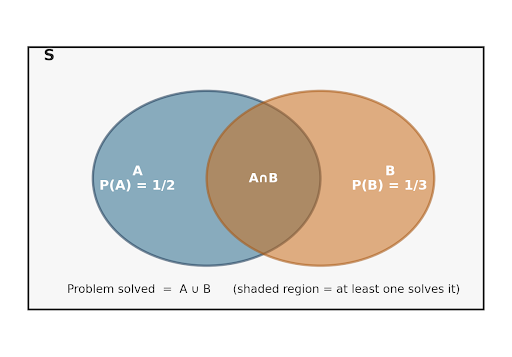
Fig. 1 — Venn diagram: the problem is solved if the outcome falls in A ∪ B.
(i) Probability that the problem is solved
The problem is solved if at least one of A or B solves it:
P(A ∪ B) = 1 − P(A′)·P(B′) = 1 − (1/2 × 2/3) = 1 − 1/3 = 2/3
(ii) Probability that exactly one solves the problem
Exactly one solves the problem when A solves and B does not, or B solves and A does not:
P(exactly one) = P(A ∩ B′) + P(A′ ∩ B) = (1/2 × 2/3) + (1/2 × 1/3) = 1/3 + 1/6 = 1/2
Answer
(i) P(problem solved) = 2/3
(ii) P(exactly one) = 1/2
Question 5: An urn contains 5 red and 5 black balls. A ball is drawn at random, its colour noted and returned, with 2 additional balls of that colour added. A second ball is then drawn. Find the probability that the second ball is red.
Let R₁ = red drawn first, B₁ = black drawn first, R₂ = red drawn second. Initially P(R₁) = P(B₁) = 1/2.
Case 1: First ball is red (2 red balls added → 7 red, 5 black)
P(R2 | R1) = 7/12
Case 2: First ball is black (2 black balls added → 5 red, 7 black)
P(R2 | B1) = 5/12
Apply the theorem of total probability
P(R2) = P(R1)P(R2|R1) + P(B1)P(R2|B1)
= (1/2 × 7/12) + (1/2 × 5/12) = 7/24 + 5/24 = 1/2
Answer: 1/2
Question 6: In a college, 60% of students reside in the hostel and 40% are day scholars. 30% of hostellers and 20% of day scholars attain an A grade. A student chosen at random has an A grade — what is the probability that the student is a hosteller?
Given
P(H) = 0.6, P(D) = 0.4
P(A | H) = 0.3, P(A | D) = 0.2
We need P(H | A). Apply Bayes' theorem:
P(H | A) = [P(H)·P(A|H)] / [P(H)·P(A|H) + P(D)·P(A|D)]
= (0.6×0.3) / (0.6×0.3 + 0.4×0.2) = 0.18 / (0.18 + 0.08) = 0.18/0.26 = 9/13
Answer: 9/13
Question 7: A factory has two machines A and B. Machine A produces 60% of output, machine B produces 40%. 2% of A's items and 1% of B's items are defective. An item chosen at random is found defective — what is the probability that it was produced by machine B?
Given
P(A) = 0.6, P(B) = 0.4
P(D | A) = 0.02, P(D | B) = 0.01
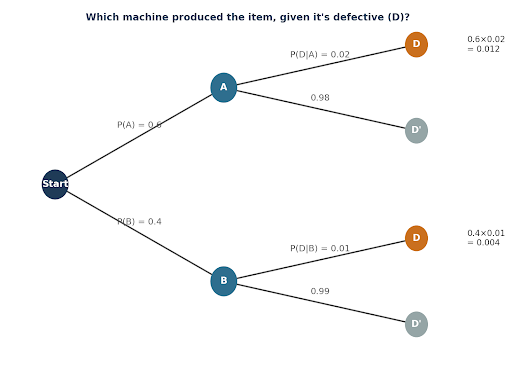
Fig. 2 — Probability tree: machine choice, then defective / not-defective outcomes.
We need P(B | D). Apply Bayes' theorem:
P(B | D) = [P(B)·P(D|B)] / [P(A)·P(D|A) + P(B)·P(D|B)]
= (0.4×0.01) / (0.6×0.02 + 0.4×0.01) = 0.004 / (0.012 + 0.004) = 0.004/0.016 = 1/4
Answer: 1/4
Question 8: A couple has two children.
(i) Find the probability that both children are males, given that at least one is male.
(ii) Find the probability that both are females, given that the elder child is female.
Assume each child is equally likely to be male or female. The sample space is {MM, MF, FM, FF}, each with probability 1/4.
(i) Both males, given at least one male
Outcomes with at least one male: {MM, MF, FM}
P(both male | at least one male) = P(MM) / [P(MM)+P(MF)+P(FM)] = (1/4) / (3/4) = 1/3
(ii) Both females, given the elder child is female
If the elder child is female, possible outcomes are {FM, FF}; only FF has both female:
P(FF | elder is female) = 1/2
Answer
(i) 1/3
(ii) 1/2
Question 9: Suppose that 90% of people are right-handed. What is the probability that at most 6 of a random sample of 10 people are right-handed?
Given
n = 10, p = 0.9, q = 1 − p = 0.1
Using the binomial probability formula:
P(X = r) = 10Cr (0.9)r (0.1)10−r
We need P(X ≤ 6) = P(X=0) + P(X=1) + ⋯ + P(X=6):
P(X ≤ 6) = Σr=0610Cr(0.9)r(0.1)10−r
= 7996999/625000000 ≈ 0.0128
Answer: P(X ≤ 6) ≈ 0.0128
Question 10: If a leap year is selected at random, what is the chance that it will contain 53 Tuesdays?
A leap year contains:
366 = 52 × 7 + 2
Every weekday occurs at least 52 times, and two consecutive weekdays occur 53 times. For 53 Tuesdays, Tuesday must be one of the two “extra” weekdays. There are 7 equally likely possibilities for the first extra weekday, and Tuesday occurs in 2 of them:
P(53 Tuesdays) = 2/7
Answer: 2/7
Question 11: Bag I contains 3 red and 4 black balls; Bag II contains 4 red and 5 black balls. One ball is transferred from Bag I to Bag II, and then a ball is drawn from Bag II. It is found to be red. Find the probability that the transferred ball was black.
Let B = transferred ball is black, R = transferred ball is red, D = ball drawn from Bag II is red. Initially P(B) = 4/7 and P(R) = 3/7.
Case 1: A black ball is transferred (Bag II → 4 red, 6 black)
P(D | B) = 4/10 = 2/5
Case 2: A red ball is transferred (Bag II → 5 red, 5 black)
P(D | R) = 5/10 = 1/2
Apply Bayes' theorem
P(B | D) = [P(B)·P(D|B)] / [P(B)·P(D|B) + P(R)·P(D|R)]
= (4/7 × 2/5) / (4/7 × 2/5 + 3/7 × 1/2) = (8/35) / (8/35 + 3/14) = 16/(16+15) = 16/31
Answer: 16/31
Key Features of These NCERT Solutions
- Exact NCERT question statements for the selected questions
- Step-by-step calculations for numerical problems
- Formula-first approach for probability questions
- Clear working for conditional probability and Bayes' theorem
- Separate treatment of independent-event problems
- Structured probability calculations for repeated trials
- Solutions designed for clear examination presentation
- Coverage of questions from the current NCERT exercise structure
- Useful for CBSE board preparation and competitive-exam practice
Why Choose Infinity Learn NCERT Solutions for This Chapter?
Probability problems can involve several stages of calculation, particularly when conditional probability, independent events and Bayes' theorem are involved. Infinity Learn's solutions present the calculation in a structured sequence so students can identify the appropriate formula, substitute the given values and reach the final answer systematically.
The solutions also help students revise the chapter through NCERT exercise questions rather than relying only on formula memorisation.
Students can use Infinity Learn's Class 12 Maths resources for NCERT solutions, practice material, video lessons and additional exam preparation. Infinity Learn also provides Class 12 learning resources and competitive-exam preparation through its platform.
Download NCERT Solutions for Class 12 Maths Chapter 13 Probability
Download the free PDF of the NCERT Solutions for Class 12 Maths Chapter 13 Probability to revise the complete exercise set and study the step-by-step solutions offline.
For additional Class 12 Maths learning resources, practice material and exam preparation, explore Infinity Learn's Class 12 resources.
course
No courses found
FAQs on NCERT Solutions for Class 12 Math Chapter 13 Probability
What is the difference between conditional probability and independent events?
Conditional probability finds the probability of an event when the occurrence of another event is known. Two events are independent when the occurrence of one does not change the probability of the other.
How many exercises does Class 12 Maths Chapter 13 Probability contain?
Chapter 13 contains five numbered exercises, Exercises 13.1 to 13.5, followed by a Miscellaneous Exercise. The exercises progress from conditional probability and independent events to Bayes' theorem, random variables, probability distributions and binomial distribution.
How is Bayes' theorem used to solve probability problems?
Bayes' theorem is used to determine the probability of a particular cause or event when related information about an observed event is known:
P(Ei|A) = P(Ei)P(A|Ei) / Σj P(Ej)P(A|Ej)
What is a random variable and how is its probability distribution defined?
A random variable assigns a numerical value to each outcome of a random experiment. Its probability distribution lists the possible values of the random variable along with their corresponding probabilities.
What are Bernoulli trials and how do they relate to binomial distribution?
Bernoulli trials are repeated independent trials in which each trial has two possible outcomes, generally described as success and failure. The binomial distribution gives the probability of obtaining a specified number of successes in a fixed number of Bernoulli trials.
How important is Chapter 13 for CBSE Class 12 board exams?
Probability is an important part of Class 12 Mathematics. Students should prepare the complete prescribed chapter rather than relying on an assumed fixed chapter-wise mark allocation.
Are Infinity Learn's NCERT Solutions for Chapter 13 updated as per the latest syllabus?
Infinity Learn's NCERT Solutions should be aligned with the currently prescribed NCERT content and applicable CBSE syllabus. Students should use the current edition of the textbook and syllabus when preparing for examinations.
Is Probability important for JEE Main and other competitive exams?
Yes. Conditional probability, Bayes' theorem, probability distributions and binomial probability are important probability concepts for competitive mathematics
