- Key Concepts Covered in Class 12 Math Chapter 5 – Continuity and Differentiability
- NCERT Solutions for Class 12 Maths Chapter 5 – Continuity and Differentiability PDF
- Chapter Overview and Important Results
- Selected NCERT Questions, Grouped by Concept
- Class 12 Maths Continuity and Differentiability Exercises
- Key Features of Infinity Learn NCERT Solutions for Class 12 Math Chapter 5
- Why Use NCERT Solutions for Continuity and Differentiability?
- Study Class 12 Math with Infinity Learn
- Frequently Asked Questions on NCERT Solutions for Class 12 Math Chapter 5
NCERT Solutions for Class 12 Math Chapter 5 – Continuity and Differentiability
By Karan singh ildefaultfield
|
Updated on 15 Sep 2026, 11:40 IST
Continuity and Differentiability marks an important step into advanced calculus in Class 12 Math. The chapter explores whether a function behaves continuously at a point and whether its derivative exists. Students study continuity, differentiability, derivatives of composite functions, inverse trigonometric functions, exponential and logarithmic functions, along with logarithmic differentiation and second-order derivatives. NCERT Solutions for Class 12 Math Chapter 5 Continuity and Differentiability explain the textbook problems through structured steps and calculations. These NCERT Solutions can help students understand how formulas are applied in different situations instead of relying only on memorization.
Key Concepts Covered in Class 12 Math Chapter 5 – Continuity and Differentiability
The chapter covers the following important concepts:
- Continuity of a function at a point
- Continuity over an interval and over the whole domain
- Locating the points where a function is discontinuous
- Continuity of piecewise defined functions
- Differentiability, and why a continuous function need not be differentiable
- The chain rule for a function inside another function
- Derivatives of implicit functions
- Derivatives of exponential and logarithmic functions
- Logarithmic differentiation for products, quotients and powers
- Derivatives of functions given in parametric form
- Second-order derivatives
NCERT Solutions for Class 12 Maths Chapter 5 – Continuity and Differentiability PDF
Chapter Overview and Important Results
Continuity at a Point
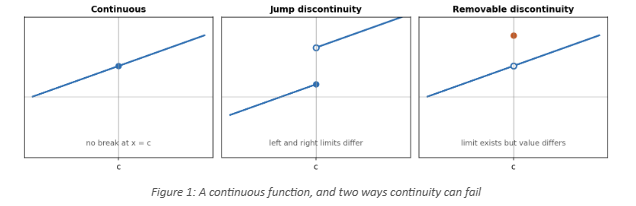
A function is continuous at a point when there is no break in its graph there. Three separate conditions must all hold.
- f(c) is defined
- the limit of f(x) as x approaches c exists
- that limit equals f(c)
For the limit to exist, the left-hand limit and the right-hand limit must agree. So the full test is that the left limit, the right limit, and the value of the function are all the same number.
Loading PDF...
Differentiability
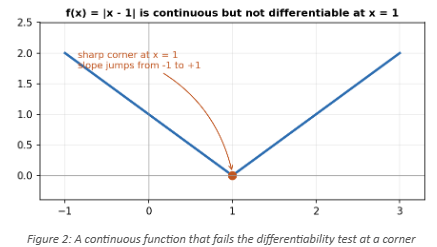
A function is differentiable at a point when it has a definite slope there. Every differentiable function is continuous, but the reverse is not true. A graph can be unbroken and still have a sharp corner, and at a corner the slope is not defined.
Rules for Differentiating
- Chain rule: if y = f(u) and u = g(x), then dy/dx = (dy/du) x (du/dx)
- Product rule: (uv)′ = u′v + uv′
- Quotient rule: (u/v)′ = (u′v − uv′) / v²
- d/dx (eˣ) = eˣ d/dx (log x) = 1/x
Implicit, Logarithmic and Parametric Differentiation
- Implicit differentiation is used when y is not written on its own. Differentiate both sides with respect to x, remembering that every y term carries a factor of dy/dx, then collect the dy/dx terms together.
- Logarithmic differentiation is used when the function is a long product, a quotient, or has a variable in the power. Take the logarithm of both sides first, which turns products into sums and brings powers down as multipliers.
- Parametric differentiation is used when x and y are both given in terms of a third variable such as t. dy/dx = (dy/dt) ÷ (dx/dt)
Selected NCERT Questions, Grouped by Concept
The questions below are taken from across the chapter and arranged by concept rather than by exercise number, so that each technique can be practiced as one block.
| Concept | What the questions test | Source |
| A. Continuity at a point | Applying the three-part test | Ex 5.1 Q1, Q2, Q4 |
| B. Discontinuity and corners | Piecewise functions and differentiability | Ex 5.1 Q6; Ex 5.2 Q9 |
| C. Chain rule | Differentiating a function inside a function | Ex 5.2 Q1, Q2 |
| D. Implicit differentiation | Finding dy/dx without isolating y | Ex 5.3 Q1, Q5, Q8 |
| E. Exponential and logarithmic | Derivatives of e and log expressions | Ex 5.4 Q6, Q9 |
| F. Logarithmic differentiation | Long products and variable powers | Ex 5.5 Q1, Q3, Q5 |
| G. Parametric form | dy/dx through a third variable | Ex 5.6 Q1 |
| H. Second-order derivatives | Differentiating twice | Ex 5.7 Q2, Q4 |
Class 12 Maths Continuity and Differentiability Exercises
Concept A: Continuity at a Point

Q1. Ex 5.1 Q1: Prove that f(x) = 5x − 3 is continuous at x = 0, at x = −3 and at x = 5.
Step 1. At x = 0. The value is f(0) = 5(0) − 3 = −3. The limit as x approaches 0 is 5(0) − 3 = −3. They agree, so f is continuous at x = 0.
Best Courses for You

JEE

NEET

Foundation JEE

Foundation NEET

CBSE
Step 2. At x = −3. The value is f(−3) = 5(−3) − 3 = −18. The limit is also −18. They agree.
Step 3. At x = 5. The value is f(5) = 5(5) − 3 = 22. The limit is also 22. They agree.
Answer: f is continuous at all three points.
Remember: for a polynomial, the limit can always be found by substituting the value directly. Every polynomial is continuous everywhere.
Q2. Ex 5.1 Q2: Examine whether f(x) = 2x² − 1 is continuous at x = 3.
Step 1. Value. f(3) = 2(9) − 1 = 17.
Step 2. Limit. As x approaches 3, 2x² − 1 approaches 2(9) − 1 = 17.
Step 3. Compare. The limit equals the value.
lim f(x) = f(3) = 17, so f is continuous at x = 3
Q3. Ex 5.1 Q4: Prove that f(x) = xⁿ is continuous at x = n, where n is a positive integer.
Step 1. Value. Substituting x = n gives f(n) = nⁿ.
Step 2. Limit. As x approaches n, xⁿ approaches nⁿ, since a power function is built from repeated multiplication and limits pass through products.
Step 3. Compare. The limit equals the value, so the function is continuous at x = n.
Remember: the letter n is doing two jobs here, as the power and as the point. That is deliberate, and it does not change the method.
Concept B: Discontinuity and Corners
Q4. Ex 5.1 Q6: Find all points of discontinuity of f, where f(x) = 2x + 3 if x ≤ 2, and f(x) = 2x − 3 if x > 2.
Step 1. Each piece is a polynomial, so the only place a break can occur is where the definition changes, at x = 2.
Step 2. Left-hand limit. Approaching from below uses the first piece: 2(2) + 3 = 7.
Step 3. Right-hand limit. Approaching from above uses the second piece: 2(2) − 3 = 1.
Step 4. Compare. The two limits are 7 and 1, which are different, so the limit does not exist at x = 2.
f is discontinuous only at x = 2
Remember: with a piecewise function, only test the joining points. Everywhere else, each piece is already continuous.
Q5. Ex 5.2 Q9: Prove that f(x) = |x − 1|, for x in R, is not differentiable at x = 1.
Step 1. Write the function without the modulus. For x ≥ 1, it is x − 1, and for x < 1, it is 1 − x.
Step 2. Slope from the right. The piece x − 1 has derivative +1.
Step 3. Slope from the left. The piece 1 − x has derivative −1.
Step 4. Compare. The two one-sided derivatives are +1 and −1, which do not agree, so no single slope exists at x = 1.
f is continuous at x = 1 but not differentiable there
Remember: this is the standard example showing that continuity does not guarantee differentiability. The graph has a sharp corner at x = 1.
Concept C: The Chain Rule
Q6. Ex 5.2 Q1: Differentiate sin(x² + 5) with respect to x.
Step 1. Identify the layers. The outer function is sine, and the inner function is x² + 5.
Step 2. Differentiate the outer layer, keeping the inside unchanged: cos(x² + 5).
Step 3. Multiply by the derivative of the inside, which is 2x.
dy/dx = 2x cos(x² + 5)
Remember: forgetting the inner derivative is the single most common chain rule error. Writing only cos(x² + 5) loses the marks.
Q7. Ex 5.2 Q2: Differentiate cos(sin x) with respect to x.
Step 1. The outer function is cosine, and the inner function is sin x.
Step 2. Differentiating the outer layer gives −sin(sin x).
Step 3. The derivative of the inside is cos x.
dy/dx = −sin(sin x) · cos x
Remember: sin(sin x) is not the same as sin² x. Keep the inner function written inside its own bracket.
Concept D: Implicit Differentiation
Q8. Ex 5.3 Q1: Find dy/dx if 2x + 3y = sin x.
Step 1. Differentiate every term with respect to x. The term 3y gives 3 dy/dx because y is a function of x.
2 + 3 dy/dx = cos x
Step 2. Rearrange to isolate dy/dx.
dy/dx = (cos x − 2) / 3
Q9. Ex 5.3 Q5: Find dy/dx if x² + xy + y² = 100.
Step 1. Differentiate term by term. The middle term xy needs the product rule, giving y + x dy/dx. The term y² gives 2y dy/dx.
2x + y + x dy/dx + 2y dy/dx = 0
Step 2. Collect the dy/dx terms on one side.
dy/dx (x + 2y) = −(2x + y)
dy/dx = −(2x + y) / (x + 2y)
Remember: the term xy is a product of two functions of x, so it needs the product rule, not just a dy/dx.
Q10. Ex 5.3 Q8: Find dy/dx if sin² x + cos² y = 1.
Step 1. Differentiate each term. For sin² x, the chain rule gives 2 sin x cos x. For cos² y, it gives 2 cos y (−sin y) dy/dx.
2 sin x cos x − 2 cos y sin y (dy/dx) = 0
Step 2. Both sides simplify using the double-angle identity, since 2 sin A cos A = sin 2A.
sin 2x = sin 2y (dy/dx)
dy/dx = sin 2x / sin 2y
Concept E: Exponential and Logarithmic Functions
Q11. Ex 5.4 Q6: Differentiate log(cos eˣ) with respect to x.
Step 1. Three layers here. The outermost is log, then cosine, then e to the power of x.
Step 2. Differentiating the log layer gives 1 divided by (cos eˣ).
Step 3. Multiply by the derivative of cos eˣ, which is −sin(eˣ) times eˣ.
dy/dx = −eˣ sin(eˣ) / cos(eˣ) = −eˣ tan(eˣ)
Remember: peel the layers from the outside inwards, one at a time, and multiply as you go.
Q12. Ex 5.4 Q9: Differentiate log(log x), for x > 1, with respect to x.
Step 1. The outer function is log, and the inner function is log x.
Step 2. Differentiating the outer layer gives 1 divided by (log x).
Step 3. The derivative of the inside is 1/x.
dy/dx = 1 / (x log x)
Concept F: Logarithmic Differentiation
Q13. Ex 5.5 Q1: Differentiate y = cos x · cos 2x · cos 3x with respect to x.
Step 1. This is a product of three factors, so take the logarithm of both sides. Logs turn products into sums.
log y = log(cos x) + log(cos 2x) + log(cos 3x)
Step 2. Differentiate both sides. The left side gives (1/y) dy/dx.
(1/y) dy/dx = −tan x − 2 tan 2x − 3 tan 3x
Step 3. Multiply through by y and put the original expression back.
dy/dx = −cos x cos 2x cos 3x [ tan x + 2 tan 2x + 3 tan 3x ]
Remember: the coefficients 2 and 3 come from the chain rule on cos 2x and cos 3x. Leaving them out is the usual error.
Q14. Ex 5.5 Q3: Differentiate y = (log x)^(cos x) with respect to x.
Step 1. The variable appears in the power, so logarithms are the only way in. Take the log of both sides.
log y = cos x · log(log x)
Step 2. Differentiate. The right side is a product, so use the product rule.
(1/y) dy/dx = −sin x · log(log x) + cos x · 1/(x log x)
Step 3. Multiply by y.
dy/dx = (log x)^(cos x) [ cos x/(x log x) − sin x log(log x) ]
Remember: whenever x appears in the base and in the power, take logs first. The ordinary power rule does not apply.
Q15. Ex 5.5 Q5: Differentiate y = (x + 3)² (x + 4)³ (x + 5)⁴ with respect to x.
Step 1. Take logs, which brings every power down to the front as a multiplier.
log y = 2 log(x + 3) + 3 log(x + 4) + 4 log(x + 5)
Step 2. Differentiate both sides.
(1/y) dy/dx = 2/(x+3) + 3/(x+4) + 4/(x+5)
Step 3. Multiply by y.
dy/dx = (x+3)²(x+4)³(x+5)⁴ [ 2/(x+3) + 3/(x+4) + 4/(x+5) ]
Remember: expanding this product first would take far longer and invites mistakes. Logs turn it into three simple fractions.
Concept G: Parametric Form
Q16. Ex 5.6 Q1: Find dy/dx if x = 2at² and y = at⁴, without eliminating the parameter.
Step 1. Differentiate x with respect to t. dx/dt = 4at.
Step 2. Differentiate y with respect to t. dy/dt = 4at³.
Step 3. Divide.
dy/dx = 4at³ ÷ 4at = t²
Remember: differentiate each equation separately with respect to the parameter, then divide dy/dt by dx/dt. Do not try to make y the subject first.
Concept H: Second Order Derivatives
Q17. Ex 5.7 Q2: Find the second-order derivative of y = x²⁰.
Step 1. First derivative. Bring the power down and reduce it by one: dy/dx = 20x¹⁹.
Step 2. Differentiate again, applying the same rule to 20x¹⁹.
d²y/dx² = 20 × 19 x¹⁸ = 380 x¹⁸
Q18. Ex 5.7 Q4: Find the second-order derivative of y = log x.
Step 1. First derivative. dy/dx = 1/x, which can be written as x to the power −1.
Step 2. Differentiate again. Applying the power rule to x⁻¹ gives −1 x⁻².
d²y/dx² = −1/x²
Remember: rewriting 1/x as x⁻¹ turns a fraction into a simple power, which is easier to differentiate correctly.
Key Features of Infinity Learn NCERT Solutions for Class 12 Math Chapter 5
- Covers selected questions arranged in eight concept groups rather than in exercise order.
- Each group can be practiced as a complete technique, from continuity through to second-order derivatives.
- Every continuity proof checks the value, the left limit, and the right limit separately.
- Chain rule solutions name the outer and inner layers before differentiating.
- Flags the Mean Value Theorem material withdrawn in the rationalization.
- Prepared in line with the current NCERT textbook.
Why Use NCERT Solutions for Continuity and Differentiability?
This chapter carries more marks than any other in the Calculus unit, and almost all of them come down to choosing the right technique and then applying it carefully. Once a student can recognize which method a question calls for, the rest is routine.
Students can use these solutions to:
- Run the three-part continuity test in the same order every time.
- Test only the joining points of a piecewise function, rather than every point.
- Name the outer and inner layers before starting a chain rule question.
- Recognize when to switch to logarithmic differentiation, which is whenever there is a long product or a variable power.
- Handle parametric questions by differentiating with respect to the parameter first.
Study Class 12 Math with Infinity Learn
Infinity Learn provides NCERT Solutions for every chapter of the current Class 12 Math syllabus, with step-by-step working, solutions written in the order the CBSE marking scheme expects, and clear labeling of the topics affected by the rationalization, so no time is spent on material that is no longer examined.
Practice chapter by chapter, check your method against the worked solutions, and revise the key results before your board examination. Start with the questions on this page, then continue through the rest of the syllabus with Infinity Learn.
course
No courses found
Frequently Asked Questions on NCERT Solutions for Class 12 Math Chapter 5
What are the three conditions for continuity at a point?
The function must be defined at the point, the limit as x approaches that point must exist, and that limit must equal the value of the function. All three must hold. For the limit to exist, the left- and right-hand limits must be equal.
Can a function be continuous but not differentiable?
Yes. The standard example is f(x) = |x − 1| at x = 1. The graph is unbroken there, so the function is continuous, but it has a sharp corner, and the slope approaching from the left is −1 while from the right it is +1. Since the two do not agree, no derivative exists at that point.
When should I use logarithmic differentiation?
Use it when the function is a long product or quotient, or when the variable appears in the power. Taking logs turns products into sums and brings powers down to the front, which makes the differentiation much shorter.
How do I differentiate an implicit function?
Differentiate every term on both sides with respect to x. Each term containing y produces a factor of dy/dx by the chain rule, and any product of x and y terms needs the product rule. Then collect the dy/dx terms together and make dy/dx the subject.
How do I find dy/dx when x and y are given in terms of t?
Differentiate x with respect to t and y with respect to t separately, then divide dy/dt by dx/dt. There is no need to eliminate the parameter first.
What is the most common mistake in chain rule questions?
Forgetting to multiply by the derivative of the inner function. For sin(x² + 5), the answer is 2x cos(x² + 5), not cos(x² + 5). Naming the outer and inner layers before starting prevents this.
Is the Mean Value Theorem still part of Chapter 5?
No. Section 5.8 on the Mean Value Theorem and the whole of Exercise 5.8 were withdrawn in the rationalization, so Rolle’s Theorem and Lagrange’s Mean Value Theorem are not examined from this chapter in the current syllabus.
How many marks does Chapter 5 carry in the CBSE Class 12 Math examination?
Chapter 5 sits in Unit III, Calculus, which is the largest unit in the paper. The syllabus assigns marks to the unit as a whole rather than to Chapter 5 on its own, so the exact figure should be checked against the current marking scheme.
