- Download Class 12 Physics Chapter 2 NCERT Solutions
- Key Concepts Covered in Chapter 2
- NCERT Class 12 Physics Chapter 2: Structure and Key Topics
- Important Formulas for Chapter 2
- Electrostatic Potential and Capacitance Chapter 2 and CBSE Board Examinations
- Key Features of NCERT Solutions for Class 12 Physics Chapter 2
- Why Use Infinity Learn NCERT Solutions for Chapter 2?
- FAQs on NCERT Solutions for Class 12 Physics Chapter 2
NCERT Solutions for Class 12 Physics Chapter 2 Electrostatic Potential and Capacitance
By Karan singh ildefaultfield
|
Updated on 1 Oct 2026, 12:44 IST
Electrostatic Potential and Capacitance is Chapter 2 of the NCERT Class 12 Physics textbook. It takes the discussion of electric charges and fields from Chapter 1 further by introducing a scalar quantity, electric potential, and then applying the idea of potential to charge systems, conductors and capacitors.
The chapter covers electric potential and potential difference, potential due to point charges and electric dipoles, equipotential surfaces, electrostatic potential energy, conductors, dielectrics, capacitance, capacitor combinations and energy stored in a capacitor.
For many students, the difficulty begins when a question combines more than one concept. A capacitor problem, for example, may require you to first find an equivalent capacitance and then use the result to determine charge, potential difference or stored energy. Similarly, potential questions involving several charges require careful attention to signs and distances.
These NCERT Solutions for Class 12 Physics Chapter 2 show the working behind the answer rather than giving only the final value. The selected solutions below use the exact NCERT exercise questions and explain the relevant formula, substitution and reasoning step by step. The concepts are useful for CBSE Class 12 preparation as well as JEE Main and NEET revision.
Download Class 12 Physics Chapter 2 NCERT Solutions
Get these NCERT Solutions for Class 12 Physics Chapter 2 to practise the exercise questions on electrostatic potential and capacitance, check your calculations and revise the formulas used in capacitor problems. For more chapter-wise support, explore Infinity Learn's Class 12 Physics course for video lessons, practice questions and additional revision resources.
Key Concepts Covered in Chapter 2
1. Electrostatic Potential and Potential Difference
Loading PDF...
Electric potential at a point is defined as the work done per unit positive test charge in bringing it from infinity to that point. Potential difference describes the difference in potential between two points.
2. Potential Due to a Point Charge
For a point charge (Q), taking the potential at infinity as zero,
V = 1⁄(4πε0) · Q⁄r

Unlike electric field, electric potential is a scalar quantity.
3. Potential Due to a System of Charges
Best Courses for You

JEE

NEET

Foundation JEE

Foundation NEET

CBSE
The potential produced by several point charges is the algebraic sum of the individual potentials:
V = 1⁄(4πε0) Σᵢ (qi⁄ri)
This is particularly useful in problems involving symmetrical charge arrangements.
4. Potential Due to an Electric Dipole
An electric dipole consists of two equal and opposite charges separated by a small distance. The potential produced by a dipole depends on the position of the observation point relative to the dipole.
5. Equipotential Surfaces
An equipotential surface has the same electric potential at every point. No work is done by the electrostatic field when a charge is moved along an equipotential surface.
The electric field is always perpendicular to an equipotential surface.
6. Electrostatic Potential Energy
The chapter explains the potential energy of a system of charges and the potential energy of a charge or dipole placed in an external electric field.
For a charge (q) at a point having potential (V),
U = qV
7. Electrostatics of Conductors
In electrostatic equilibrium, the electric field inside a conductor is zero. Excess charge resides on the surface of the conductor.
8. Dielectrics and Polarisation
A dielectric is an insulating material that becomes polarised when placed in an electric field. Placing a dielectric between the plates of a capacitor changes its capacitance.
9. Capacitors and Capacitance
Capacitance measures the charge stored per unit potential difference:
C = Q⁄V
The SI unit of capacitance is the farad (F).
10. Parallel Plate Capacitor
For a parallel plate capacitor with air or vacuum between the plates,
C = ε0A⁄d
where (A) is the area of each plate and (d) is the separation between them.
11. Combination of Capacitors
For capacitors connected in parallel,
Ceq = C1 + C2 + C3 + ⋯
For capacitors connected in series,
1⁄Ceq = 1⁄C1 + 1⁄C2 + 1⁄C3 + ⋯
12. Energy Stored in a Capacitor
The energy stored in a capacitor is
U = ½ CV2
It can also be written as
U = ½ QV
or
U = Q2⁄2C
NCERT Class 12 Physics Chapter 2: Structure and Key Topics
Chapter 2 develops electrostatics through potential and then uses the same ideas to explain capacitors and energy storage.
The main topics are:
- Electrostatic potential
- Potential difference
- Potential due to a point charge
- Potential due to an electric dipole
- Potential due to a system of charges
- Equipotential surfaces
- Relation between electric field and potential
- Potential energy of a system of charges
- Potential energy in an external field
- Electrostatics of conductors
- Dielectrics and polarisation
- Capacitors and capacitance
- Parallel plate capacitor
- Effect of dielectric on capacitance
- Capacitors in series and parallel
- Energy stored in a capacitor
- Van de Graaff generator
Important Formulas for Chapter 2
Here are the tables formatted cleanly and professionally using standard Markdown:
| S.NO. | CONCEPT / TOPIC | FORMULA (MATHEMATICAL EQUATION) | KEY SYMBOLS & EXPLANATION |
| 1 | Electric Potential (V) | V = W/q | V: Potential, W: Work Done, q: Test Charge |
| 2 | Potential due to Point Charge | V = (1/4πε₀) × (q/r) | ε₀: Permittivity of Free Space, q: Source Charge, r: Distance |
| 3 | Relationship: E and V | E = -dV/dr | E: Electric Field, V: Potential, r: Position |
| 4 | Potential Energy (U) - Pair of Charges | U = (1/4πε₀) × (q₁q₂/r) | q₁, q₂: Charges, r: Separation |
| 5 | Capacitance (C) | C = Q/V | C: Capacitance, Q: Charge, V: Potential Difference |
| 6 | Parallel Plate Capacitor | C = ε₀A/d | A: Area, d: Separation (no dielectric) |
| 7 | Capacitor with Dielectric (K) | C' = K × C = Kε₀A/d | K: Dielectric Constant |
| 8 | Energy Stored in Capacitor (U) | U = 1/2 QV = 1/2 CV² = 1/2 Q²/C | U: Stored Potential Energy |
Important Constants for Class 12 Physics Chapter 2
| CONSTANT | SYMBOL | VALUE (S.I. UNITS) | DESCRIPTION |
| Permittivity of Free Space | ε₀ | 8.854 × 10⁻¹² F/m | Fundamental physical constant |
| Elementary Charge (Proton/Electron) | e | 1.602 × 10⁻¹⁹ C | Charge of a single electron e ≈ 1.6 × 10⁻¹⁹ C (approx.) |
| Mass of Electron | mₑ | 9.109 × 10⁻³¹ kg | Rest mass of an electron |
| Mass of Proton | mₚ | 1.672 × 10⁻²⁷ kg | Rest mass of a proton |
| Electrostatic Constant (k) | k = 1/(4πε₀) | ≈ 9 × 10⁹ N·m²/C² | Coulomb's constant |
Electrostatic Potential and Capacitance Chapter 2 and CBSE Board Examinations
Chapter 2 is part of Unit I: Electrostatics, together with Chapter 1, Electric Charges and Fields. The CBSE 2026–27 Physics syllabus assigns 16 marks to the combined unit, rather than a separate fixed weightage to Chapter 2.
This makes it important to prepare both chapters together. Questions from this area can test definitions and concepts as well as numerical applications involving potential, capacitance, dielectrics and capacitor combinations. The concepts also provide useful preparation for competitive examinations, where a problem may require several steps rather than direct substitution into a single formula.
Question 1: Finding the Point Where Potential Is Zero
Question
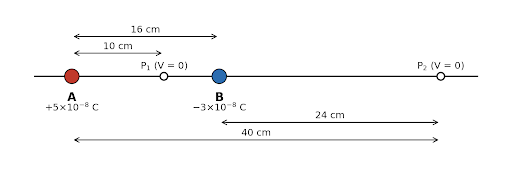
Two charges 5 × 10⁻⁸ C and −3 × 10⁻⁸ C are located 16 cm apart. At what point(s) on the line joining the two charges is the electric potential zero? Take the potential at infinity to be zero.
Solution
Let the charges be
q1 = 5×10⁻⁸ C
and
q2 = −3×10⁻⁸ C
Their separation is
d = 16 cm = 0.16 m
The potential due to a point charge is
V = 1⁄(4πε0) · q⁄r
Because potential is a scalar, the potentials due to the two charges are added algebraically.
For zero net potential,
V1 + V2 = 0
or
5⁄r1 − 3⁄r2 = 0
We need to examine the possible positions of the point.
Case 1: Point between the charges
Let the point be (r) metres from the (+5×10⁻⁸ C) charge.
Its distance from the negative charge is
0.16 − r
Therefore,
5⁄r = 3⁄(0.16 − r)
Cross-multiplying,
5(0.16 − r) = 3r
0.8 − 5r = 3r
8r = 0.8
r = 0.10 m
Thus, one point is 10 cm from the positive charge, between the two charges.
Case 2: Point outside the charges
The second zero-potential point lies on the side of the charge with the smaller magnitude, i.e. the (−3×10⁻⁸ C) charge.
Let its distance from the positive charge be (r). Its distance from the negative charge is then
r − 0.16
Therefore,
5⁄r = 3⁄(r − 0.16)
5(r − 0.16) = 3r
5r − 0.8 = 3r
2r = 0.8
r = 0.40 m
So the second point is 40 cm from the positive charge.
It is (24,cm) from the negative charge.
Answer
The electric potential is zero at:
- 10 cm from the positive charge, between the two charges.
- 40 cm from the positive charge, outside the pair on the side of the negative charge.
Question 2: Potential at the Centre of a Regular Hexagon
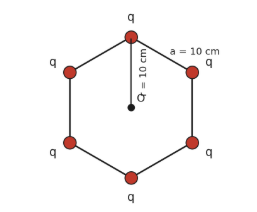
Question: A regular hexagon of side 10 cm has a charge 5 μC at each of its vertices. Calculate the potential at the centre of the hexagon.
Solution
Given:
a = 10 cm = 0.10 m
q = 5 μC = 5×10⁻⁶ C
A regular hexagon has six vertices. The distance from its centre to each vertex is equal to the side length:
r = 0.10 m
Potential due to one charge is
V1 = 1⁄(4πε0) · q⁄r
Using
1⁄(4πε0) = 9×10⁹ N·m2/C2
V1 = 9×109 × (5×10-6⁄0.10)
V1 = 4.5×10⁵ V
Potential is a scalar, so the six potentials are added:
V = 6V1
V = 6(4.5×10⁵)
V=2.7 × 10⁶ V
Answer 2.7×10⁶ V
Question 3: Equipotential Surface of an Electric Dipole
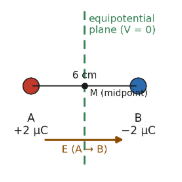
Question: Two charges 2 μC and −2 μC are placed at points A and B 6 cm apart.
- (a) Identify an equipotential surface of the system.
- (b) What is the direction of the electric field at every point on this surface?
Solution
The two charges have equal magnitude and opposite signs, so they form an electric dipole.
(a) Equipotential surface
Consider the plane that is perpendicular to the line AB and passes through its midpoint.
Every point on this plane is equidistant from the positive and negative charges.
Therefore, the potential due to the positive charge and the potential due to the negative charge are equal in magnitude and opposite in sign:
Vnet = V+ + V− = 0
Thus, this plane is an equipotential surface.
Plane perpendicular to AB through its midpoint
(b) Direction of the electric field
The electric field is perpendicular to an equipotential surface.
For the perpendicular bisector of this dipole, the resultant electric field is along the line joining the charges, directed from the positive charge towards the negative charge.
Therefore,
E is perpendicular to the plane and directed from A towards B
Answer
(a) The plane perpendicular to AB and passing through its midpoint is an equipotential surface.
(b) The electric field is perpendicular to this plane and is directed from the positive charge towards the negative charge.
Question 4: Electric Field of a Charged Spherical Conductor
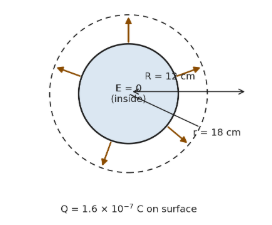
Question: A spherical conductor of radius 12 cm has a charge of 1.6 × 10⁻⁷ C distributed uniformly on its surface. What is the electric field
- (a) inside the sphere?
- (b) just outside the sphere?
- (c) at a point 18 cm from the centre of the sphere?
Solution: Given:
R = 12 cm = 0.12 m
Q = 1.6×10⁻⁷ C
For a charged conducting sphere, the electric field inside the conductor is zero. At points outside the sphere, its field is equivalent to that of a point charge Q at its centre.
(a) Inside the sphere
For a point inside the conductor, (r < R)
The electric field is
E = 0
(b) Just outside the sphere
Just outside the surface,
r = R = 0.12 m
Using
E = 1⁄(4πε0) · Q⁄r2
E = 9×109 × (1.6×10-7⁄(0.12)2)
E = 1.0×10⁵ N/C
Since the charge is positive, the field is directed radially outward.
E = 1.0×10⁵ N/C
(c) At 18 cm from the centre
r = 18 cm = 0.18 m
Therefore,
E = 9×109 × (1.6×10-7⁄(0.18)2)
E ≈ 4.44×10⁴ N/C
The field is again radially outward.
E ≈ 4.44×10⁴ N/C
Answer
(a) 0 N/C
(b) 1.0×10⁵ N/C radially outward.
(c) ≈4.44×10⁴ N/C radially outward.
Question 5: Capacitance After Introducing a Dielectric
Question: A parallel plate capacitor with air between the plates has a capacitance of 8 pF (1 pF = 10⁻¹² F). What will be the capacitance if the distance between the plates is reduced by half, and the space between them is filled with a substance of dielectric constant 6?
Solution
Initial capacitance:
C0 = 8 pF
For the original capacitor,
C0 = ε0A⁄d
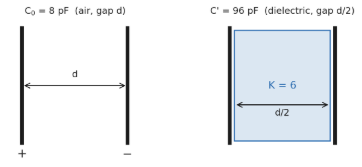
The new plate separation is
d′ = d⁄2
and the dielectric constant is
K = 6
With the dielectric completely filling the space,
C′ = Kε0A⁄d′
Substituting (d′ = d/2),
C′ = Kε0A⁄(d/2)
C′ = 2K · ε0A⁄d
Since
ε0A⁄d = C0
we get
C′ = 2K·C0
C′ = 2(6)(8)
C′ = 96 pF
Answer
96 pF
Question 6: Three Capacitors in Series
Question: Three capacitors each of capacitance 9 pF are connected in series.
- (a) What is the total capacitance of the combination?
- (b) What is the potential difference across each capacitor if the combination is connected to a 120 V supply?
Solution
Each capacitor has
C1 = C2 = C3 = 9 pF
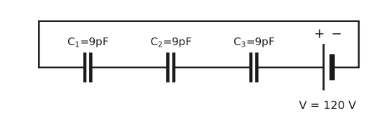
(a) Equivalent capacitance
For a series combination,
1⁄Ceq = 1⁄C1 + 1⁄C2 + 1⁄C3
Therefore,
1⁄Ceq = 1⁄9 + 1⁄9 + 1⁄9
1⁄Ceq = 1⁄3
Hence,
Ceq = 3 pF
(b) Potential difference across each capacitor
In a series combination, the same charge is stored on each capacitor.
Since all three capacitors have the same capacitance, the total voltage divides equally.
V1 = V2 = V3
and
V1 + V2 + V3 = 120 V
Therefore,
V1 = V2 = V3 = 120⁄3
V1 = V2 = V3 = 40 V
Answer
(a) Ceq = 3 pF
(b) 40 V across each capacitor.
Question7: Three Capacitors in Parallel
Question: Three capacitors of capacitances 2 pF, 3 pF and 4 pF are connected in parallel.
- (a) What is the total capacitance of the combination?
- (b) Determine the charge on each capacitor if the combination is connected to a 100 V supply.
Solution
Given:
C1 = 2 pF, C2 = 3 pF, C3 = 4 pF
V = 100 V
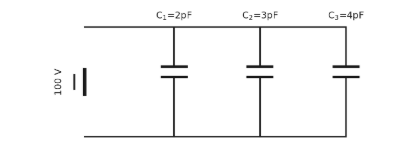
(a) Equivalent capacitance
For a parallel combination,
Ceq = C1 + C2 + C3
Ceq = 2 + 3 + 4
Ceq = 9 pF
(b) Charge on each capacitor
In parallel, every capacitor has the same potential difference:
V1 = V2 = V3 = 100 V
Using
Q = CV
For (C₁ = 2 pF):
Q1 = (2×10-12)(100)
Q1 = 2×10⁻¹⁰ C = 200 pC
For (C₂ = 3 pF):
Q2 = (3×10-12)(100)
Q2 = 3×10⁻¹⁰ C = 300 pC
For (C₃ = 4 pF):
Q3 = (4×10-12)(100)
Q3 = 4×10⁻¹⁰ C = 400 pC
Answer
(a) Ceq = 9 pF
(b) Q1 = 200 pC, Q2 = 300 pC, Q3 = 400 pC
Question 8: Capacitance and Charge of a Parallel Plate Capacitor
Question: In a parallel plate capacitor with air between the plates, each plate has an area of 6 × 10⁻³ m² and the distance between the plates is 3 mm. Calculate the capacitance of the capacitor. If this capacitor is connected to a 100 V supply, what is the charge on each plate of the capacitor?
Solution
Given:
A = 6×10⁻³ m2
d = 3 mm = 3×10⁻³ m
V = 100 V
For air,
ε0 = 8.854×10⁻¹² F/m
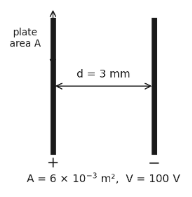
Step 1: Calculate capacitance
For a parallel plate capacitor,
C = ε0A⁄d
Therefore,
C = (8.854×10⁻¹²)(6×10⁻³)⁄3×10⁻³
C = 17.708×10⁻¹² F
Hence,
C ≈ 17.71 pF
Step 2: Calculate the charge
The capacitor is connected to a 100 V supply.
Using
Q = CV
Q = (17.708×10⁻¹²)(100)
Q = 1.7708×10⁻⁹ C
Therefore,
Q ≈ 1.77×10⁻⁹ C ≈ 1.77 nC
Answer
The capacitance is 17.71 pF and the charge on each plate is 1.77×10⁻⁹ C, or approximately 1.77 nC.
Key Features of NCERT Solutions for Class 12 Physics Chapter 2
- Exact NCERT exercise questions for the problems featured on this page
- Step-by-step calculations rather than answer-only solutions
- Formula selection shown before numerical substitution
- Separate working for every part of a multi-part question
- Correct treatment of charge signs in potential calculations
- Clear distinction between series and parallel capacitor behaviour
- SI units retained throughout the calculations
- Coverage of potential, equipotential surfaces, conductors, dielectrics and capacitance
- Useful as a reference while solving NCERT exercises for CBSE preparation
- Concepts are also relevant to JEE Main and NEET preparation
Why Use Infinity Learn NCERT Solutions for Chapter 2?
Infinity Learn's Chapter 2 NCERT solutions lay out that reasoning along with the calculation, so students can use the page to check not only what the answer is, but also how to reach it.
The solutions are particularly useful for:
- revising formulas before solving exercises;
- checking numerical calculations;
- understanding how potential contributions are combined;
- applying dielectric and capacitance relations;
- distinguishing charge and voltage behaviour in capacitor networks; and
- revising NCERT concepts before attempting higher-level problems.
course
No courses found
FAQs on NCERT Solutions for Class 12 Physics Chapter 2
What is the difference between electric potential and potential energy?
Electric potential is the potential energy per unit positive test charge at a point. It is a scalar quantity measured in volts. Electric potential energy is the energy associated with a charge or a system of charges because of their positions in an electric field. It is measured in joules. For a charge (q) placed at a point where the potential is (V), U = qV
How many questions does Class 12 Physics Chapter 2 contain?
The regular NCERT chapter-end exercise section contains 11 questions, numbered 2.1 to 2.11. A separate Additional Exercises section follows, beginning with Exercise 2.12. Therefore, the number of regular chapter-end exercises should not be confused with the larger set of Additional Exercises.
How do I calculate electric potential due to multiple charges?
Electric potential is a scalar, so the potential due to multiple point charges is obtained by adding the individual potentials algebraically: V = 1⁄(4πε0) (q1⁄r1 + q2⁄r2 + ⋯) Unlike electric field calculations, you do not need to add the potentials as vectors.
How does a dielectric affect the capacitance of a parallel plate capacitor?
If a dielectric completely fills the space between the plates, the capacitance becomes C = K·C0 where (K) is the dielectric constant and (C₀) is the capacitance without the dielectric. Thus, if K = 6, the capacitance becomes six times its original value when the plate geometry remains unchanged.
What is the difference between series and parallel combinations of capacitors?
For series-connected capacitors, the same charge is stored on each capacitor, while the total potential difference is divided between them. The equivalent capacitance is 1⁄Ceq = 1⁄C1 + 1⁄C2 + ⋯ For parallel-connected capacitors, the potential difference across each capacitor is the same, while the total charge is distributed among the capacitors. The equivalent capacitance is Ceq = C1 + C2 + ⋯
How is energy stored in a capacitor calculated?
If the capacitance and potential difference are known, U = ½ CV2 If charge and potential difference are known, U = ½ QV And if charge and capacitance are known, U = Q2⁄2C Choosing the appropriate form can make a capacitor-energy problem much quicker to solve.
How important is Chapter 2 for CBSE Class 12 Physics?
Chapter 2 is part of Unit I: Electrostatics, along with Chapter 1. The current CBSE syllabus assigns 16 marks to the combined unit, so students should prepare both chapters rather than treating Chapter 2 as having a separate fixed 4–6 mark allocation.
Are Infinity Learn's NCERT Solutions for Chapter 2 updated as per the latest CBSE syllabus?
The page should be maintained against the latest NCERT exercise set and the current CBSE syllabus. For the 2026–27 CBSE Physics syllabus, Chapters 1 and 2 are included under Unit I: Electrostatics. The featured questions on this page are taken from the NCERT Chapter 2 exercise section rather than being rewritten from another solution website.
Is Electrostatic Potential and Capacitance important for NEET and JEE Main preparation?
Yes. Potential, potential energy, equipotential surfaces, capacitance, dielectric effects and capacitor combinations are all important electrostatics concepts. NCERT exercises are a useful starting point because they establish the relationships that are then used in more involved competitive-exam problems.
